

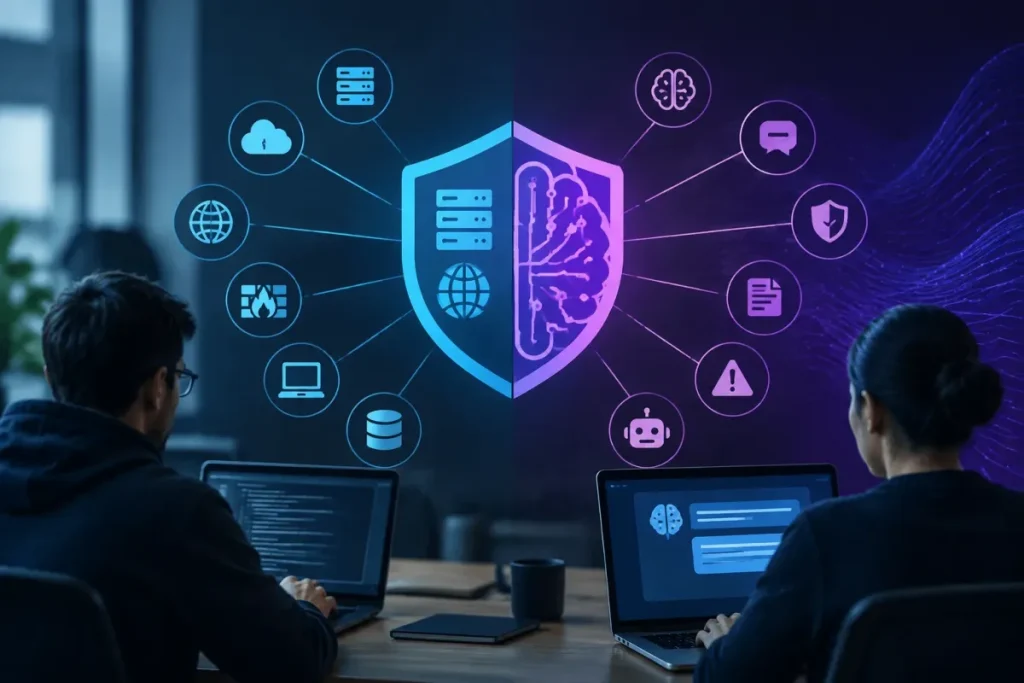

At a glance
- AI red teaming and traditional penetration testing test different layers and risks. Traditional penetration testing finds and validates exploitable technical weaknesses in infrastructure, applications, APIs, and code; AI red teaming probes AI models and workflows for behavioral, safety, security, and misuse failures. For an AI-enabled application, they are complementary and generally both are needed.
- Use traditional penetration testing for networks, servers, web applications, APIs, cloud resources, authentication, access control, code, and configuration.
- Use AI red teaming for model behavior, prompts, guardrails, RAG and agent workflows, harmful or biased outputs, prompt injection, jailbreaks, data leakage, and unsafe permissions.
- For an AI-powered product, combine conventional pentesting of the surrounding infrastructure with AI red teaming of the model and AI-specific workflows.
- Each approach has a distinct primary focus and attack surface.
AI red teaming and traditional penetration testing test different layers and risks. Traditional penetration testing finds and validates exploitable technical weaknesses in infrastructure, applications, APIs, and code; AI red teaming probes AI models and workflows for behavioral, safety, security, and misuse failures. AI-enabled applications generally need both.
AI Red Teaming vs Traditional Penetration Testing: The Short Answer
Traditional penetration testing assesses defined technical assets for exploitable vulnerabilities. Its scope can include networks, servers, web applications, APIs, source code, authentication, access controls, cloud infrastructure, and configuration. For a fuller comparison, see AI red teaming vs penetration testing, including when to use each.
AI red teaming assesses how an AI model and its surrounding workflows behave under adversarial, unusual, harmful, or context-dependent conditions. It can cover prompts, guardrails, outputs, retrieval-augmented generation (RAG), autonomous agents, permissions, data leakage, bias, and misuse.
A non-AI web or API environment may primarily need traditional penetration testing. An AI-enabled product generally needs conventional testing of its surrounding infrastructure plus AI red teaming of the model and AI-specific workflows. Neither approach replaces the other because they produce different types of security evidence.
What Each Approach Tests
Traditional penetration testing
Traditional penetration testing is an authorized assessment of defined systems and assets. Testers look for technical weaknesses and validate whether they are exploitable. Typical examples include:
- SQL injection
- Broken access control
- Authentication weaknesses
- Exposed services
- Insecure application logic
- Cloud, infrastructure, or configuration weaknesses
The resulting evidence usually connects a finding to a specific endpoint, code path, control, service, or configuration. Reports commonly include severity, reproduction details, exploit evidence, and remediation guidance.
AI red teaming
AI red teaming evaluates the relationship between user input, system instructions, model behavior, safety controls, retrieved information, and final output. It may examine:.
- Prompt injection and jailbreaks that challenge instructions or guardrails
- Unsafe or harmful outputs and misuse scenarios
- Data leakage through responses, retrieval, or application context
- Bias in model behavior or decisions
- RAG and retrieval-workflow risks
- Excessive or unsafe permissions in agent workflows
- Model inversion and data-poisoning risks
AI red teaming is not simply penetration testing performed with an AI-powered tool. AI can assist with security testing, but the defining feature of AI red teaming is testing the AI system’s behavior and AI-specific failure modes.
Side-by-Side Comparison
| Dimension | Traditional penetration testing | AI red teaming |
|---|---|---|
| Primary objective | Find and validate exploitable technical vulnerabilities. | Find behavioral, safety, security, misuse, and decision-making failures in AI systems. |
| Attack surface | Networks, servers, web applications, APIs, source code, access controls, infrastructure, and configuration. | Models, prompts, guardrails, outputs, RAG pipelines, retrieval workflows, agents, permissions, and application context. |
| Testing behavior | Generally structured, repeatable, and coverage-oriented, with emphasis on technical validation. | More adaptive and exploratory, including multi-step testing of context-dependent AI behavior. |
| Representative risks | SQL injection, broken access control, exposed services, and misconfiguration. | Prompt injection, jailbreaks, unsafe outputs, data leakage, bias, misuse, and unsafe agent permissions. |
| Required expertise | Technical security and application or infrastructure assessment skills. | Security expertise combined, where relevant, with machine learning, data, domain, human-factors, and AI-safety knowledge. |
| Typical outputs | Severity, exploit evidence, reproduction details, and technical remediation guidance. | Attack narratives, test conditions, behavior metrics, safety findings, leakage or bias findings, detection gaps, and repeated-validation results. |
The deterministic-versus-variable distinction is useful but not absolute. Traditional penetration testing often targets technical flaws that can be reproduced under defined conditions. AI behavior can vary with prompts, context, retrieved information, permissions, and other application factors.
How the Testing Methods Differ
Structured validation versus adaptive exploration
Traditional penetration testing is usually planned around defined assets, boundaries, repeatable checks, and technical exploit validation. The tester seeks evidence that a particular weakness exists and can be reproduced.
AI red teaming is more adaptive. Testers may explore combinations of prompts, context, retrieved content, model responses, permissions, and multi-step workflows. When a failure appears, they must record the conditions carefully and test whether the behavior can be reproduced or consistently observed.
Automation can support either approach, but automation alone does not define the assessment. The method should match the threat model, target system, required evidence, and capabilities of the authorized testers.
Different expertise and team needs
A conventional penetration test primarily requires technical security and application or infrastructure expertise. An AI red-team effort may require that foundation plus knowledge of machine learning, data, the relevant business domain, human factors, or AI safety.
This broader expertise matters because an AI failure may involve more than a technical control. It can also involve unsafe behavior, misleading decisions, privacy or leakage concerns, misuse, or consequences specific to the system’s domain.
Different remediation questions
A conventional finding may require correcting access control, application code, or configuration. An AI finding may require changing prompts or guardrails, adjusting retrieval behavior or permissions, improving monitoring, revising policies, or retesting the model and workflow under the same conditions.
Outputs, Detection, and Organizational Readiness
A penetration-test report generally emphasizes vulnerability severity, exploit evidence, reproduction details, and technical remediation. An AI red-team report can add attack narratives, test conditions, behavior metrics, confidence, safety findings, leakage or bias findings, and detection gaps.
Broader red-team exercises can also evaluate detection, escalation, containment, recovery, policies, people, and processes. Those activities are related to—but distinct from—AI red teaming and traditional penetration testing.
For an AI system, this broader validation may include monitoring model behavior, identifying leakage or misuse, reviewing alerting and escalation, and checking whether teams can respond when an AI workflow behaves outside its intended boundaries.
Traditional red teaming and penetration testing are therefore related but not identical terms. Traditional red teaming can evaluate organizational resilience in addition to technical weaknesses. AI red teaming focuses specifically on testing AI behavior and AI-specific risks. Purple teaming is a collaborative approach that connects adversarial testing with defensive validation; it is not a synonym for either method.
When to Use Each Approach
Use traditional penetration testing for non-AI systems
For a system without an AI model or AI-specific workflow, traditional penetration testing is the relevant primary assessment. Focus on the network, servers, web application, APIs, code, authentication, access control, infrastructure, exposed services, and configuration.
Use AI red teaming for AI-specific risks
Use AI red teaming when the assessment objective includes model behavior, prompts, guardrails, RAG, agent actions, unsafe outputs, data leakage, bias, misuse, or other AI-specific risks. Use the AI red teaming checklist to structure coverage of these AI-specific risks.
Use both for AI-enabled applications
An AI-powered product generally needs both layers. Conventional testing assesses the surrounding infrastructure and services, while AI red teaming assesses the model, prompts, retrieval workflows, outputs, and agent behavior.
Neither approach is universally sufficient on its own for an AI application. A technically secure API can still support an AI workflow that produces unsafe outputs, discloses sensitive information, or uses permissions unsafely. Conversely, an AI-focused assessment does not replace testing the infrastructure and application controls that support the model.
A Practical Combined Assessment
- Define the assets, AI workflows, authorization, boundaries, and assessment objectives.
- Test the surrounding technical environment for vulnerabilities in infrastructure, applications, APIs, code, authentication, access controls, and configuration.
- Remediate major technical findings and confirm the changes.
- Conduct AI red-team testing of model behavior, prompts, retrieval, outputs, permissions, and misuse risks.
- Improve controls, monitoring, detection, response, and operating processes based on the findings.
- Retest both layers after material changes to the application, model, data, permissions, or workflows.
The sequence can be adapted to the system and objective. The key decision is to assess both the conventional technical foundation and the AI layer when both create risk.
Cadence and Lifecycle Integration
Penetration tests are generally more structured, repeatable, and coverage-oriented, while AI red-team exercises may involve broader, adaptive exploration. Exact duration and scope depend on the system, objectives, boundaries, and evidence required.
Traditional penetration testing is often organized around defined assessment cycles. AI red teaming may need to recur as models, data, applications, permissions, and threats change. Material changes to an AI workflow should prompt a review of whether model-layer testing needs to be repeated.
This does not mean every change requires a full red-team exercise. It means the testing cadence should reflect how the system changes and which risks those changes can introduce.
Run AI Red-Team Testing Safely
AI red-team exercises should be authorized, bounded, and observable. At a minimum:.
- Define written scope, permitted targets, boundaries, and objectives.
- Use controlled environments where possible rather than testing directly against production.
- Maintain logging for prompts, responses, retrieved context, actions, and relevant test conditions.
- Apply rate limits and controls that prevent unnecessary disruption.
- Prioritize remediation according to the observed safety, security, leakage, bias, misuse, or detection risk.
- Retest findings after changes and repeat assessments as the AI system evolves.
Threat modeling should guide the scope and assessment design. Tool and automation choices should fit the threat model, target system, required evidence, and testers’ capabilities.
Decision Guide
| System or objective | Primary assessment | Reason |
|---|---|---|
| Non-AI network, server, web application, API, or infrastructure | Traditional penetration testing | Assesses technical vulnerabilities, access controls, code, services, and configuration. |
| AI model, prompt layer, or AI workflow | AI red teaming | Assesses behavior, safety, misuse, outputs, prompts, retrieval, and model-layer risks. |
| AI-enabled product with conventional infrastructure | Both | Tests the surrounding technical stack and the AI model and workflows together. |
| AI behavior and safety assurance | AI red teaming | Focuses on unsafe outputs, bias, leakage, jailbreaks, prompt injection, and misuse. |
| Combined assurance, including detection or response | Combined program | Connects technical testing with AI-behavior assessment and defensive validation. |
Bottom line: conventional systems need traditional penetration testing. AI-enabled products generally need traditional penetration testing for the surrounding stack plus AI red teaming for the model and workflows. AI red teaming does not replace penetration testing; the two approaches test different layers and should be combined when both layers create risk.