


AI Agent Risk Assessment: 5-Part Lifecycle
- Perform the assessment as a repeatable lifecycle: inventory and classify the agent and its data/tool connections; define scope, business impact, regulatory requirements, and risk thresholds; threat-model and test prompt injection, excessive permissions, data exposure, unsafe actions, failures, and escalation paths; implement least-privilege, human-approval, logging, monitoring, and recovery controls; document findings in a risk register and continuously reassess the agent as it changes.
- Use an inventory and autonomy classification to determine assessment depth.
- Run adversarial and integration testing, including prompt-injection and permission testing.
- Require human-in-the-loop approval for high-stakes or irreversible actions.
- Use least-privilege access, explicit boundaries, monitoring, tool-call logs, error handling, and recovery mechanisms.
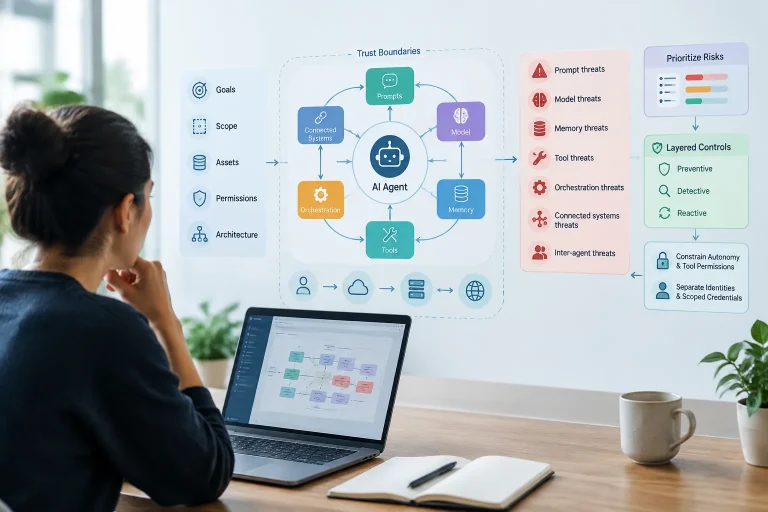
Perform an AI agent risk assessment as a repeatable lifecycle: inventory and classify the agent and its data and tool connections; define scope, business impact, regulatory requirements, and risk thresholds; test agent-specific risks; apply controls; document findings; and continuously reassess changes.
Assessment depth should increase with the agent’s autonomy, data sensitivity, permissions, and action impact. An agent that only retrieves information has a different risk profile from one that can modify systems of record, execute transactions, delete data, or communicate externally.
1. Inventory and Map the AI Agent
Start by documenting what the agent is designed to do and what it can actually do. Effective capabilities may come from inherited permissions, tool combinations, memory, integrations, or multi-step workflows—not only from the stated use case. For examples of how connected capabilities can be abused, see our AI agent tool misuse guide.
Document the Agent and Operating Context
- Purpose, business process, users, stakeholders, and operating environment
- Models, versions, system prompts, prompt templates, instructions, and workflows
- Memory, conversation history, retrieval sources, vector stores, and other persistent context
- Deployment environments, dependencies, monitoring arrangements, and human review points
- Expected outputs, decisions, actions, and external communications
Map Data, Tools, Integrations, Permissions, and Users
For every connection, record what data enters the agent, where it goes, who can access it, and what actions the agent can take. A review of purpose-built defenses appears in our AI agent security tools comparison.
| Inventory area | Questions to answer | Evidence to collect |
|---|---|---|
| Data | What data can the agent read, retain, transform, or output? | Data-flow diagrams, classifications, sample inputs, and outputs |
| Tools and APIs | Which tools can it call, and what actions do they support? | Tool definitions, API documentation, and integration tests |
| Credentials | Which identities, tokens, or service accounts does it use? | Access policies, credential owners, and scope documentation |
| Users and workflows | Who can invoke, approve, configure, or override it? | Role definitions, approval paths, and workflow diagrams |
| Systems | Which systems of record and external services can it reach? | Architecture diagrams, environment inventories, and connection lists |
Identify Systems of Record and Action Capability
Record whether the agent can read, write, modify, delete, transact, execute, or communicate externally. Note whether it can chain actions without a person approving each step. Write access to a system of record or the ability to send an external message generally requires more scrutiny than read-only retrieval.
2. Classify Autonomy and Impact
Use the inventory to classify both autonomy and consequences. Assessment depth should increase with greater autonomy, more sensitive data, broader privilege, and higher-impact or irreversible actions.
- Read-only assistance: Retrieves or summarizes information without changing connected systems.
- Constrained action: Performs limited updates or workflow steps within defined boundaries.
- High-impact action: Changes system-of-record data, executes transactions, deletes information, or communicates externally.
- Autonomous workflow: Plans and performs multiple steps with limited human intervention.
For each classification, ask what could happen if the agent receives incorrect instructions, follows untrusted content, exposes data, takes an unauthorized action, or continues after an error. Consider privacy, security, operational, financial, compliance, reputational, and customer impacts.
3. Define Scope and Acceptance Criteria
Set the decision criteria before testing begins. Define the agent versions, assets, workflows, environments, stakeholders, data types, integrations, and capabilities included in the assessment.
Set Business, Security, Privacy, and Regulatory Criteria
- Business processes and systems affected by the agent
- Consequences of incorrect, unauthorized, delayed, or unavailable actions
- Privacy requirements for inputs, memory, retrieval sources, logs, and outputs
- Security requirements for identities, integrations, data flows, and tool access
- Applicable organizational, contractual, regulatory, and third-party review requirements
- Human involvement, approval points, incident ownership, and escalation paths
Define the organization’s risk tolerance and measurable pass/fail conditions. For example, an organization might prohibit personally identifiable information in outputs or require rollback when accuracy drops by more than 3%. These are illustrative acceptance criteria, not universal requirements. For a broader security-focused assessment process, see our AI security risk assessment guide.
A failed condition might include unauthorized tool access, an unreviewed high-impact action, unacceptable data exposure, missing audit records, or an inability to stop and recover from unsafe behavior.
4. Threat-Model and Test Agent-Specific Risks
Test in a controlled environment that represents the relevant integrations without unnecessarily exposing production systems. Evaluate both model behavior and interactions with tools, data, users, and connected systems. A static model review alone is insufficient for an agent that uses tools, external data, memory, or autonomous workflows.
Test Prompt Injection, Data Exposure, and Excessive Access
Use controlled scenarios involving:
- Indirect prompt injection: Untrusted instructions in retrieved content, documents, messages, or other data sources
- Data leakage: Sensitive information appearing in responses, logs, memory, tool parameters, or external communications
- Excessive privilege: Attempts to use tools, records, credentials, or actions outside the approved scope
- Permission confusion: Conflicting instructions, ambiguous authority, shared credentials, or missing approval boundaries
Verify that the agent limits or escalates actions when it lacks authority. Test each important tool independently and in combination with other tools.
Test Unsafe Actions, Loops, Failures, and Escalation
- Hallucination-related actions, such as acting on an incorrect record or unsupported conclusion
- Unsafe or malformed tool calls and unexpected tool responses
- Repeated retries, runaway loops, stalled workflows, and conflicting instructions
- Integration outages, timeouts, partial completion, and stale data
- Unauthorized actions, ambiguous requests, and failed approval or escalation paths
- Whether the agent stops safely, preserves evidence, alerts the right person, and supports recovery
Record the test input, relevant output, tool calls, resulting system changes, controls triggered, human notifications, and final outcome. Use varied adversarial and integration scenarios rather than a single successful demonstration.
5. Implement Controls and Human Oversight
Use the findings to reduce the agent’s ability to cause harm and improve detection, approval, and recovery.
Set Permission and Tool Boundaries
- Apply least privilege to identities, service accounts, APIs, data sources, and tools.
- Use scoped credentials and separate permissions for reading, writing, deleting, transacting, and administration.
- Limit tools by task, environment, record type, amount, destination, and time where appropriate.
- Define explicit boundaries for what the agent may and may not do.
- Separate testing and production environments and prevent unnecessary access to systems of record.
Add Approval, Observability, and Recovery Controls
Require human review and approval before high-stakes, externally visible, financially significant, destructive, or irreversible actions. The approval request should show the proposed action, relevant data, expected impact, and available evidence. For principles governing verification and least-privilege controls, see our Zero Trust for AI agents guide.
Log agent actions, tool calls, decision paths where available, approvals, errors, and interactions with external systems or data. Add retry limits, fallback routines, graceful degradation, safe stopping, rollback, recovery procedures, and escalation to a human operator.
6. Validate Governance and Operational Readiness
Confirm that the agent is operationally ready, not merely technically functional.
Assign Review and Incident Ownership
Name the owners for security, privacy, compliance, engineering, business operations, and incident response. Define who validates outputs, interprets exceptions, approves high-impact actions, investigates incidents, and accepts remaining risk.
Human teams remain responsible for validation, interpretation, strategic decisions, performance review, and decisions about continued use. If several agents contribute to an assessment, assign ownership for combining their findings and resolving conflicting results.
Define Change and Approval Conditions
Document the conditions for deployment, suspension, rollback, and reapproval. Include privacy and third-party review where relevant, along with change-management requirements for models, prompts, memory, tools, permissions, workflows, and connected systems.
7. Score and Prioritize Risk
Use a documented likelihood-impact model so findings can be compared and remediation can be prioritized consistently.
Use an Illustrative Likelihood-Impact Model
One simple model rates likelihood and impact from 1 to 5, then multiplies the values:
| Score | Illustrative band | Example response |
|---|---|---|
| 1–4 | Low | Document, monitor, and address through routine improvement |
| 5–12 | Moderate | Assign an owner, control, and target remediation date |
| 13–19 | High | Require additional mitigation and management review |
| 20–25 | Critical | Do not deploy or continue the affected capability until addressed or formally accepted |
This model is illustrative rather than universally required. Define your own severity bands, escalation rules, evidence standards, and acceptance authority.
Separate Inherent and Residual Risk
Inherent risk is the exposure before controls, based on autonomy, data, access, action capability, and failure consequences. Residual risk is the exposure remaining after controls, testing, approvals, monitoring, and recovery measures are applied.
Prioritize risks that combine high impact with broad permissions, irreversible actions, sensitive data, weak human oversight, or poor recovery. Base deployment decisions on documented residual risk, not simply on whether controls exist.
8. Maintain the AI-Agent Risk Register
Use a living risk register to preserve the reasoning behind assessment and approval decisions. At minimum, record:
| Field | What to capture |
|---|---|
| Risk or scenario | What could happen and under which conditions |
| Affected asset | Data, tool, workflow, user, system, or external party affected |
| Likelihood and impact | Ratings and the evidence supporting them |
| Inherent rating | Risk before controls |
| Controls | Permissions, approvals, monitoring, testing, and recovery measures |
| Residual rating | Risk remaining after controls |
| Owner | Person or team accountable for treatment and review |
| Remediation | Required action, due date, and current status |
| Approval or exception | Acceptance decision, authority, rationale, and conditions |
Update the register when a finding changes, a control is weakened, an exception expires, an incident occurs, or the agent’s capabilities or environment changes.
9. Approve, Monitor, and Reassess Continuously
Approval is not the end of the assessment. Continuous monitoring and reassessment are required parts of the lifecycle.
Monitor Behavior and System Interactions
Monitor behavior, tool calls, permissions, performance, errors, incidents, approval outcomes, and interactions with connected systems. Use the logs and thresholds defined during assessment to identify drift, unsafe patterns, and control failures.
Trigger Reassessment After Changes or Incidents
Repeat relevant testing after changes to the model, prompt, memory, tool, credential, permission, workflow, integration, connected system, data, or business process. Reassess after incidents, unexpected behavior, material performance changes, or a change in the agent’s action scope.
Keep the risk register, acceptance criteria, controls, and ownership current. A system that was acceptable before a capability or integration change may require a new approval decision.
Practical Checklist and Organizing Framework
- Inventory: Agent purpose, models, prompts, memory, data flows, tools, APIs, credentials, permissions, users, environments, and systems.
- Classify: Autonomy, data sensitivity, privilege, reversibility, and action impact.
- Scope: Assets, workflows, stakeholders, privacy and regulatory requirements, risk tolerance, thresholds, and pass/fail criteria.
- Test: Prompt injection, data leakage, excessive privilege, unsafe tool calls, hallucination-related actions, loops, integration failures, and escalation.
- Control: Least privilege, scoped credentials, boundaries, approvals, logging, observability, retry limits, fallback, rollback, and recovery.
- Govern: Owners, reviewers, incident responsibilities, third-party and privacy review, change management, and deployment conditions.
- Document: Inherent risk, residual risk, remediation, status, and approval or exception rationale.
- Reassess: Monitor continuously and repeat testing after relevant changes or incidents.
NIST AI RMF as an Organizing Option
The NIST AI Risk Management Framework can provide a useful structure for organizing governance, risk identification, measurement, and management activities. It is an organizing option, not the only valid method or a universal requirement. Retain the agent-specific inventory, tool and permission analysis, testing, controls, risk register, and continuous reassessment as core parts of the process.
Before deployment, base the decision on documented residual risk, defined controls, accountable owners, and explicit approval conditions. After deployment, continue monitoring behavior and system interactions, and reassess whenever the agent, its permissions, tools, workflow, data, or connected systems change.