


AI security risk assessment: five stages
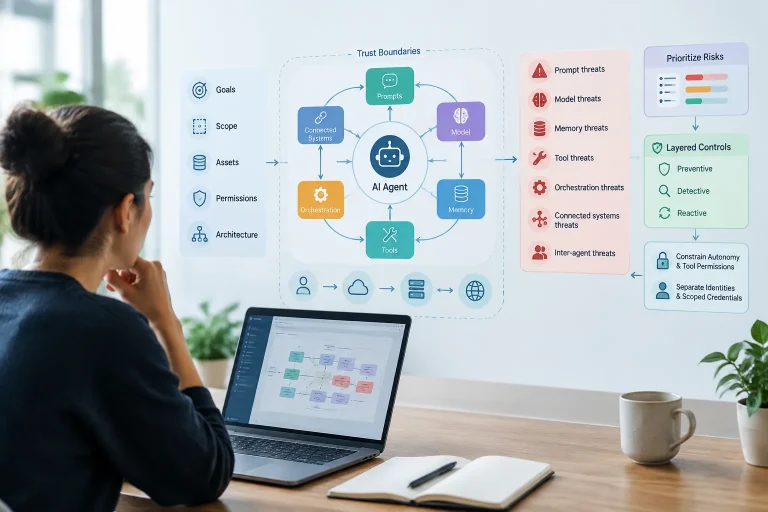
- Use a practical five-stage process: define the scope and inventory AI assets and data flows; identify threats and assess the complete AI attack surface; score and prioritize risks by likelihood and impact; implement and assign mitigations and controls; then continuously monitor, test, document, and reassess the system.
- Create an AI asset and data-flow inventory before testing.
- Use an AI threat model or attack-surface review, including prompt injection, data poisoning, privacy leakage, unauthorized access, and supply-chain or integration risks.
- Maintain a likelihood-impact risk register with severity tiers and residual-risk tracking.
- Apply layered controls such as access and data governance, environment isolation, input/output protections, secure pipelines, logging, and remediation ownership.
Use a practical five-stage process: define scope and inventory AI assets and data flows; identify threats across the complete attack surface; prioritize risks by likelihood and impact; apply assigned controls; then monitor, test, document, and reassess the system.
An AI security risk assessment covers the complete AI system and lifecycle—not only the base model. Include data, applications, APIs, infrastructure, deployment pipelines, integrations, users, vendors, and dependencies.
What an AI security risk assessment covers
An AI security risk assessment is a structured process for identifying, analyzing, prioritizing, mitigating, documenting, and monitoring risks across an AI or machine-learning system.
Security is the primary focus, but related risk categories may also affect the assessment:
- Privacy: exposure, misuse, retention, or unauthorized disclosure of sensitive data.
- Operational: outages, unreliable outputs, unsafe integrations, and control failures.
- Compliance and contractual: requirements tied to the organization, sector, customer, or use case.
- Fairness and transparency: biased outcomes, inadequate explanations, or insufficient human review.
- Safety and societal: harmful system behavior or effects on people and groups.
These categories inform the review without replacing the technical security assessment. Securing the base model alone does not secure the complete AI system.
Step 1: Define the assessment scope and objectives
Start by deciding what the assessment must answer, which AI system is being reviewed, and which lifecycle stages are included. A clear scope prevents the review from overlooking connected systems or concentrating too heavily on the model.
Define the use case and decision context
Record the system’s purpose, business objectives, intended users, deployment status, and decisions the assessment will support. State whether the review covers data collection, model development, fine-tuning, retrieval, deployment, vendor changes, and post-deployment operation.
Identify the people responsible for providing evidence and approving decisions. Participants may include the AI owner, security and engineering teams, data owners, privacy or compliance specialists, operations, and business leadership.
Set risk criteria before reviewing findings
Document risk tolerance, internal requirements, escalation rules, and risk-acceptance authority, and evidence expectations. Evidence may include inventory records, data-flow maps, testing results, control mappings, approvals, and monitoring records.
Verify legal, regulatory, contractual, privacy, and sector requirements for the specific use case. No single scope, framework, scoring scale, or sequence is universally mandatory.
Deliverable: a scope statement naming the system, objectives, lifecycle boundaries, stakeholders, risk criteria, approval authorities, and required evidence.
Step 2: Inventory AI assets and map data flows
Create the AI asset inventory before testing or threat analysis. Unidentified assets—especially third-party, embedded, or unmanaged AI—can leave important exposure outside the review.
Record the complete AI estate
For each asset, record its owner, purpose, version, environment, vendor, dependencies, connected systems, and lifecycle status. Include:
- Internally developed models, applications, and datasets
- Third-party models, APIs, hosted AI services, and software dependencies
- AI features embedded in business applications
- Development, testing, staging, and production environments
- Possible shadow AI, unauthorized tools, and unmanaged integrations
- Administrative accounts, service accounts, users, and downstream consumers
Map data movement
Document how training data, fine-tuning data, prompts, retrieved content, outputs, logs, and other sensitive data enter, move through, and leave the system. Show storage locations, external transfers, trust boundaries, integrations, and systems that receive AI outputs.
This AI data-flow map reveals where sensitive information may be exposed, where access controls apply, and which connected systems could be affected by a compromised or manipulated component.
Review third-party and supply-chain dependencies
Record which components the organization operates and which are controlled by vendors or service providers. Include model providers, data sources, packages, plugins, APIs, infrastructure services, update processes, and dependencies that could change the risk profile.
Deliverables: an AI asset register, dependency list, system diagram, data-flow map, ownership record, and list of known or suspected shadow AI.
Step 3: Identify threats and assess the complete AI attack surface
Use an AI threat model or attack-surface review across the model, data, application or wrapper, APIs, infrastructure, deployment pipeline, integrations, and supply chain. Model behavior alone is not the full security boundary.
Review AI-specific threats
- Prompt injection and jailbreaking: attempts to override intended behavior or bypass safeguards.
- Data poisoning: manipulated or untrustworthy training, fine-tuning, retrieval, or evaluation data.
- Model inversion and privacy leakage: attempts to infer sensitive information from behavior, outputs, or exposed data.
- Unauthorized access: improper access to models, datasets, prompts, outputs, APIs, administrative functions, or connected systems.
- Model theft or exfiltration: unauthorized extraction of model files, parameters, configurations, or valuable behavior.
- Adversarial attacks: inputs or conditions designed to produce incorrect, unsafe, or unexpected results.
- Excessive agency: overly broad permissions or autonomous actions available to an AI-enabled application.
- Supply-chain risk: weaknesses in third-party models, data sources, packages, services, vendors, or update processes.
Assess agentic features and connected actions
For systems that use agents, review their goals, tools, identities, permissions, memory or context, inter-agent communication, and approval points. Confirm that tool access matches the system’s purpose, human review is used where appropriate, activity is observable, and actions can be contained. For a focused treatment of this risk, read the guide to AI agent tool misuse.
Assess the surrounding technology
Review conventional security issues in the wrapper application, APIs, identity systems, infrastructure, storage, pipelines, integrations, and deployment process. A model may produce acceptable responses while its credentials, data connections, application layer, or deployment process remains exposed.
Use authorized validation activities
Depending on the system and scope, use threat modeling, scenario analysis, vulnerability assessment, model and API testing, privacy and fairness checks, behavior benchmarks, and authorized red teaming or adversarial testing.
Testing must be approved and controlled to protect sensitive data and live operations. Do not test production systems or attempt to access data without authorization.
Deliverables: a threat model, attack-surface review, test plan, findings list, supporting evidence, and record of affected assets and data flows.
Step 4: Evaluate, score, and prioritize risks
Turn findings into decisions by evaluating likelihood and business impact. Consider the affected asset, attack or failure conditions, potential consequences, existing controls, and risk tolerance.
Use an organization-defined scoring approach
A likelihood-impact matrix can group findings into organization-defined risk levels or severity tiers. Select the scale, thresholds, escalation rules, and acceptance criteria for the organization and use case rather than treating them as universal.
Prioritize findings that could expose sensitive data, compromise connected systems, create unauthorized access, disrupt important operations, or produce serious consequences for users or the organization. Record the rationale for each priority.
Distinguish inherent and residual risk
Where the organization has a defined method, record both:
- Inherent risk: exposure before considering existing controls.
- Residual risk: exposure remaining after existing controls and planned treatment are considered.
Document the method, assumptions, prioritization rationale, and whether each risk will be reduced, transferred, avoided, accepted, or analyzed further.
Deliverable: a prioritized risk register containing findings, likelihood, impact, severity, existing controls, treatment decisions, and residual-risk information where applicable.
Step 5: Apply controls, assign remediation, and continue monitoring
Map every prioritized finding to controls that reduce likelihood, limit impact, detect misuse, or support recovery. Use layered protections rather than relying on a single model safeguard.
Apply layered controls
- Access and identity: restrict users, service accounts, administrative functions, APIs, and connected-system permissions.
- Data governance: apply data minimization, classification, privacy protection, secure storage and transmission, segmentation, and integrity measures.
- Model and application protection: use appropriate gateways, input and output controls, filtering, isolation, sandboxing, and human approval.
- Secure engineering and deployment: protect pipelines, dependencies, versions, lineage, testing, and rollback capability.
- Detection and response: maintain logging, alerting, incident procedures, containment options, and recovery plans.
- Governance and oversight: define approval points, human review, control validation, and risk-acceptance authority.
For systems that influence important decisions or take actions, determine when human review, override, explanation, or additional validation is required. Include fairness, transparency, and affected-user considerations when relevant, while keeping them connected to the risk decision.
Assign remediation and document decisions
Assign an accountable owner to every treatment item. Record the remediation plan, deadline or target timing, approval authority, required evidence, validation method, and decision to accept or continue reducing remaining risk.
Deliverable: a treatment plan mapping findings to controls, owners, deadlines, approvals, validation evidence, and risk-acceptance decisions.
Monitor after deployment
An AI security risk assessment does not end when controls are implemented. Monitor:
- Model drift and changes in performance, accuracy, or behavior
- Unexpected or unsafe outputs and changes in output patterns
- Data flows, access activity, anomalies, and connected-system behavior
- Security incidents, privacy events, and control failures
- Control effectiveness, remediation progress, and response performance
Conduct periodic reviews and recurring authorized adversarial testing. Set the cadence according to the system’s use case, risk, rate of change, and operational importance. Trigger reassessment after material changes to the model, data, vendor, lifecycle, integrations, deployment environment, or controls.
AI security risk assessment checklist and risk-register fields
The assessment should produce an auditable record of what was reviewed, what was found, and how decisions were made. A practical register can include:. For vendor-focused questions and evidence, use the AI vendor security assessment checklist.
| Field | What to record |
|---|---|
| Asset and scope | System, model, dataset, environment, owner, lifecycle stage, and assessment boundary |
| Data flows | Training data, prompts, outputs, logs, sensitive data, storage, transfers, and integrations |
| Threat or finding | Threat scenario, vulnerability, affected component, and supporting details |
| Likelihood and impact | Organization-defined ratings, business consequences, and prioritization rationale |
| Existing controls | Preventive, detective, corrective, governance, access, data, model, or deployment controls |
| Treatment decision | Planned mitigation, validation method, acceptance, transfer, avoidance, or further analysis |
| Ownership and approval | Accountable owner, remediation timing, approval authority, and decision date |
| Evidence and remaining risk | Test results, control evidence, approvals, accepted risk, and residual or remaining risk |
Keep the scoring scale, severity thresholds, risk-acceptance criteria, and residual-risk method alongside the register so reviewers can interpret findings consistently.
Third-party AI and supply-chain review
Third-party AI belongs within the same assessment boundary as internally developed systems. Review the provider’s privacy practices, safeguards, security testing information, performance and fairness information where relevant, model updates or drift, dependencies, and incident-reporting arrangements.
Document what the vendor operates, what the organization controls, where data is sent, how changes are communicated, and which risks remain outside the organization’s direct control. A hosted service, embedded feature, or API can expand the attack surface even when the underlying model is managed elsewhere.
Incident response and validation
Connect the assessment to an incident-response process. Define how the organization detects, escalates, contains, communicates, and reviews an AI security incident.
Depending on the system, response options may include restricting access, disabling an integration, rolling back a model or configuration, preserving evidence, and notifying relevant parties where applicable. Validate controls through security testing, vulnerability assessment, benchmarks, privacy or fairness checks, and authorized red teaming where appropriate.
A control should not be treated as effective solely because it is documented. Retain supporting test, review, approval, and monitoring evidence.
Framework alignment
Frameworks can provide useful structure and terminology, but they should be adapted to the organization and use case. Possible references include the NIST AI Risk Management Framework, ISO/IEC 42001, OWASP guidance, and Google SAIF, alongside internal security and risk requirements.
- Scope and governance: use context and governance guidance to define objectives, roles, and risk criteria.
- Inventory: use mapping practices to understand assets, data, dependencies, and system boundaries.
- Threat assessment: use security guidance to review vulnerabilities, attacks, controls, and testing.
- Risk treatment: use risk-management practices to prioritize findings, document treatment, and assign accountability.
- Monitoring: use improvement practices to track changes, incidents, control effectiveness, and reassessment.
No framework replaces the organization’s own scope decisions, risk criteria, evidence requirements, control selection, or approval process.
Conclusion
A strong AI security risk assessment starts with scope and inventory, examines the full attack surface, prioritizes findings by likelihood and impact, assigns accountable remediation, and continues through monitoring and reassessment.
Use authorized testing, document the evidence, and reassess after material changes. Adapt scoring, controls, frameworks, and applicable requirements to the organization and the specific AI use case.