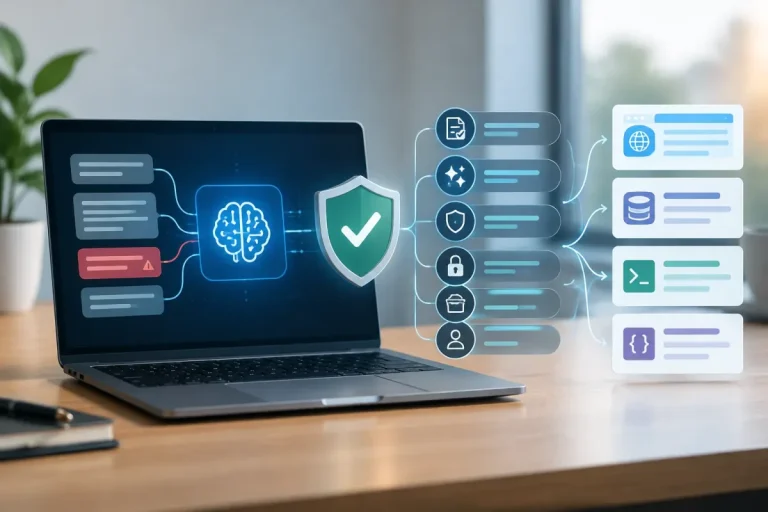

LLM model theft at a glance
- LLM model theft is the unauthorized copying, access, or extraction of a proprietary language model or its behavior. It commonly happens either through direct theft of model files and infrastructure or through API-based model extraction, where many queries are used to build a functional replica. It can cause intellectual-property and competitive harm, and defenses center on strong access controls, securing model infrastructure, API monitoring and rate limiting, and detecting abnormal extraction activity.
- Restrict access to model files, registries, storage, and serving infrastructure using least privilege, RBAC, MFA, and strong identity controls.
- Monitor and rate-limit APIs to identify automated, high-volume, or suspicious query patterns.
- Protect the software and supply chain, and audit insiders and third-party access.
- Use model-output provenance or watermarking where appropriate to help detect unauthorized downstream use.
LLM model theft is the unauthorized copying, access, or extraction of a proprietary language model or its behavior. It occurs through direct asset theft or API-based extraction that builds a functional replica.
The OWASP Gen AI Security Project classifies this risk as LLM10: Model Theft. The two main pathways are stealing stored model assets and reconstructing model behavior from API outputs.
What is LLM model theft?
LLM model theft, also called model theft or model extraction, is the unauthorized access, copying, extraction, or use of a proprietary model or its components. These may include weights, parameters, files, repositories, serving infrastructure, or the model’s behavior.
The unauthorized nature of the activity is central. Model theft can duplicate intellectual property and transfer the value of substantial development work to another party. The security issue is the theft or replication of a protected model or its functionality.
Direct theft versus API-based model extraction
| Direct model-asset theft | API-based behavioral extraction |
|---|---|
| What is accessed: Stored weights, parameters, files, repositories, storage, or serving infrastructure. | What is accessed: The model’s input-output behavior through an API or other interface. |
| How it occurs: Unauthorized access to systems that store or serve model assets. | How it occurs: Repeated or targeted queries collect outputs and characterize capabilities. |
| Typical result: A stolen copy, exposed asset, or unauthorized distribution of model files. | Typical result: A surrogate or shadow model that reproduces some or much of the target’s functionality. |
These pathways can overlap, but they are not the same. Direct theft obtains stored assets. API-based model extraction reconstructs behavior from responses without necessarily obtaining the original weights.
How LLM model theft occurs
Direct theft of model assets
Direct model theft can involve an infrastructure compromise, an exposed service, a misconfiguration, insider leakage, a supply-chain failure, or unauthorized distribution. The target may be a model repository, storage system, parameter or weight file, or model-serving environment.
Because model assets move through development, deployment, and third-party systems, access governance matters at every stage. Weak identity controls or excessive permissions can make unauthorized copying easier. Organizations should treat model repositories and serving infrastructure as sensitive intellectual-property assets. For guidance on governing identities and permissions across AI systems, see IAM for AI applications.
API-based behavioral extraction
In an API-based extraction scenario, an unauthorized party submits repeated or targeted prompts, collects the outputs, and analyzes the observed behavior. That input-output material can support a surrogate model or shadow model. For practical defenses against this query-based threat, see model extraction attacks.
The result may reproduce some or much of the target model’s functionality without direct access to its weights. This can transfer part of the original model’s value while leaving the original files untouched.
What API extraction does not mean
Query-based extraction does not necessarily recover the exact original weights or produce a perfect copy. It may create a partial or functional equivalent instead, based on the behavior that was observed and represented.
Why model theft matters
Model theft can cause intellectual-property loss and transfer substantial model-development investment to rivals or other unauthorized users. It can weaken the owner’s competitive position by making proprietary capabilities easier to reproduce or deploy elsewhere.
Stolen assets or extracted behavior may also expose proprietary or sensitive information associated with the model. They can support unauthorized experimentation and follow-on attacks, making the impact broader than the loss of a file.
Illustrative case: The early-2023 public sharing of Meta’s LLaMA weights by an authorized user is used as an example of unauthorized model distribution. The security lesson is the importance of access control, auditing, monitoring, and clear governance over who can access and distribute model assets.
How to prevent and detect LLM model theft
Protect model assets and infrastructure
- Apply least privilege to model files, registries, storage, repositories, and serving infrastructure.
- Use strong identity controls, role-based access control (RBAC), and multifactor authentication (MFA) for sensitive systems.
- Maintain controlled repositories and regularly review permissions, including access granted to insiders and third parties.
- Protect the supporting infrastructure, software, dependencies, and supply chain.
- Audit access and distribution paths so unauthorized copying or movement of model assets is easier to identify.
Govern API access and usage
- Monitor API activity and apply rate limiting to reduce and identify automated, high-volume, or suspicious use.
- Establish baselines for normal query volume, user behavior, prompt structure, and response patterns.
- Review permissions and service accounts regularly, especially for high-capability or proprietary models.
- Distinguish legitimate evaluation, testing, and customer use from systematic behavioral collection.
Detect abnormal extraction behavior
Detection should consider combinations of signals rather than one suspicious request. Relevant indicators include unusually high query volume, automated usage, unusual prompt structures, systematic exploration of capabilities, and response patterns consistent with collecting model behavior.
API logs, usage baselines, anomaly detection, rate-limit alerts, and periodic access reviews can help identify suspicious activity. Monitoring should cover requests and, where organizational policy and applicable requirements allow it, responses as well. For a broader monitoring framework covering these signals, see AI security monitoring.
Use supporting output protections
Output controls and provenance measures can reduce information exposure or help identify unauthorized downstream use. Watermarking may be useful in appropriate settings, but it is a supporting measure, not conclusive proof that theft occurred.
How model extraction differs from related threats
Model extraction focuses on copying or approximating a model’s functionality. Model inversion concerns reconstructing hidden information, while membership inference and training-data extraction address different questions about information associated with a model. These are related security issues, but they are not interchangeable with model theft. For a detailed explanation of this distinct threat, see model inversion attacks.
Model collapse is also a separate concept, not another name for model theft or model extraction.
Conclusion
LLM model theft has two principal pathways: direct access to stored model assets and API-based behavioral extraction. API queries can create a functional or partial replica without recovering the original weights.
Effective defense combines repository and infrastructure protection with least-privilege access, strong authentication, supply-chain and third-party governance, API monitoring, rate limiting, and detection of abnormal extraction behavior.