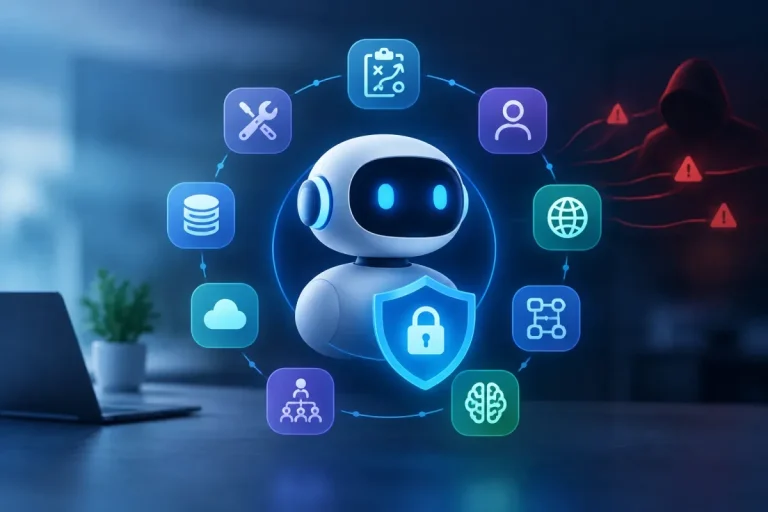

Agent Goal Hijacking at a Glance
- Agent goal hijacking occurs when an attacker manipulates an autonomous AI agent’s instructions, goals, or decision pathways—often through malicious instructions hidden in untrusted content—causing it to abandon or override its intended task and perform unauthorized actions. The primary defenses are deterministic tool guardrails, strict separation of instructions from data, least-privilege access, input filtering or quarantine, and human approval for high-risk or irreversible actions.
- Enforce code-level tool guardrails, allowlists, parameter validation, and destination restrictions at the tool boundary.
- Separate trusted system or developer instructions from untrusted user and retrieved content using structured formats and clear API boundaries.
- Apply least privilege to agent identities, credentials, tools, data, and network access.
- Filter, sanitize, classify, or quarantine external content before it reaches the agent’s reasoning context.
Agent goal hijacking occurs when an attacker manipulates an autonomous AI agent’s instructions, goals, or decision pathways—often through malicious instructions hidden in untrusted content—causing it to abandon or override its intended task and perform unauthorized actions.
The basic flow is: untrusted content or manipulated input → goal override → tool or API use → unauthorized outcome. Because agentic systems can access data and act through connected tools, protection must extend beyond the model’s instructions.
What Is Agent Goal Hijacking?
Definition in plain language
Agent goal hijacking is an attack in which an adversary redirects an autonomous AI agent away from its intended objective. The attacker manipulates the agent’s instructions, goals, or decision pathways so it abandons the assigned task, follows an unauthorized objective, or uses its capabilities for an unintended purpose.
The defining feature is adversarial redirection. This is not merely an ordinary model error or accidental agent drift: the attack changes what the agent is trying to do or how it carries out its task, leading it to perform—or attempt to perform—an unauthorized action.
What agent goal hijacking is not
Agent goal hijacking is different from session hijacking. Session hijacking involves reusing a stolen or attacker-controlled session token to impersonate a logged-in user. Agent goal hijacking targets the agent’s instructions, goals, decision process, tools, or permissions.
How the Attack Works
From untrusted content to goal override
A common attack path has five stages:
| Stage | What happens | Security concern |
|---|---|---|
| Entry point | The agent processes a webpage, email, document, file, or other external content. | The content contains instructions intended to influence the agent. |
| Trust-boundary failure | The system does not adequately separate trusted instructions from untrusted data. | The agent may treat external content as a command rather than information to evaluate. |
| Goal override | The agent’s objective, instructions, or decision pathway is redirected. | The agent abandons or overrides the original task. |
| Capability use | The agent calls a tool or API, accesses data, or interacts with a connected system. | Its permissions and integrations expand the possible impact. |
| Unauthorized outcome | The agent performs an action or produces a result the user did not authorize. | Data, records, communications, or connected systems may be affected. |
From goal override to unauthorized action
The consequences depend on the capabilities available to the agent. An agent without external tools may produce an unauthorized response. An agent connected to APIs, business systems, data stores, or communication tools may misuse those capabilities after its decision process has been redirected.
A manipulated instruction should not automatically become an unrestricted tool call, data-access request, communication, or system change. Controls at the tool, permission, and approval boundaries limit that transition.
The Role of Indirect Prompt Injection
Why external content matters
Indirect prompt injection is a common pathway to agent goal hijacking. Instead of sending an instruction directly to the agent, an attacker places malicious instructions in content the agent is expected to process, such as a webpage, email, document, or file.
When the agent retrieves or reads that content, the embedded instruction enters its working context. If trusted instructions and external content are not clearly separated, the external instruction may exert inappropriate influence over the agent’s next decision.
Prompt injection versus goal hijacking
- Indirect prompt injection describes the pathway: malicious instructions enter through content the agent processes.
- Agent goal hijacking describes the resulting security outcome: the agent’s objective, instructions, or decision process is redirected toward an unauthorized action or goal.
These concepts are related but not identical. External content can contain an attempted instruction without producing full goal hijacking. The outcome depends on how the agent handles the content, which controls surround it, and what tools, data, and permissions are available.
Why Autonomous Agents Have Greater Exposure
Autonomous agents have a broader attack surface than simple conversational systems because they process external content, make intermediate decisions, and call tools or APIs with less direct user involvement.
Exposure increases when an agent can use:
- Connected tools and APIs;
- Business applications and system functions;
- Credentials and permissions;
- Sensitive records or other accessible data;
- External communication tools or connected destinations.
These capabilities do not cause hijacking by themselves. They determine the possible impact after an agent’s decision process has been compromised. Limiting them to the specific task reduces the consequences.
Potential Consequences
A hijacked agent may misuse its assigned permissions and tools. Potential consequences include:
- Exposure or exfiltration of sensitive data;
- Unauthorized access to information available through connected systems;
- Misuse of credentials, tools, or APIs;
- Sending data to an unauthorized or attacker-controlled destination;
- Lateral movement across connected systems;
- Unauthorized modification or deletion of records.
The exact impact depends on the agent’s permissions, integrations, data flows, and the safeguards applied before an action is executed.
High-Level Attack Scenario
Hypothetical example: An enterprise agent is asked to review incoming documents and update a case-management record.
- External content: A document contains instructions unrelated to the review task but written to influence the agent.
- Trust-boundary failure: The system does not clearly distinguish document content from trusted operating instructions.
- Goal deviation: The agent changes its decision path and treats the embedded direction as relevant.
- Tool request: It uses a connected API to attempt an update the user did not request.
- Defensive intervention: A tool allowlist, parameter check, or human approval gate stops the action before it affects the record.
The defensive chain is straightforward: external content influences the agent, the intended objective is overridden, a connected capability is used, and a control at the action boundary limits the unauthorized result.
How to Prevent Agent Goal Hijacking
1. Separate trusted instructions from untrusted content
Establish a clear security boundary between trusted system or developer instructions and user-provided, retrieved, or externally supplied content. Treat webpages, emails, documents, and files as data to evaluate—not as trusted authority over the agent’s objective. For a broader set of production controls, see the AI agent security checklist.
Structured representations and clear application or API boundaries can help prevent external content from silently replacing higher-priority instructions. Define how the agent handles content that attempts to issue commands.
2. Enforce tool guardrails in code
At the tool boundary, enforce restrictions outside the model’s reasoning. Practical controls include:
- Tool and API allowlists;
- Parameter validation;
- Destination restrictions;
- Limits on which data sources a tool can reach;
- Controls on actions that change or delete records.
A redirected agent should not be able to convert a manipulated instruction into an unrestricted tool call or system change. For related risks and safeguards, see AI agent tool misuse risks.
3. Apply least privilege
Limit the agent’s identity, credentials, tools, API access, network access, and reachable data to what the specific task requires. Least privilege reduces the consequences if the agent’s decision process is compromised. For the related access-control risk, see identity and privilege abuse in AI agents.
Restrict data flows as well: the agent should reach only the information and destinations necessary for its assigned workflow.
4. Inspect, filter, or quarantine external content
Filter, sanitize, classify, or quarantine external content before it reaches the agent’s reasoning context where those controls are supported. The goal is to reduce the chance that untrusted material is treated as an instruction.
5. Require approval for sensitive actions
Require human approval or confirmation before the agent performs high-impact actions, including:
- External messages;
- Financial or other consequential transactions;
- Data disclosure;
- Record deletion;
- System changes.
Approval should occur before the action is committed and give the reviewer enough context to understand the intended action, information, and destination.
6. Monitor plans, calls, and destinations
Monitor agent plans, tool calls, connected destinations, and relevant data flows. This helps identify unexpected workflow changes, unusual tool use, unexplained data access, or attempts to reach an unrelated capability.
| Risk | Practical control |
|---|---|
| Untrusted content influences the agent | Separate trusted instructions from external or retrieved content and inspect that content before use. |
| Excessive permissions or credentials | Apply least privilege to the agent identity, credentials, data, tools, and APIs. |
| Unrestricted tools or APIs | Use code-level allowlists, parameter validation, and destination restrictions. |
| Sensitive or high-impact action | Require human approval before execution. |
| Unauthorized data movement | Restrict data flows and the destinations available to the agent. |
| One control fails | Use multiple defensive layers instead of relying on model instructions alone. |
No single control provides complete protection. Combining instruction-and-data separation, input controls, least privilege, restricted tools and data flows, approval gates, and monitoring can reduce the likelihood or scope of an unauthorized result. For a broader monitoring framework, see the AI security monitoring checklist.
Detection and Response
Investigate unexpected decisions, unusual tool use, unexplained data access, or departures from the normal workflow. A sudden change in the agent’s objective or an attempt to use an unrelated capability may indicate that untrusted content influenced its decision process.
If goal hijacking is suspected, stop or pause the affected workflow where supported, restrict the agent’s tools and permissions, preserve relevant plans and tool-call records, review connected access and destinations, and validate the workflow before restoring it. Monitoring does not replace prevention, but it can help detect the problem and limit damage.
Agent Goal Hijacking vs. Session Hijacking
| Agent goal hijacking | Session hijacking | |
|---|---|---|
| Primary target | The agent’s goals, instructions, decisions, tools, or permissions. | An authenticated user session. |
| Typical mechanism | Manipulation of instructions or decision pathways, often through untrusted content. | Reuse of a stolen or attacker-controlled session token. |
| Possible result | The agent performs an unauthorized action or pursues an unauthorized objective. | The attacker impersonates a logged-in user. |
| Primary controls | Instruction-and-data separation, least privilege, tool restrictions, approval, input controls, and behavior monitoring. | Session and token protection controls. |
Session-token protections do not stop an agent from being influenced by malicious content. Likewise, session-hijacking defenses do not replace controls for agent instructions, tools, permissions, or decision processes. The two problems can exist in the same environment, but they target different security boundaries.
Frequently Asked Questions
What is agent goal hijacking in simple terms?
It is the adversarial redirection of an autonomous agent’s intended objective. The agent is influenced to abandon or override its assigned task and perform an unauthorized action.
Which type of agent uses goals to decide actions?
An autonomous or agentic AI system uses an assigned goal or objective to guide decisions, tool calls, and other workflow steps.
What is the difference between being hacked and being hijacked?
Hacked is a broad term for unauthorized compromise or manipulation. Hijacked describes the takeover or redirection of something that already has an intended function, such as an AI agent’s objective or a user’s authenticated session.
What actions prevent session hijacking?
Session-hijacking defenses protect authenticated sessions through controls such as secure cookie settings, short or idle timeouts, token rotation, continuous authentication, and token binding. These controls address session-token takeover; they do not replace agent-security controls for instructions, tools, permissions, and data.
Final Takeaway
Agent goal hijacking is adversarial redirection of an autonomous agent’s intended objective—not session-token theft and not merely accidental model error. Prioritize separation between trusted instructions and untrusted data, code-level tool restrictions, least-privilege access, controlled data flows, input inspection, approval for sensitive actions, and monitoring for workflow deviations. Layered defenses can prevent or limit the attack, but no single safeguard should be treated as complete protection.