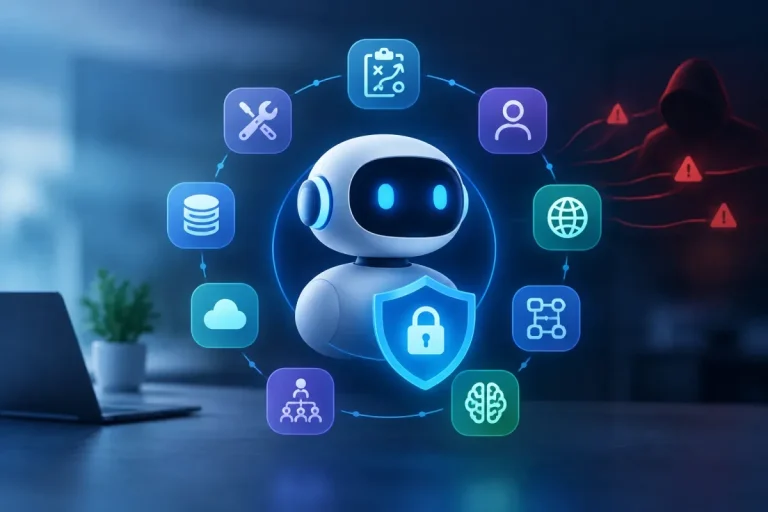
AI Agent Security at a Glance
- AI agent security is the practice of protecting autonomous AI agents—including their models, prompts and memory, tools, credentials, workflows, and connected systems—and controlling their actions so they operate only within authorized boundaries.
- Assign each agent a dedicated identity with narrowly scoped, short-lived credentials.
- Apply task-specific least privilege to tools, APIs, data, and network access.
- Require human approval or policy gates for destructive, financial, production, or otherwise high-impact actions.
- Sandbox agent execution and restrict outbound network and tool access.
AI agent security is the practice of protecting autonomous AI agents—including their models, prompts and memory, tools, credentials, workflows, and connected systems—and controlling their actions so they operate only within authorized boundaries.
The security boundary includes both the AI agent and everything it can access or affect, including data, identities, tools, workflows, and downstream services. Protecting only the underlying model or chatbot interface is not enough.
What Is AI Agent Security?
Definition and scope
AI agent security, also called agentic AI security, is the layered discipline of keeping autonomous or semi-autonomous agents within authorized boundaries. It covers how an agent is identified, what it can access, which actions it may take, how those actions are validated, and how its activity is monitored and contained.
An agent can interpret a goal, retain context, plan across multiple steps, call external tools, and affect real systems. Security therefore applies to the agent itself and to every resource connected to it.
What the security boundary includes
- The model or reasoning engine
- Prompts, instructions, context, and retrieved content
- Short-term and persistent memory
- Tools, APIs, connectors, and workflows
- Agent identities and credentials
- Data sources and information the agent can read or change
- Downstream systems, communications, and other side effects
The goal is not to prevent every autonomous action. It is to make each action authorized, constrained, observable, accountable, and recoverable.
How AI Agent Security Differs From Traditional Application Security
Traditional applications generally expose defined interfaces and follow relatively predictable execution paths. An AI agent can combine natural-language input, retained state, multi-step planning, tool calls, and action chaining.
This creates a broader and less predictable attack surface. An agent may receive instructions, read external content, retain information, select a tool, pass results to another step, and produce an effect in a downstream system. A failure can result from the interaction between several components, not only from a defective model response.
Model and interface security still matter, but they do not cover identity, credentials, memory, tool permissions, action-level authorization, or downstream effects. AI agent security must address the complete agentic system.
The AI Agent Security Attack Surface
Model, prompts, context, and memory
The model or reasoning engine influences how an agent interprets goals and chooses its next steps. Prompts and context shape that behavior, while memory can carry information from one task into another. Manipulated instructions, contaminated context, or corrupted memory can therefore influence later actions.
Tools, APIs, workflows, and data sources
Tools and APIs give an agent practical capabilities. Workflows determine how those capabilities are chained, and data sources provide information that may influence a plan. Each connector introduces another place where authorization, input validation, data integrity, and monitoring matter.
Access to a service is not permission to perform every operation within it. Searching or drafting, for example, should not automatically authorize sending, deleting, transferring, or administering. Security should distinguish service access from permission for a specific action.
Identity, credentials, and downstream systems
An agent needs an accountable identity so its actions can be attributed, limited, reviewed, and stopped. Its credentials determine which systems it can reach. Downstream systems may include internal services, data stores, business workflows, and communication channels.
The consequences of an action are part of the attack surface: data may be changed, communications sent, configurations altered, or other side effects triggered. This is why securing only the model is insufficient.
Major AI Agent Security Threats
Prompt injection and indirect prompt injection
Prompt injection attempts to influence an agent with instructions that conflict with its authorized task. Indirect prompt injection places those instructions in content the agent is expected to read, such as a document, email, webpage, ticket, retrieved result, or API response.
External content can become part of the agent’s working context and redirect its plan or encourage unintended tool use. Separating instructions from untrusted data, validating proposed actions, limiting permissions, and monitoring tool calls help reduce this risk.
Memory poisoning and context contamination
Memory poisoning manipulates retained memory or context so later behavior is influenced by inaccurate or unauthorized information. The risk increases when memory persists across tasks or is treated as trusted without integrity checks.
Control what enters memory, review memory changes, limit access to stored context, and test whether contaminated context changes future actions.
Tool misuse, excessive privilege, and confused-deputy behavior
An agent can misuse a legitimate tool, act outside the user’s intent, or apply broad authority for an attacker’s purpose. This is confused-deputy behavior: the agent has legitimate access but is induced to use it incorrectly. For a focused treatment of this risk, see AI Agent Tool Misuse.
Excessive permissions increase the potential impact. Task-specific least privilege, action-level authorization, runtime policy checks, and approval gates reduce that risk.
Credential abuse, data exfiltration, and unsafe action chains
Compromised, overbroad, or poorly managed credentials can let an agent reach systems beyond its task. Data may also be exposed through tool interactions or legitimate access used for an unauthorized purpose.
Several individually permitted steps can form an unsafe chain when combined. Narrow permissions, restricted destinations, monitoring, and policy checks before consequential actions help limit the risk.
Third-party, supply-chain, and multi-agent risks
External tools, connectors, orchestration components, and other dependencies introduce third-party and supply-chain risk. In environments with multiple agents, harmful instructions or contaminated information may move across agent boundaries. Test integrations, limit trust between components, isolate execution, and monitor cross-system chains.
Threat-to-control matrix
| Threat | Affected component | Potential consequence | Key control |
|---|---|---|---|
| Prompt or indirect prompt injection | Prompts, context, data sources | Redirected goals or unintended tool use | Separate instructions from external data, validate actions, apply policy checks, and monitor tool calls |
| Memory poisoning | Memory and persistent context | Later decisions influenced by contaminated information | Control memory writes, review changes, check integrity, and test retained context |
| Tool misuse or excessive privilege | Tools, APIs, identities | Unauthorized actions or an enlarged blast radius | Use task-specific least privilege and action-level permissions |
| Credential abuse | Agent credentials and downstream systems | Unauthorized access or persistent compromise | Use dedicated identities, scoped credentials, rotation, and rapid revocation |
| Data exfiltration | Data sources, tools, communications | Sensitive information leaving authorized boundaries | Restrict data and network access, validate destinations, and monitor unusual activity |
| Unsafe action chaining | Workflows and downstream systems | Several permitted steps combine into harmful effects | Use runtime policy checks, action limits, approval gates, and chain monitoring |
| Third-party or multi-agent compromise | Connectors, tools, agent-to-agent flows | Contamination or spread across connected components | Test integrations, isolate execution, limit trust, and monitor cross-system chains |
Core Controls for AI Agent Security
Dedicated identities and scoped credentials
Give each AI agent a dedicated, accountable identity instead of shared human credentials or undifferentiated static credentials. Assign a clear owner responsible for the agent’s purpose, permissions, logs, and shutdown process. For a deeper comparison of human and non-human identities, see AI Agent Identity Differences.
Use narrowly scoped, preferably short-lived credentials where supported. Maintain an inventory, rotate credentials, and make rapid revocation possible. Keep the user’s identity distinct from the agent’s identity: the user may authorize a task, while the agent identity records which autonomous process performed it. For more detail on temporary, task-scoped credentials, see Short-Lived Tokens for AI Agents.
Task-specific least privilege
Least privilege means giving an agent only the tool, API, data, and network access required for its current task. Permissions should be task-specific rather than broad defaults that remain active across unrelated workflows.
Authorization should also operate at the action level. Access to a service may allow searching or drafting without allowing sending, deleting, transferring, changing configuration, or performing administrative operations. Review permissions as the agent’s purpose changes, and make revocation part of normal operations.
Runtime policy checks and sandboxing
Before a tool call or consequential side effect executes, runtime controls should validate inputs and outputs and check the proposed action against policy, task goal, authorization, and data-integrity requirements.
Run agent code and tool calls in restrictive, isolated environments with limited access to networks, files, tools, and other execution resources. Sandboxing limits what a compromised agent or unsafe execution path can reach. For a practical guide to securing tool execution environments, see Secure an MCP Client.
Guardrails complement authorization; they do not replace it. A policy check cannot compensate for excessive permissions, and monitoring cannot undo every harmful action after the fact.
Human approval for high-impact actions
Require human approval or a policy gate for high-risk or irreversible actions, not necessarily for every routine step. Examples include financial actions, destructive changes, administrative operations, configuration changes, and mass communications.
Lower-risk actions can proceed under predefined policy and monitoring. Approval requests should show the proposed action, relevant context, affected system, and intended consequence.
Memory, Context, and Data Protection
Persistent state can improve continuity, but it also creates a security dependency: future behavior may be influenced by information retained earlier. Treat memory changes as security-relevant events. Control who or what can write to memory, review changes, and check whether retained information remains consistent with the agent’s authorized task.
Instructions that govern an agent should be distinguishable from user requests and external content. Documents, email, webpages, tickets, retrieved content, and API responses may provide useful information, but they should not automatically become authoritative instructions.
Limit the data sources an agent can access to those required for its task. Restrict where information can be sent, monitor unusual destinations and cross-system chains, and validate communications or other side effects when their impact is high.
Monitoring, Logging, and Security Testing
Comprehensive audit trails
A practical AI agent security logging baseline includes:
- Prompts, requests, and relevant inference-related events
- Memory changes and context updates
- Plans or proposed actions where available
- Tool calls, parameters, results, and outcomes
- Policy decisions, authorization checks, and approvals
- Communications and other external side effects
- Identity, credential, privilege, and configuration changes
These records support behavioral analysis, investigation, auditability, and recovery. Protect logs from unauthorized alteration and make them useful for tracing activity across connected systems.
Behavioral monitoring and testing
Monitor for first-time tool use, unexpected privilege changes, volume spikes, unusual destinations, and new cross-system chains. Test direct and indirect prompt injection, memory poisoning, excessive permissions, tool misuse, unsafe action chains, third-party weaknesses, and unwanted propagation across connected agents. For a practical monitoring framework, see the AI Security Monitoring Checklist.
Use test results to revise permissions, policies, sandbox boundaries, approval requirements, monitoring, and recovery procedures. Security testing complements preventive controls and operational oversight.
Secure Architecture, Rollout, and Response
Control plane and execution plane
A product-neutral architecture can separate a control plane from an execution plane:
- Control plane: identity, authorization policy, approvals, logging, monitoring, and shutdown.
- Execution plane: the runtime, tools, workflows, connectors, and data interactions used to perform the task.
This separation makes it easier to apply consistent policies, observe activity, and contain an agent without treating its runtime as fully trusted.
Start with a restricted rollout
Begin with a tightly scoped, read-only pilot and full logging. Validate identity, permissions, context handling, tool behavior, alerting, and incident procedures before allowing changes to data or systems.
Expand permissions and approval pathways cautiously. Each additional tool, data source, or action should have a clear purpose, owner, authorization rule, and monitoring plan.
Containment and recovery
When an agent may be compromised or behaves outside its role:
- Isolate or disable the agent and restrict its execution and tool access.
- Revoke active tokens and rotate affected secrets.
- Review prompts, memory changes, permissions, and tool-call chains.
- Identify the entry point, attack path, affected systems, and side effects.
- Patch the relevant identity, authorization, runtime, memory, or monitoring controls.
- Retest the agent and connected workflows against the triggering scenario.
- Reactivate cautiously with restricted permissions and close monitoring.
An agent that cannot be quickly isolated, investigated, and reauthorized is not ready for broad autonomy.
AI Agent Security Checklist
- Identity and ownership: Give every agent a dedicated identity, clear owner, inventory record, and accountable credentials.
- Credential lifecycle: Use narrow, preferably short-lived credentials with rotation and rapid revocation.
- Least privilege: Limit tools, APIs, data, and network access to the current task.
- Action authorization: Restrict specific operations within each tool, not only access to the tool itself.
- Runtime protection: Validate inputs and outputs, apply policy checks, and use restrictive sandboxing.
- Approval gates: Require human approval for high-impact financial, destructive, administrative, configuration, and mass-communication actions.
- Monitoring: Log prompts, memory changes, tool calls, policy decisions, approvals, communications, and side effects.
- Testing: Continuously test injection, memory poisoning, tool misuse, supply-chain risks, and multi-agent spread.
- Response: Maintain procedures for isolation, token revocation, secret rotation, investigation, retesting, and cautious reactivation.
AI agent security is not a single safeguard or a model-only exercise. Secure deployment requires layered identity, authorization, containment, high-impact oversight, monitoring, testing, and incident response across the entire agentic system.