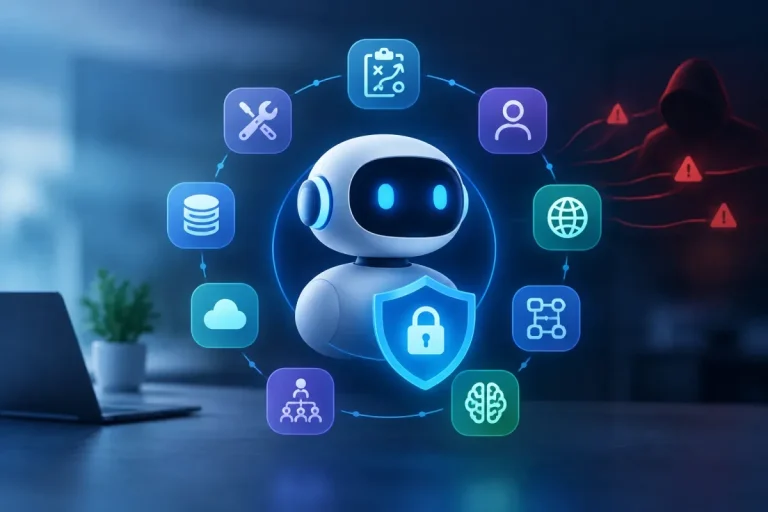

Agentic AI security at a glance
- Agentic AI security is the practice of protecting autonomous AI agents that can plan, make decisions, use tools, access data, and take actions with limited human supervision. It secures the agent’s identity and permissions, inputs and reasoning workflow, tools and APIs, memory, data, and runtime behavior so the agent operates within authorized boundaries.
- Use distinct, least-privileged identities and short-lived credentials for agents.
- Restrict and validate tool, API, data, and parameter access.
- Validate instructions and inputs throughout the agent’s execution loop, not only at the initial prompt.
- Protect agent memory and monitor runtime behavior with audit trails and containment or kill-switch capabilities.
Agentic AI security is the practice of protecting autonomous AI agents that can plan, make decisions, use tools, access data, and take actions with limited human supervision. It secures identity, permissions, inputs, tools, APIs, memory, data, and runtime behavior so agents stay within authorized boundaries.
What does agentic AI security cover?
An AI agent can do more than generate text. It may interpret a goal, create a plan, retrieve information, call a tool or API, update memory, and execute a task across connected systems. Agentic AI security protects this complete execution path. For a broader overview of this subject, see the AI agent security guide.
Its scope includes the agent’s identity and permissions, authentication, instructions, inputs, reasoning workflow, tools, APIs, integrations, memory, data access, decisions, and runtime actions. The goal is to control what the agent can do and how it does it—not merely to filter prompts or review generated text.
This broader scope matters because an agent can access data, invoke an API, change a system, or trigger a workflow. These capabilities create security risks beyond the content of a model’s response. For a structured framework covering these risks, read the OWASP Top 10 for Agentic Applications guide.
Why agentic AI needs specialized security
Traditional generative AI security often emphasizes prompt handling, model behavior, and output safety. Those protections remain important, but an agent also needs controls around its actions and execution environment.
An agent may pursue a goal through a multistep workflow: selecting information to retrieve, choosing a tool, passing parameters, evaluating the result, and continuing toward an outcome. It may retain context or memory and adapt its next action based on new information.
Agents are not necessarily fully autonomous. Many operate with human review or policy limits. The defining security concern is that they can perform actions with limited or intermittent human supervision.
- Which tools and APIs can the agent call?
- Which data and systems can it access?
- Which parameters and actions are allowed?
- How can memory and retrieved content influence its decisions?
- When must a person or policy approve an action?
Main risks of agentic AI systems
Prompt injection and manipulated inputs
Prompt injection occurs when instructions influence an agent in ways its operator did not intend. Indirect prompt injection can come from documents, retrieved content, tool results, or other untrusted data. This content may redirect the agent’s plan away from its authorized purpose.
Memory or context poisoning creates a related risk. Malicious or incorrect information stored in memory can influence later decisions, even after the original input is no longer visible. Inputs therefore need validation throughout the agent’s execution loop, not only at the initial prompt.
Excessive permissions and privilege escalation
Agents can create risk when they have more tools, data, systems, or actions available than their task requires. If an agent’s identity or credentials are compromised, excessive access may enable unauthorized activity, privilege escalation, or lateral movement. For a deeper look at these identity and access failures, see the identity and privilege abuse guide.
Unsafe tools, APIs, and integrations
Tools and APIs are the points where an agent’s decisions become external actions. Unsafe tool use, vulnerable integrations, or compromised software components can lead to unintended changes. Supply-chain attacks may also enter through tools, dependencies, connected services, or other components used by the agent.
Data leakage and uncontrolled behavior
Agents may expose sensitive information through inappropriate data access, tool calls, or generated actions. Other risks include uncontrolled looping, resource abuse, cascading failures, and erroneous actions that are repeated or amplified across connected workflows.
| Risk surface | Relevant control categories |
|---|---|
| Prompt injection and poisoned context | Input validation, instruction controls, memory protection, and policy enforcement |
| Excessive permissions or compromised identity | Distinct identities, authentication, authorization, and least privilege |
| Unsafe tools, APIs, and integrations | Allowlists, scoped access, parameter validation, action restrictions, and monitoring |
| Data leakage and uncontrolled execution | Data controls, approval gates, audit trails, runtime monitoring, and containment |
Core controls for agentic AI security
Use distinct identities and least privilege
Each agent should have a distinct non-human identity with authentication, authorization, scoped access, and lifecycle controls. Avoid relying on broad inherited permissions or an individual user’s access. Distinct identities make it easier to determine what an agent was allowed to do and revoke its access when necessary.
Least privilege limits an agent to the tools, data, systems, and actions required for its task. Use narrowly scoped permissions and, where appropriate, short-lived credentials. Reassess access when the agent, workflow, or connected environment changes.
Least agency limits what the agent may do autonomously within its permissions. For example, an agent may prepare an action but require approval before executing a sensitive or irreversible change.
Restrict and validate tools, APIs, and data access
Security controls should restrict access before execution rather than relying on the agent’s reasoning alone. Useful boundaries include:
- Allowlists for approved tools, APIs, systems, and data sources.
- Validation of parameters, destinations, requested data, and proposed actions.
- Policy enforcement at tool and API boundaries.
- Separate read, write, administrative, and irreversible capabilities where possible.
- Monitoring for abnormal or unexpected integration use.
Controls should match the task and risk level. An agent that retrieves information does not need the same authority as one that modifies records or triggers an irreversible system change.
Validate instructions and protect memory
Documents, retrieved content, tool results, and external messages can all influence an agent’s plan. They should not automatically be treated as trusted instructions. Validate inputs and instructions throughout the execution loop, and separate trusted instructions from untrusted content.
Protect memory from unauthorized or malicious updates so that poisoned context does not influence future decisions. Controls may include limiting who or what can update memory, reviewing stored information, and removing harmful content when the system supports those capabilities.
Monitor runtime behavior and maintain audit trails
Runtime monitoring helps identify behavior that differs from the expected task, such as unusual tool calls, unexpected data access, abnormal sequencing, repeated failures, or uncontrolled loops. For practical guidance on tracking agent actions and abnormal behavior, use the AI security monitoring checklist.
Audit trails should connect significant events to the agent’s identity, permissions, plans, tool calls, data access, and applicable policies or approvals. This traceability supports accountability, investigation, and detection of compromise or misuse.
Require approval for high-impact actions
Human or policy approval is appropriate for sensitive, high-risk, or irreversible actions. This may include changing important records, affecting access, disclosing sensitive data, or creating consequences that cannot easily be undone. The approval requirement should reflect the action’s impact, not simply the fact that an AI system proposed it.
Deployments should also provide containment options for abnormal or compromised behavior. Depending on the system, these may include isolation, permission overrides, emergency stops, or kill-switch capabilities.
Defense in depth and lifecycle governance
There is no single universally accepted checklist for every agentic deployment. A product-neutral approach combines controls across the model, application, identity, infrastructure, data, monitoring, and user-interaction layers.
Isolation and segmentation can limit how far a compromised or misbehaving agent can reach. Layered controls also reduce reliance on any one safeguard: identity controls limit access, tool policies constrain actions, memory protection defends context, and monitoring helps detect behavior that bypasses earlier controls.
Security should begin during design and testing, continue through deployment and operation, and be revisited when the agent’s tools, data, permissions, or objective changes. Organizations need an inventory of agents and their access, along with processes for reassessment and identity or credential revocation. For a structured approach to deployment, reassessment, ownership, and lifecycle controls, read the AI agent governance guide.
A practical sequence is to:
- Identify each agent, its connected systems, and its data access.
- Assign a distinct identity and remove unnecessary permissions.
- Restrict tools, APIs, data, and parameters.
- Validate inputs and instructions throughout execution and protect memory.
- Add monitoring, audit trails, approval gates, and containment mechanisms.
- Reassess controls when the agent or its operating environment changes.
Securing agentic AI versus using agents for cybersecurity
The primary meaning of agentic AI security is protecting the agents themselves: their identities, permissions, decisions, tools, memory, data, workflows, and runtime actions.
A secondary meaning is using agentic AI for cybersecurity. In that context, agents support security operations such as alert triage, threat investigation, or incident response. The focus is on using agents to perform security work rather than on securing the agents themselves.
An agent used for cybersecurity still needs identity, access, tool, monitoring, approval, and containment controls. The dominant meaning remains protecting autonomous or semi-autonomous agents and the connected systems they can affect.
Bottom line
Agentic AI security keeps agents that can plan and act within authorized boundaries. It goes beyond prompt and output protection by securing identities, permissions, tools, APIs, inputs, memory, data, workflows, and runtime behavior.
The core approach combines least privilege, least agency, validated tool access, protected memory, continuous monitoring, auditability, and human or policy approval for high-impact actions. Isolation, overrides, emergency stops, or kill switches add an important boundary when an agent behaves abnormally or becomes compromised.