
LLM vs. AI Agent: Key Differences
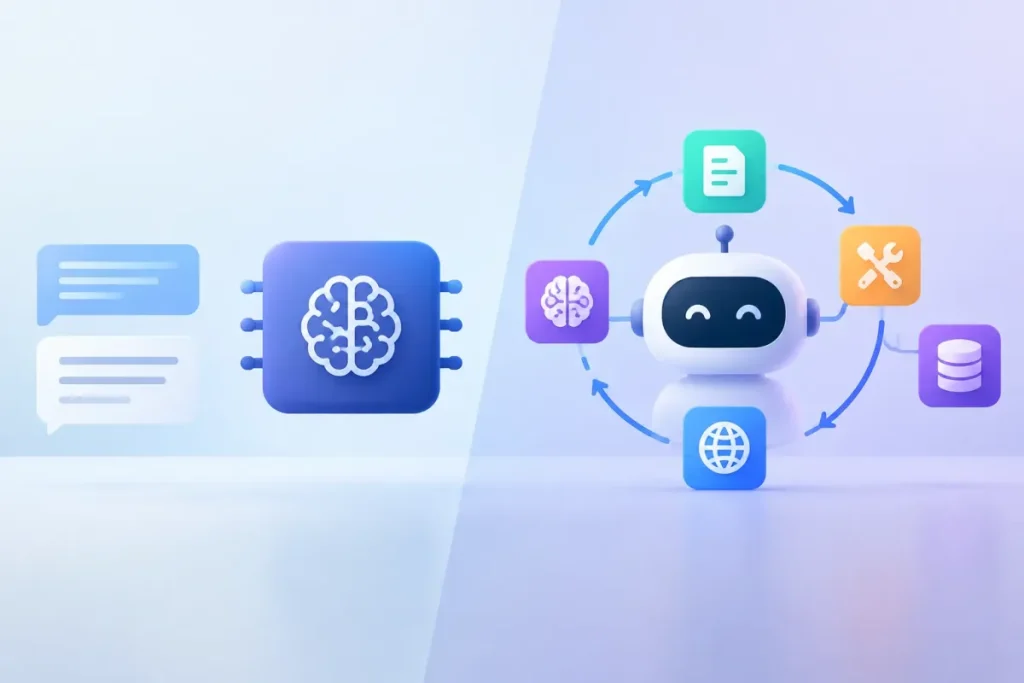
- An LLM is the underlying language model that processes prompts and generates text. An AI agent is a broader software system that may use an LLM plus instructions, state or memory, tools, and an action/observation loop to pursue goals and complete multi-step tasks. Therefore, an agent can contain or call an LLM, but an LLM by itself is not necessarily an agent.
- For simple drafting, summarizing, translation, question answering, or text generation, use an LLM call or chatbot.
- For tasks requiring multiple steps, tool/API calls, information gathering, state tracking, or actions in external systems, use an agent-style application.
- When choosing between them, evaluate whether the task needs external actions and iterative workflow execution rather than merely generated text.
- Define LLM as the model responsible mainly for language understanding and generation.
An LLM is the underlying language model that processes prompts and generates text; an AI agent is a broader software system that may use an LLM plus tools, state, memory, and an action loop to pursue multi-step goals. An LLM alone is not necessarily an agent.
AI Agent vs. LLM: The Short Answer
The core distinction is model versus system. An LLM mainly understands, generates, or transforms language. An AI agent is a goal-directed application built around a model, with additional instructions, orchestration, and potentially planning, memory, tools, and workflow logic. For a broader comparison, see our guide to AI Agent vs. AI Model.
These are not mutually exclusive types of AI model. An agent can contain or call an LLM as its language component, while an LLM-based application does not automatically qualify as an agent. The exact capabilities depend on the surrounding software.
LLM vs. AI Agent: Side-by-Side Comparison
| Aspect | LLM | AI agent |
|---|---|---|
| What it is | A language model that processes prompts and generates or transforms text. | A broader software system that uses a model and workflow logic to pursue a goal. |
| Interaction | Usually responds to a request with generated content. | May plan, act, observe results, evaluate them, and continue through several steps. |
| Planning | Can describe a plan, but a basic call does not necessarily execute it. | May use planning or workflow logic to determine what to do next. |
| State or memory | A basic call does not automatically retain information across separate interactions. | May carry state or use memory across steps; persistence varies by implementation. |
| Tools | Does not browse, run code, or call APIs by itself. An application can add those capabilities. | May use browsers, APIs, databases, code runners, and other connected tools. |
| External action | Typically returns generated content. | May take approved actions in external systems, subject to permissions and controls. |
| Typical tasks | Drafting, summarizing, translating, classifying, extracting information, and answering questions. | Multi-step research, information gathering, process automation, and workflows requiring iteration. |
| Complexity | Usually simpler to build, test, operate, and debug. | Requires orchestration, tool handling, state management, and failure handling. |
This table describes common patterns, not absolute rules. An LLM-based application can add tools or state without becoming a fully agentic workflow, and agents differ in their autonomy, memory, planning, and tool access.
What Is an LLM?
A large language model (LLM) is a language-focused model that processes input and generates or transforms text. It uses the prompt and any supplied context to produce an output, such as an answer, summary, translation, classification, or piece of code.
How an LLM Handles a Request
A basic LLM call usually follows three steps:
- You provide a prompt and relevant context.
- The LLM interprets the request and generates an output.
- An application displays, stores, or validates that output.
An LLM can generate a plan, code, or proposed procedure in its response. However, a basic model call does not necessarily carry out those instructions. Browsing a website, querying a database, calling an API, or running code requires capabilities supplied by the surrounding application and its integrations.
Likewise, persistent memory is not an automatic property of every LLM. An application can include previous messages or other information in a later prompt, but that added context comes from the application layer.
Common LLM Tasks
- Drafting, rewriting, or formatting text
- Summarizing a document
- Translating content
- Classifying a message or document
- Extracting structured information
- Answering a question using supplied context
- Generating a conversational response
What Is an AI Agent?
An AI agent is a broader software system that uses a model—often an LLM—along with components that help it pursue a goal. Those components may include instructions, tools, state or memory, planning, orchestration, and workflow logic.
Components Around the Model
In an agent-style application, the LLM may interpret the goal, propose a next step, select a tool, or evaluate a result. Other software handles the workflow, integrations, permissions, and execution. Depending on the design, the system may connect to:
- APIs and business applications
- Browsers or other information sources
- Databases
- Code execution environments
- State stores that carry information between steps
These capabilities are not universal requirements. Not every agent has persistent long-term memory, unrestricted tool access, or a high degree of autonomy. The term agent also varies somewhat across the industry, so evaluate what a particular system can actually do.
Goal-Directed, Multi-Step Execution
Unlike a single response, an agent can break a goal into steps, choose an action, inspect the result, and continue. For example, it might gather information, compare the results, prepare an output, and adjust the next step if a tool returns unexpected information.
This does not mean every agent independently decides everything. Some systems follow mostly fixed workflows, while others allow more flexible planning. Their behavior depends on the instructions, tools, permissions, state, and execution logic supplied by the application.
How LLMs and AI Agents Work Together
The simplest way to understand the relationship is to treat the LLM as one component inside the broader AI-agent system. The model provides language understanding and generation; surrounding software supplies tools, state, permissions, and execution logic.
- Instructions: Define the goal, available tools, and operating limits.
- LLM: Interprets the current context and proposes a response or next step.
- Orchestration: Routes that decision to a tool, another workflow step, or a final response.
- Tools: Retrieve information or perform an approved operation.
- State: Carries relevant results and context into later steps.
- Validation: Checks the result before continuing or presenting it.
The architecture varies. Some systems use a fixed sequence of steps, while others allow the model to select among available actions. Both may be described as agent-style systems, but their behavior and reliability can differ.
Simple LLM Call vs. Agent Loop
A simple LLM call might be: “Summarize this document in five bullet points.” The model receives the document and returns a bounded answer.
An agent loop is more like: “Prepare a report using information from several approved sources.” The system may plan the work, gather information with tools, inspect the results, decide whether more information is needed, assemble the report, and validate the output.
The practical difference is the iterative workflow: planning, tool use, observation, evaluation, and further action. The LLM may participate in those steps, but the surrounding application makes the loop possible. For a security-focused view of this workflow, see our guide to AI agent threat modeling.
When to Use an LLM vs. an AI Agent
Use an LLM for Bounded Language Tasks
Use an LLM or chatbot when the task can be expressed clearly in one prompt and the result is easy to validate. This is usually the better choice when no external action or iterative process is required.
- Drafting an email, outline, or report section
- Summarizing supplied text
- Translating content
- Classifying a message
- Extracting fields from a document
- Answering a question using provided context
A single LLM call is generally simpler, faster, less expensive, and easier to debug than an agent workflow when the task is well defined.
Use an Agent-Style System for Multi-Step Tasks
Consider an AI agent when the task requires one or more of the following:
- Calling tools or APIs
- Gathering information from external sources
- Tracking state across several steps
- Changing the sequence of actions based on earlier findings
- Repeating a process until a defined condition is met
- Taking an approved action in an external system
Agents can support cross-functional workflows that connect information gathering, analysis, decision-making, and execution across business applications. They may be useful when a process spans several systems or teams, but they still need clear boundaries, permissions, and success criteria.
Choose an agent when workflow capability matters more than the simplicity of a single response. Otherwise, use the smallest system that reliably solves the task.
Where RAG Fits
Retrieval-augmented generation (RAG) retrieves information from external sources and supplies it to an LLM before the model generates a response.
RAG addresses an information problem: the answer needs relevant material from a document collection or another source. An agent addresses a broader workflow problem: the system may need to plan, use multiple tools, track state, and take actions.
A RAG workflow can be part of an AI agent, but retrieval alone does not make a system an agent:
- LLM: Generates or transforms language.
- RAG: Retrieves relevant information and gives it to the LLM.
- AI agent: Orchestrates multiple steps and may use retrieval, tools, state, and external actions.
One Goal, Three System Designs
Consider the goal of preparing a short answer about a company policy using information supplied by the user.
| Approach | How it works | Best fit |
|---|---|---|
| LLM call | The user supplies the policy text, and the LLM summarizes or explains it in one response. | The needed information is already available in the prompt. |
| RAG workflow | The system retrieves relevant passages from a policy collection and gives them to the LLM to produce a grounded answer. | The answer depends on information stored in external documents. |
| Agent workflow | The system may determine which sources to consult, retrieve information, compare results, request additional input, and produce the answer after several steps. | The task requires flexible sequencing, iteration, tool use, or action. |
The choice depends on whether the task needs only generated text, retrieved information, or iterative tool use and action. These approaches can also be combined.
Trade-Offs and Controls
AI agents can handle workflows that a single LLM response cannot, but the added capability increases complexity. An agent may involve more model and tool calls, higher latency and cost, additional failure points, and more difficult testing and debugging.
When an agent can affect an external system, limit its permissions and define what each tool can do. Logging can record instructions, decisions, tool calls, and results. Validation can check data and proposed actions before they are accepted. For a production-focused checklist covering these safeguards, see AI agent security controls.
Human approval may be appropriate before consequential actions such as sending, changing, purchasing, or deleting information. Not every workflow needs the same level of oversight, but external action should remain bounded by the system’s controls. For organization-wide guidance on implementing these protections, see the AI security controls checklist.
How to Choose
- Does the task only need generated or transformed text? Use a simple LLM call.
- Does it need information retrieved from an external source? Use an LLM with a retrieval workflow, such as RAG.
- Does it require iterative tool use, state tracking, flexible sequencing, or external action? Consider an agent-style system.
- Can the result be checked easily? Prefer the simplest design that meets the reliability requirement.
In short, an LLM is the model that handles language, while an AI agent is the broader goal-directed system that may use an LLM with tools, state, planning, and action logic. Use the simplest system that reliably solves the task.