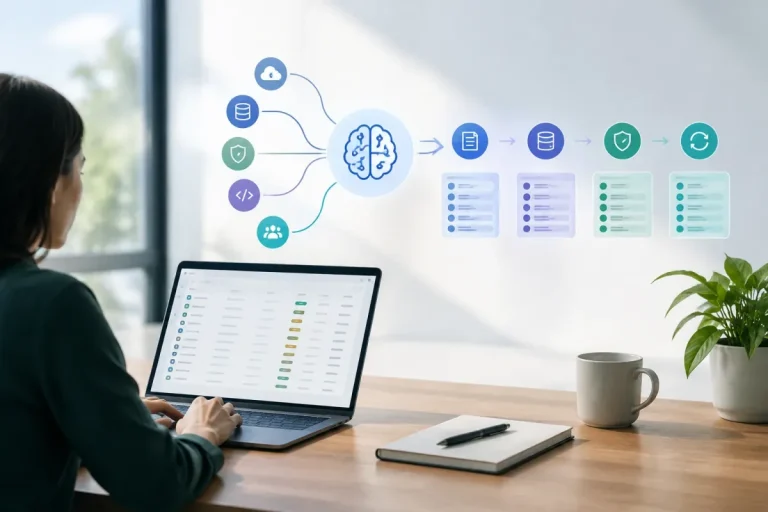
AI Agent Governance at a Glance
- AI agent governance is the structured framework for controlling delegated authority in autonomous AI systems. It combines unique agent identity and least-privilege access, clearly defined objectives and action boundaries, independent runtime guardrails, human approval or monitoring for consequential actions, comprehensive logging and accountability, and recovery controls such as revocation, rollback, or shutdown. A practical program typically inventories agents, assigns ownership and permissions, assesses risks before deployment, enforces policies during execution, audits activity, and continuously improves controls.
- Create a live inventory of sanctioned and unsanctioned agents.
- Register each agent with a unique identity, owner, purpose, and minimal permissions.
- Perform pre-deployment risk and impact assessments.
- Implement independent runtime guardrails, approval gates, circuit breakers, and tool/API restrictions.
AI agent governance is the structured framework for controlling delegated authority in autonomous AI systems. It combines unique identity, least-privilege access, defined objectives and boundaries, runtime guardrails, risk-based human oversight, comprehensive logging and accountability, and recovery through revocation, rollback, or shutdown.
In practice, AI agent governance determines what agents may access, decide, and execute. A practical program inventories agents, assigns ownership and permissions, assesses risk before deployment, enforces policies during execution, audits activity, and continuously improves controls.
What Is AI Agent Governance?
AI agent governance is the structured management of delegated authority, actions, identities, permissions, and accountability across an agent’s lifecycle. It applies to agents that can plan, call tools, access systems, exchange data, communicate externally, or perform multi-step tasks.
Governance establishes:
- Who owns the agent and its decisions
- Which data, systems, tools, and APIs it may access
- Which objectives and actions are permitted
- Which actions are prohibited or require approval
- How policies are enforced while the agent is running
- What activity is logged and attributable
- How the organization detects, contains, and recovers from unwanted behavior
The lifecycle runs from discovery and design through risk assessment, testing, production approval, runtime operation, monitoring, incident response, reassessment, and decommissioning.
How Agent Governance Differs From Model Governance
Model governance focuses on development, validation, data quality, performance, outputs, and responsible use. Traditional automation governance often focuses on fixed workflows and permissions. Those controls remain relevant, but they do not fully govern an agent that can interpret instructions, select tools, create plans, and change its next action.
Agent governance extends control to the action layer, including:
- Plans and multi-step execution
- Tool calls, APIs, plugins, and integrations
- Credentials, delegated permissions, and non-human identity
- Data access and movement between systems
- Actions with financial, operational, privacy, security, or reputational impact
- Agent-to-agent communication and dependency changes
Reviewing model output alone is not enough. An agent may produce a plausible explanation while selecting an unauthorized tool, accessing excessive data, or combining individually permitted steps into a harmful result. Preventive access controls and runtime enforcement are required alongside output review.
Risks and the Agent Attack Surface
Agents combine model behavior with authority to act. An instruction, retrieved document, tool response, or generated output can therefore influence an unauthorized result. A practical way to map these attack paths is to use an AI agent threat modeling workflow.
Core action-layer risks
- Prompt manipulation: Untrusted content redirects instructions or intended behavior.
- Goal hijacking: The agent is diverted from its approved objective.
- Tool misuse: A legitimate tool is used outside its purpose, data scope, or action limits.
- Privilege escalation: Excessive permissions or uncontrolled delegation exposes systems or data beyond the agent’s role.
- Credential leakage: Secrets or delegated credentials appear in tools, outputs, logs, or integrations.
- Data poisoning: Manipulated information influences retrieval, decisions, or later actions.
- Compound action chains: Several low-risk steps combine into a high-impact result.
Each risk should connect to an authority boundary, runtime check, approval threshold, monitoring signal, or recovery action. Reading data may be permitted while deleting data, approving a payment, disclosing sensitive information, or communicating externally requires a separate control.
Multi-agent and integration risks
When agents, tools, plugins, APIs, and other integrations interact, responsibility becomes harder to trace. Govern communication, delegation, trusted integrations, isolation, and system-level monitoring. Changes to models, tools, dependencies, MCP connections, or A2A-related connections should receive appropriate review and testing. Because MCP connections are explicitly in scope, see this MCP security guide for additional controls.
Core AI Agent Governance Pillars
A complete program combines complementary controls. No single pillar is sufficient, and monitoring cannot compensate for excessive permissions or missing runtime restrictions.
| Governance pillar | Objective | Typical controls |
|---|---|---|
| Ownership and accountability | Make authority and decisions attributable | Named owner, approval authority, operating responsibilities, escalation paths |
| Identity and least privilege | Limit and attribute access | Distinct non-human identity, scoped permissions, credential lifecycle, revocation |
| Boundaries and risk tiers | Define what the agent may and may not do | Objectives, permitted data, tools, prohibited actions, impact classification |
| Runtime enforcement | Prevent unauthorized actions during execution | Policy checks, tool restrictions, sandboxing, allow/deny rules, circuit breakers |
| Human oversight | Match intervention to impact | Approval gates, human-in-the-loop review, human-on-the-loop monitoring |
| Observability and auditability | Reconstruct activity and decisions | Action logs, tool-call records, policy decisions, provenance, owner attribution |
| Data, privacy, and compliance | Control sensitive data and obligations | Classification, minimization, lineage, residency, retention, deletion, encryption |
| Recovery and incident response | Contain and correct unwanted behavior | Isolation, suspension, credential revocation, rollback, kill switches, shutdown |
Controls should vary according to the agent’s capability, data sensitivity, regulatory context, and business impact.
Build the Governance Operating Model
Governance works only when decision rights and operational responsibilities are explicit. Each agent needs a named owner accountable for its purpose, permissions, boundaries, performance, and retirement.
Document responsibility for:
- Approving objectives, data access, tools, and authority
- Operating and monitoring the agent in production
- Suspending the agent or revoking its credentials
- Investigating policy violations and incidents
- Reviewing privacy, security, compliance, audit, and retention requirements
- Approving material changes and decommissioning
Accountability should cover the agent’s decisions and actions, not only the underlying model or software team. Depending on the operating model, responsibilities may be distributed among the deploying organization, agent owner, platform operator, integrator, model or tool provider, security, privacy, compliance, audit, and operations teams. The division must be documented.
Inventory Agents Across the Enterprise
Organizations cannot govern agents they cannot identify. Maintain a live inventory of sanctioned, unsanctioned, and shadow agents across development, testing, and production. For a structured approach to this process, see the AI agent inventory guide.
Each record should include:
- Agent name, purpose, business owner, and operating team
- Environment, platform, version, status, and deployment location
- Distinct non-human identity and mapped owner
- Data sources, access scope, tools, APIs, integrations, and dependencies
- Approved objectives, action boundaries, risk tier, and approval requirements
- Monitoring, escalation, recovery, and decommissioning arrangements
Discovery should include agents created outside formal channels. A shadow agent may still access business data or external services, making inventory coverage both a governance and security concern.
Lifecycle management should cover design, development, testing, production approval, operation, updates, incident response, reassessment, and decommissioning. Retirement includes access removal, credential revocation, data and log handling, dependency review, and confirmation that the agent is no longer executing.
Define Policies, Boundaries, and Risk Tiers
Before deployment, write a boundary statement that defines what the agent is authorized to do and what it must not do. Specify:
- Approved objectives and business purpose
- Permitted data sources and uses
- Allowed tools, APIs, integrations, and execution environments
- Permitted actions, transaction limits, and operating conditions
- Prohibited actions and restricted data
- Delegation rules and exceptions
- Actions that require human approval
- Conditions that require suspension, investigation, or shutdown
Use a repeatable action-impact assessment to set oversight. Consider the agent’s capability, data sensitivity, business impact, reversibility, external effect, and potential regulatory or privacy consequence. Classify actions as low impact, material impact, or prohibited or anomalous. The action-impact method can be developed further through an AI agent risk assessment.
| Action impact | Autonomy approach | Oversight and recovery |
|---|---|---|
| Low impact and within approved scope | Operate automatically within defined permissions | Continuous monitoring, escalation thresholds, and audit records |
| Material operational, privacy, financial, or external impact | Require a policy check and human approval before execution | Named approver, evidence, intervention path, and recovery procedure |
| Prohibited, anomalous, or outside approved scope | Deny, isolate, or suspend rather than execute | Circuit breaker, credential revocation, investigation, and remediation |
Reassess the classification when the agent’s purpose, data, tools, integrations, model, or environment changes.
Identity, Access, Delegation, and Least Privilege
Every agent should have a distinct non-human identity mapped to an accountable owner. Do not treat it as an untraceable extension of a user’s account. Identity records should support attribution, lifecycle management, access review, and revocation. For a detailed treatment of this control model, read about identity and access management for AI applications.
Apply least privilege by limiting permissions according to the agent’s function, data, capability, and approved environment. Control:.
- Which systems and data the agent can reach
- Which operations it can perform on each resource
- Whether it may delegate authority to another agent or service
- How permissions are inherited or expanded
- When access must be reviewed, changed, suspended, or revoked
Access management alone is not enough: a correctly authenticated agent can still misuse an authorized tool. Combine identity controls with objective boundaries, tool restrictions, runtime checks, human oversight, and auditability.
Separate Pre-Deployment Governance From Runtime Enforcement
Pre-deployment approval establishes the intended operating envelope. Runtime governance enforces that envelope while the agent is executing. Controls should operate across four layers:
Input controls
Identify untrusted instructions, restricted content, and attempts to manipulate the agent’s objective before they influence execution.
Process controls
Check plans, tool selections, permissions, execution paths, and policy conditions before the next step is taken.
Output controls
Review generated content for policy violations, sensitive data, unauthorized commitments, or content that should not be transmitted.
Action controls
Validate the actual API call, target, parameters, impact, and authorization immediately before execution.
Use allow and deny rules, tool and API restrictions, sandboxing, policy checks, execution-path limits, and action-impact controls. Runtime guardrails should be enforceable outside the agent’s own reasoning process so the agent cannot simply choose to bypass its limits.
Monitoring alone is insufficient. Preventive permissions and action restrictions must work with detective monitoring and corrective mechanisms such as circuit breakers, isolation, credential revocation, rollback, and shutdown.
Set Risk-Based Human Oversight
Human oversight should be risk-based rather than attached to every action. High-risk actions should require human-in-the-loop approval before execution. Lower-risk approved actions may operate under human-on-the-loop monitoring with defined escalation thresholds and intervention authority.
Approval gates are appropriate for actions such as:
- Payments, purchases, or commitments above an approved limit
- Deletion or irreversible changes to data
- Access to sensitive or restricted information
- Changes to permissions, production systems, or security controls
- External communications with legal, financial, reputational, or contractual impact
An approval record should identify the proposed action, relevant context, agent identity, responsible owner, policy decision, and approver. Define what happens when an approver rejects, delays, or cannot evaluate the request.
Govern Data, Privacy, and Compliance
Agents should access only the data required for their approved objectives. Data governance should address:
- Classification and minimization
- Permitted use and purpose limitation
- Lineage and provenance
- Privacy, residency, retention, and deletion
- Encryption and sensitive-data controls
- Data movement through tools, plugins, APIs, and other agents
Compliance obligations depend on the agent’s use case, data, industry, and jurisdictions. Treat compliance review as part of the production gate and reassess it when the agent’s purpose, data, integrations, or operating context changes. A general model review does not automatically cover downstream agent actions or data flows.
NIST AI RMF, ISO/IEC 42001, ISO/IEC 42005, ISO/IEC 23894, the EU AI Act, GDPR, NIST CSF, OWASP resources, and applicable sector requirements can serve as alignment references. They are not one universal agent-governance standard. Map applicable controls to the organization’s use cases and jurisdictions.
Test and Approve Agents for Production
Before production approval, test whether the agent respects its purpose, boundaries, permissions, and escalation rules.
Testing should include:
- Sandbox testing of normal and edge-case workflows
- Adversarial testing and red teaming
- Prompt-injection and manipulation testing
- Tool, API, permission, and integration validation
- Tests of prohibited actions and approval gates
- Failure, anomaly, circuit-breaker, and shutdown tests
- Validation after significant model, tool, policy, data, or dependency changes
A production-readiness decision should verify ownership, scope, least privilege, approved boundaries, testing results, logging, escalation ownership, compliance review, monitoring, recovery arrangements, and a decommissioning plan.
Operate, Monitor, and Audit Agents
Centralized observability should allow authorized reviewers to reconstruct what happened and why. Maintain records of:
- Agent identity, owner, version, environment, and active permissions
- Relevant requests, inputs, plans or action sequences, and outputs
- Tool and API calls, targets, parameters, results, and errors
- Policy evaluations, denied actions, exceptions, approvals, and overrides
- Anomalies, escalations, interventions, incidents, and recovery actions
These records support accountability, incident investigation, compliance review, and audit. Protect audit records from inappropriate alteration and apply suitable retention and access controls. Logging should support reconstruction without creating unnecessary exposure of sensitive data.
Monitor drift and behavior change
Production governance is continuous. Monitor behavioral, performance, data, and concept drift, as well as policy exceptions, anomalous activity, unauthorized integration expansion, accuracy, fairness, sensitive-data handling, and external communications.
Where an action cannot be reliably evaluated, use escalation, human review, denial, or a defined fallback rather than allowing unexamined autonomy. Use monitoring results to adjust permissions, policies, testing, approvals, deployment status, or recovery procedures. For a practical way to define those monitoring signals and escalation rules, use the AI security monitoring checklist.
Handle Incidents and Recover Safely
Every high-impact agent needs an intervention plan before production. Define escalation, isolation, suspension, circuit-breaker, shutdown, credential-revocation, rollback, remediation, communication, and forensic-preservation procedures.
When anomalous or unauthorized behavior is detected:
- Stop or contain the affected execution path.
- Isolate the agent, tool, integration, or credential involved.
- Revoke access and suspend the agent where necessary.
- Preserve relevant logs and evidence for investigation.
- Assess completed and pending actions, including downstream effects.
- Roll back changes where supported and appropriate.
- Remediate the cause, reassess the boundary, and approve safe reactivation or decommissioning.
High-risk agents should have a practical kill switch and an owner authorized to use it. Recovery controls should be tested, documented, and matched to the agent’s action impact.
Govern Multi-Agent Systems and Dependencies
Governance must extend beyond a single agent. Review how agents communicate, delegate, exchange data, and rely on models, tools, plugins, frameworks, and external services.
- Set explicit rules for agent-to-agent communication and delegation.
- Approve trusted integrations and narrowly scope connection permissions.
- Monitor the complete action chain at the system level.
- Use isolation and circuit breakers for contamination, collusion, or emergent behavior.
- Review model, tool, plugin, dependency, MCP, and A2A-related changes.
- Reassess risk when a dependency changes the agent’s data or capability.
Do not evaluate an agent only in isolation when its authority depends on connected systems. The effective risk is determined by the combined capabilities and permissions of the full chain.
Practical AI Agent Governance Implementation Roadmap
This practical implementation model provides a repeatable sequence; governance requirements vary by deployment context rather than following one universal standard.
| Phase | Key actions | Decision gate |
|---|---|---|
| Discover and inventory | Find sanctioned, unsanctioned, and shadow agents; record purpose, owner, identity, environment, access, tools, and integrations. | Is the agent known, owned, and accurately represented? |
| Register and assess | Assign a distinct identity, map ownership, classify data, assess impact, and define a qualitative risk tier. | Are the risks and accountable decision-makers clear? |
| Define boundaries and permissions | Document objectives, permitted resources, prohibited actions, least-privilege permissions, delegation rules, and approval thresholds. | Is the intended authority explicit and enforceable? |
| Test and approve | Use sandbox, adversarial, prompt-injection, tool, integration, failure, and recovery testing. | Does the agent meet production-readiness requirements? |
| Enforce and monitor | Apply runtime guardrails, approval gates, API restrictions, sandboxing, circuit breakers, logging, and drift monitoring. | Can the organization prevent, detect, and intervene? |
| Audit, recover, reassess, and decommission | Review evidence, investigate incidents, revoke credentials, roll back where appropriate, reassess changes, and retire agents safely. | Can the organization prove accountability and recover from failure? |
Example: Procurement Agent
Consider a procurement agent authorized to source routine purchases. Its boundary can restrict it to approved vendors, defined budgets, and permitted purchasing categories. A transaction above the approved threshold requires human approval before execution.
If the agent encounters an unapproved vendor, unusual pricing, an unfamiliar account, or a request outside its purpose, it should escalate the anomaly rather than execute automatically. Its identity, owner, tool calls, policy decisions, approvals, and final action should be auditable.
This illustrates risk-based autonomy: routine approved activity can be monitored, while consequential or anomalous activity is stopped or reviewed.
Tooling and Enterprise Operations
Evaluate governance tooling by capability rather than vendor labels. Useful capabilities include:
- Agent discovery, inventory, ownership, and lifecycle status
- Distinct identity, access management, permission review, and revocation
- Policy definition, boundary enforcement, approval gates, and runtime protection
- Tool, API, integration, dependency, and multi-agent controls
- Centralized logs, provenance, audit evidence, and incident investigation
- Drift detection, anomaly monitoring, circuit breakers, rollback, and shutdown
- Portability and integration with existing controls
At enterprise scale, governance must also manage agent sprawl, duplicate or abandoned deployments, uncontrolled access expansion, operating ownership, and the cost of maintaining inventories, policies, approvals, monitoring, and recovery procedures. Cost allocation and monitoring should cover agent and platform use where relevant, while mergers, acquisitions, and platform growth should trigger inventory and ownership reviews.
Tools support governance; they do not replace ownership, risk decisions, policy design, or incident accountability. Agent frameworks may provide orchestration, but they should not be assumed to provide complete identity, access, approval, audit, cost, drift, and runtime-governance controls by default.
AI Agent Governance Checklist
Before deployment
- Is the agent in the live inventory with an owner, purpose, environment, version, and status?
- Does it have a distinct non-human identity and narrowly scoped, revocable permissions?
- Are objectives, permitted data sources, tools, integrations, prohibited actions, and delegation rules documented?
- Is its action-impact profile and risk tier understood?
- Are human-approval thresholds and monitoring responsibilities defined?
- Have sandbox, adversarial, prompt-injection, tool, integration, and failure tests been completed?
- Are privacy, security, compliance, logging, escalation, recovery, and decommissioning requirements addressed?
During operation
- Are permissions, tool calls, plans, actions, policy decisions, approvals, anomalies, and owner attribution recorded?
- Are runtime guardrails enforcing boundaries rather than relying on monitoring alone?
- Are drift, policy exceptions, unauthorized integration expansion, and anomalous behavior monitored?
- Can authorized responders isolate, suspend, revoke credentials, trigger a circuit breaker, roll back where appropriate, or shut down the agent?
- Are incidents investigated with preserved evidence and followed by remediation and reassessment?
- Are material changes tested and approved before returning to production?
- Is the agent decommissioned safely when its purpose or authorization ends?
Effective AI agent governance combines identity and least privilege, explicit boundaries, runtime enforcement, risk-based human oversight, centralized auditability, continuous monitoring, and recovery. It is the operational discipline that keeps delegated authority accountable from discovery through decommissioning.