

Quick decision
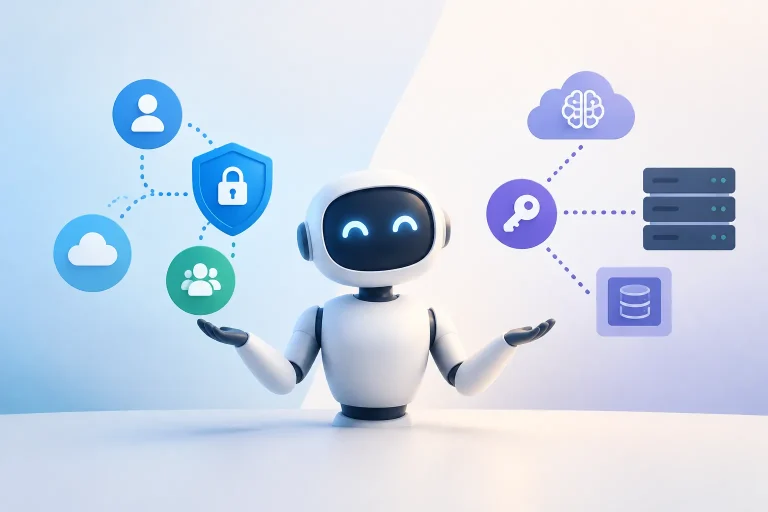
- OAuth 2.0 handles authorization—what an AI application or agent is allowed to access—while OpenID Connect authenticates and identifies the user or entity. OIDC is an identity layer on top of OAuth 2.0, so AI applications commonly use OIDC for login and user identity and OAuth 2.0 for scoped access to APIs and tools; they often use both.
- Use OIDC when the AI application must authenticate users or establish identity.
- Use OAuth 2.0 when an AI agent or application must obtain scoped, revocable access to APIs or resources.
- Use both together for a user-facing AI application that logs users in and then accesses external services on their behalf.
- Apply least-privilege scopes and appropriate token handling for agent/tool access.
OAuth 2.0 handles authorization—what an AI application or agent may access—while OpenID Connect (OIDC) authenticates the user or entity. They are different, not interchangeable: OIDC builds on OAuth 2.0; applications use OIDC for login and OAuth 2.0 for scoped API/tool access, often both.
OAuth 2.0 vs. OpenID Connect at a glance
OAuth and OIDC are different and not interchangeable. OAuth 2.0 answers, “What may this application or AI agent access?” OIDC answers, “Who authenticated?” They are generally complementary.
| Dimension | OAuth 2.0 | OpenID Connect |
|---|---|---|
| Primary purpose | Authorization: granting access to protected resources | Authentication and identity: verifying who the user or entity is |
| AI application role | Authorizes agents, applications, plugins, and tools to call APIs or access resources | Supports user login, identity, sessions, SSO, and federated identity |
| Token | An access token authorizes access to a protected resource | An ID token carries standardized identity information for the client |
| Permissions | Scopes limit the access requested or granted | Uses OAuth 2.0’s authorization foundation and adds identity information |
| Login | Not a user-authentication protocol by itself | Designed for authentication, login, and SSO |
| Relationship | Can be used independently when only authorization is needed | Builds on and depends on OAuth 2.0 |
An access token is intended for a protected API or resource. An ID token represents identity information for the client and supports authentication. Do not use an ID token as a general-purpose API authorization token.
How OIDC builds on OAuth 2.0
OAuth 2.0 provides authorization
OAuth 2.0 provides a framework for obtaining permission to access protected resources. An AI application can receive limited authorization to call an external API or tool without receiving the user’s password. It then presents the resulting access token to the protected resource according to the granted permissions.
OAuth 2.0 does not, by itself, establish who the user is. Authorization and authentication are separate responsibilities.
OIDC adds authentication and identity
OpenID Connect adds an authentication and identity layer to OAuth 2.0. An OIDC flow provides an ID token, commonly a JWT, containing standardized identity information that the application can use to support login and associate a session with the authenticated user or entity.
OIDC therefore depends on OAuth 2.0. OAuth 2.0 can be used without OIDC when an application needs resource authorization but not user authentication.
Where OIDC fits in an AI application
User login, SSO, and attribution
Use OIDC when an AI application must authenticate users or establish an entity’s identity before providing an interactive experience. It supports sign-in and supplies identity information that the application can associate with a session.
For a user-facing assistant, OIDC addresses who is using the application. It can support enterprise SSO and federated identity, while helping the application associate activity with the correct user or tenant.
OIDC establishes identity, but it does not automatically define every application permission or guarantee access to a particular resource. The application still needs its own authorization decisions and permission checks.
Where OAuth 2.0 fits in an AI application
Delegated API and tool access
Use OAuth 2.0 when an AI application or agent needs scoped access to an external API, plugin, tool, or other protected resource. A user can authorize defined access without sharing a password with the client.
For example, a user may sign in to an AI assistant through OIDC and then authorize that assistant to call a separate protected tool. The assistant’s user identity and the tool’s access permission are related, but they are not the same concern.
Scopes and non-interactive agents
Scopes limit the permissions requested or granted to an application or agent. An integration should request only the access required for its task rather than treating one broad token as permission to perform every available action.
OAuth 2.0 can also support background or autonomous processes that need authorized access to protected resources. In that model, the service or agent identity used for resource access is separate from an interactive OIDC user session. The protocol’s primary role remains the same: controlling resource access.
Which protocol should an AI application use?
| Requirement | Recommended choice | Why |
|---|---|---|
| The application needs protected API or tool access but does not need user login | OAuth 2.0 | It provides authorization and scoped resource access without adding a user-identity requirement. |
| The application must authenticate users or establish identity | OIDC on OAuth 2.0 | OIDC adds authentication and identity information to the OAuth foundation. |
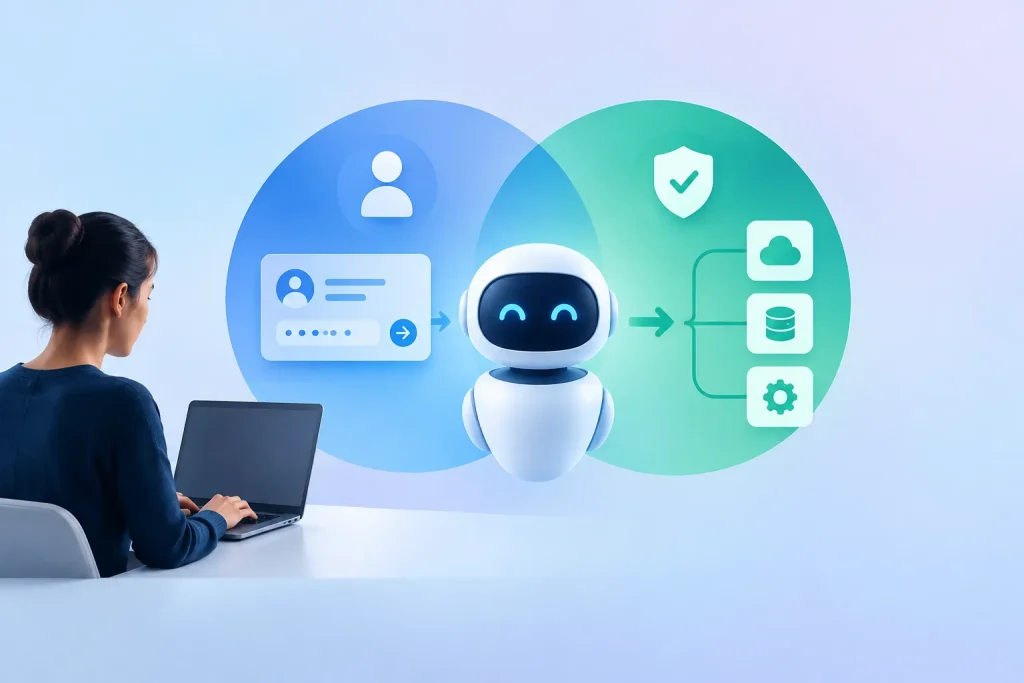
| The application must identify users and access external resources on their behalf | Both OIDC and OAuth 2.0 | OIDC handles identity; OAuth handles delegated, scoped resource access. |
| The requirement is unrelated to login or delegated access to protected resources | Neither protocol alone | Choose the mechanism that matches the actual identity or authorization requirement. |
The practical rule is simple: identity means OIDC, resource access means OAuth 2.0, and an AI application that needs both should use both.
Typical combined flow for an AI assistant
- The user signs in through an OIDC flow.
- The application receives and validates the identity information needed to establish the session.
- The user authorizes the assistant to access a protected API or tool through OAuth 2.0.
- The assistant uses the resulting access token when calling that protected resource.
- The resource or tool applies the granted scopes and its own authorization rules to each request.
This separation keeps user identity distinct from delegated resource permission. The application should not use an ID token as the credential for an API call.
AI-agent permissions and implementation safeguards
Choosing OAuth 2.0, OIDC, or both is not a complete security design. For an AI application, agent, plugin, or tool integration, verify these implementation details:
- Least-privilege scopes: request and grant only the permissions required for the task.
- Correct token purpose: use access tokens for protected-resource authorization and ID tokens for identity information.
- Token handling: protect tokens and avoid exposing them where they are not needed.
- Validation: verify relevant token properties, including issuer, audience, signature, and expiration, according to the deployment design.
- Consent and lifecycle: define how consent, expiration, and revocation are handled.
- Tool-call authorization: check authorization for each API or tool action rather than assuming that an authenticated session permits every operation.
These safeguards are implementation responsibilities; they are not provided automatically by selecting either protocol.
Enterprise context: OIDC, SAML, and SCIM
OIDC and SAML both address enterprise authentication scenarios, although they are different standards. OIDC is the identity layer commonly used alongside OAuth 2.0 in application architectures.
SCIM serves a different purpose: it provisions users and groups rather than authenticating them or authorizing an AI agent to call an API. Provisioning, authentication, and runtime resource authorization should remain separate architectural concerns. MFA, when required, is typically enforced by the identity provider rather than supplied by OAuth 2.0 or OIDC alone.
FAQ
Are OAuth and OIDC the same?
No. OAuth 2.0 is primarily an authorization framework, while OIDC is an authentication and identity layer built on OAuth 2.0. They are complementary, not interchangeable.
Can OIDC be used without OAuth?
No. OIDC depends on OAuth 2.0 because it extends the OAuth authorization framework with standardized identity information and an ID token. OAuth 2.0 can be used without OIDC when only authorization is required.
What does an OAuth access token authorize?
An OAuth access token authorizes access to a protected resource according to its permissions and scopes. It is intended for the API or resource receiving the request.
What does an OIDC ID token represent?
An OIDC ID token represents identity information for the client and supports authentication and login. It is not a general API access token.
Should an AI application use one protocol or both?
Use OIDC when the application needs user login or identity. Use OAuth 2.0 when an AI agent or application needs scoped access to APIs, tools, plugins, or other protected resources. Use both when it needs identity plus delegated access.
Final checklist: determine whether the requirement is identity, resource access, or both; choose the corresponding protocol; separate ID tokens from access tokens; limit scopes; and verify token validation, handling, expiration, revocation, consent, and authorization for every tool or API call.