


Quick decision
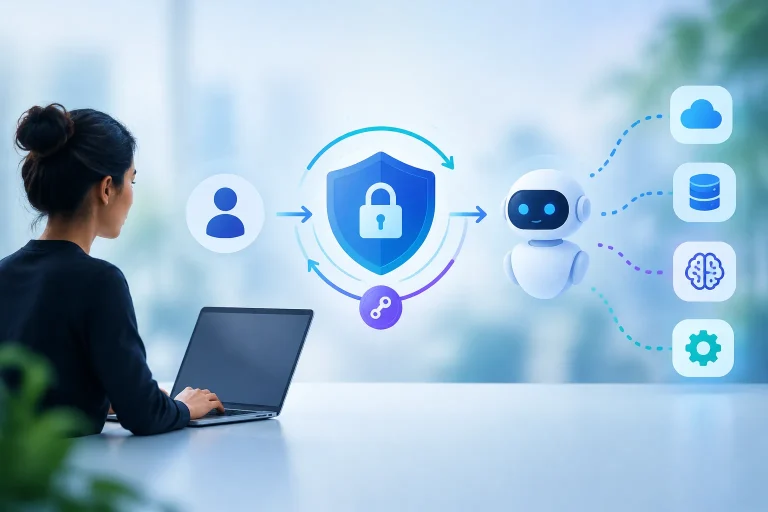
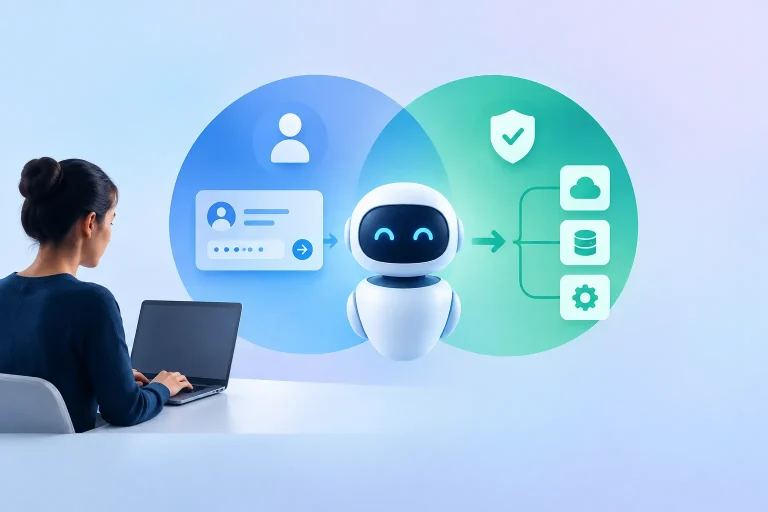
- Use OAuth 2.0/2.1 for what an AI agent is authorized to access—especially machine-to-machine calls, delegated tool access, and scoped API permissions. Use OIDC when the system must authenticate a human or entity and carry identity claims. For agents acting on behalf of users, combine them: OIDC establishes the user session or identity, while OAuth supplies scoped access tokens for APIs and tools.
- Autonomous/background agent calling APIs or tools: use OAuth client credentials or an appropriate machine-to-machine flow with narrowly scoped, short-lived access tokens.
- Agent acting for a logged-in user: use OIDC for user authentication and OAuth authorization/delegation for downstream API access.
- Downstream systems require user attribution or role-based enforcement: propagate validated identity/context through an appropriately designed token-exchange or delegation pattern, subject to provider support.
- Avoid long-lived, broad API keys; apply least-privilege scopes, token expiration, audience validation, and suitable sender-constraining or revocation controls.
Use OAuth 2.0/2.1 for an AI agent’s authorized access—especially machine-to-machine calls, delegated tools, and scoped API permissions. Use OIDC to authenticate a human or entity and carry identity claims; combine them when an agent acts for a user.
Quick comparison: OAuth or OIDC?
| Question | OAuth 2.0/2.1 | OpenID Connect |
|---|---|---|
| Primary role | Authorization: controlling access to protected resources. | Authentication and identity: establishing who a user or entity is. |
| AI-agent use | Machine-to-machine calls, tool access, APIs, and agent-to-agent workloads. | Human login, identity context, claims, and attribution when an agent acts for a user or entity. |
| Primary token | Access token, which represents authorization and may carry scopes. | ID token, which carries authenticated identity information for the client’s identity context. |
| Can it stand alone? | Often sufficient for an autonomous agent’s protected-resource access, subject to provider and resource-server support. | Not an alternative authorization protocol for API access; it is commonly paired with OAuth. |
| Relationship | Complementary, not interchangeable. OIDC is an identity layer built on OAuth 2.0 concepts. | |
OAuth answers “What may this agent access?” OIDC answers “Who authenticated?” Keeping those questions separate is essential for agent security and auditability.
Access tokens are not ID tokens
An OAuth access token is intended for a protected resource and can be limited by scopes and audience. An OIDC ID token represents authenticated identity information for the client’s login or identity context.
Do not use an ID token as the bearer credential for an API. Downstream APIs should receive an appropriate access token and validate it according to their requirements.
Which protocol should an AI-agent system use?
Autonomous or background agents: OAuth
An agent that runs independently—such as a scheduled worker, background assistant, or service that calls tools—generally needs OAuth as its primary access mechanism. Use client credentials or another machine-to-machine flow supported by the identity provider and resource server.
Issue access tokens for the intended resource and limit them to the agent’s actual responsibilities. Use narrow scopes, separate sensitive capabilities, and prefer a distinct non-human or client identity over a shared, broadly privileged credential.
Prefer short-lived, narrowly scoped tokens with explicit audience handling. Define expiration, replacement, revocation, and resource-server validation procedures. Avoid long-lived, broad API keys because they create unnecessary and persistent access if compromised.
Agents acting for signed-in users: OIDC plus OAuth
When an agent performs actions for a logged-in person, use the protocols together:
- OIDC establishes or validates the human’s authenticated identity context.
- OAuth supplies scoped authorization for downstream APIs and tools.
The agent’s non-human identity remains a separate design concern. Do not silently treat the agent and the human as the same principal. The exact consent, delegation, token, and refresh pattern depends on the identity provider, resource server, and trust relationships involved.
Human attribution and identity propagation
Some systems need to know both which human authorized an action and which agent performed it. Keep those identities distinguishable so downstream systems can apply authorization and record attribution.
Where supported, a delegation or token-exchange pattern can carry validated subject-and-actor context to another resource. Its suitability depends on provider support, token formats, trust boundaries, and resource-server behavior; it is not a universal agent flow.
Audit records should identify who authorized an action, which agent performed it, which resource was accessed, and which permissions were used. An identity claim alone does not create a complete audit trail.
OAuth alone, OIDC alone, or both?
| Agent requirement | Recommended approach | Why |
|---|---|---|
| Autonomous agent calling APIs or tools | OAuth | It provides scoped authorization for non-human access. |
| Background or agent-to-agent workload | OAuth | The core requirement is controlled access between services or resources. |
| Agent acting for a signed-in human | OIDC plus OAuth | OIDC establishes identity context; OAuth authorizes downstream actions. |
| Downstream system requires human attribution | OAuth delegation or token exchange, with OIDC context where applicable | The design may preserve subject and actor context, subject to provider support. |
| Only an identity assertion is needed by the client | OIDC | Use the identity layer for authentication, not API authorization. |
OIDC alone is not an alternative authorization protocol. OIDC is also not required for every autonomous agent. Choose based on whether the agent needs independent resource access, a human identity context, delegated permissions, or identity propagation for authorization and auditing.
Implementation safeguards
Permission and token boundaries
- Use the narrowest practical scopes and resource audiences.
- Separate read, write, administrative, and high-impact tool capabilities.
- Prefer short-lived access tokens and define renewal, revocation, replacement, and incident-response procedures.
- Ensure resource servers reject tokens intended for another resource.
- Store credentials and tokens securely, and do not expose them in logs.
Validation and negative testing
Review the issuer, audience, signature, expiry, scopes, claims, redirect handling, state, nonce, secure storage, and error behavior. Confirm that access tokens and ID tokens are handled separately.
Test expired or malformed tokens, issuer and audience mismatches, signature failures, invalid nonces, callback tampering, redirect tampering, unexpected claims, replay, and authorization failures. Successful login tests are not enough; invalid inputs must fail safely.
OAuth 2.0 and OAuth 2.1 deployment notes
Use the version and flow terminology supported by the identity provider. OAuth 2.1 support and naming may vary. For authorization-code flows, apply PKCE where supported and required; follow current provider guidance on implicit flows and confirm whether refresh-token rotation is supported or required. These deployment details do not change the OAuth-versus-OIDC decision.
MCP and protected-resource discovery
If the agent connects through an MCP server, gateway, or another tool framework, treat its authorization and protected-resource metadata as an implementation detail that must be verified for that deployment. Confirm which component acts as the client, which resource receives the access token, what issuer and audience are expected, and how scopes are configured.
Do not assume that an MCP or gateway integration changes the core rule: OAuth authorizes tool and resource access, while OIDC supplies human or entity identity when the workflow requires it. Follow the identity provider, resource server, and framework’s documented support rather than assuming a universal agent flow.
Phasing out API keys
When replacing API keys, begin by inventorying where keys are issued, stored, and used. Map each integration to an OAuth client, resource, audience, and minimum required scopes. Roll out OAuth in stages, monitor both paths during a controlled transition, set an explicit retirement date for legacy keys, and remove them after usage and failure monitoring show that migration is complete.
Practical decision checklist
- Does the agent act independently? Start with OAuth for scoped machine-to-machine or tool access.
- Does it act for a signed-in human? Use OIDC for identity context and OAuth for delegated API and tool permissions.
- Do downstream systems need human attribution? Use validated subject-and-actor context through delegation or token exchange if supported.
- What does the resource server accept? Confirm token type, issuer, audience, scopes, claims, expiration, and validation requirements.
- Are permissions bounded? Use least-privilege scopes, narrow audiences, short-lived credentials, and lifecycle controls.
- Can the system be investigated? Monitor token events, scope use, anomalies, attribution, and protected audit logs.
- Has the implementation been challenged? Review generated code and perform negative testing before production deployment.
The practical rule is direct: autonomous access points to OAuth; human identity or delegated action points to OIDC plus OAuth. Attribution and advanced delegation depend on the identity provider, resource server, and trust model.