

OAuth security for AI applications: key takeaways
- OAuth is a strong foundational authorization mechanism for AI applications because it enables delegated, scoped, and revocable access without exposing user passwords or relying on static API keys. Secure AI integrations must additionally use least-privilege permissions, appropriate flows for interactive or headless agents, protected tokens, runtime policy controls, monitoring, and rapid revocation.
- Adopt modern OAuth practices, including PKCE and exact redirect URI validation for interactive flows.
- Use least-privilege scopes or richer authorization requests instead of broad read/write grants.
- Separate user and machine identities and avoid treating autonomous agents as ordinary human sessions.
- Constrain tokens against replay and limit their lifetime and audience.
OAuth is foundational for AI security, enabling delegated, scoped, revocable access without passwords or static API keys; it is not sufficient without least privilege, protected tokens, runtime controls, monitoring, and rapid revocation.
What OAuth security means for AI applications
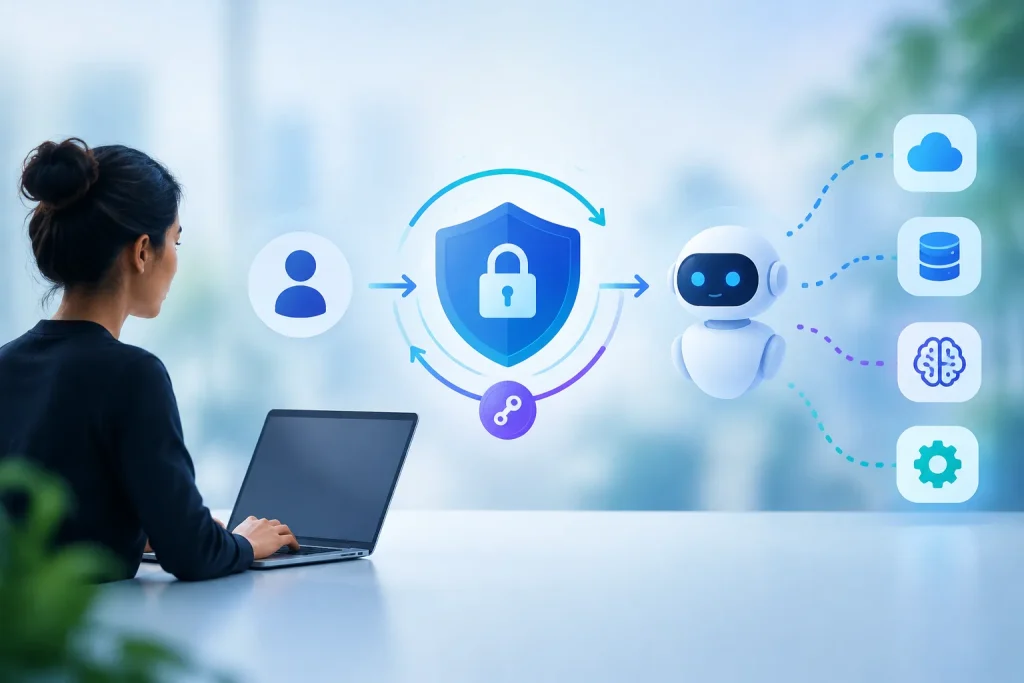
OAuth security for AI applications governs what an application or agent can do with protected APIs, tools, and SaaS services for a user or service identity. Instead of sharing a password or embedding a permanent API key, OAuth can provide access limited by scope, resource, audience, task, and lifetime.
OAuth is a foundation, not a complete security solution
OAuth primarily addresses authorization: whether a client can access a protected resource. It does not determine whether an AI-generated action is safe, prevent prompt injection, stop data exposure, or eliminate token theft and unauthorized tool use.
Authentication establishes who a human or system is. OpenID Connect adds authentication and identity capabilities on top of OAuth, while machine identity represents a service or agent operating without a human actively present. These identities should not be collapsed into one broad user session.
A secure AI deployment combines OAuth with fine-grained permissions, token protection, runtime policy enforcement, isolation or sandboxing where appropriate, monitoring, auditability, human approval for defined high-impact actions, and rapid revocation.
Delegated access versus passwords and static API keys
Delegated authorization lets an application or agent act for a user or service identity without receiving that identity’s password. This is a stronger foundation for connected AI tools than an unrestricted, reusable secret because access can be scoped, attributed, time-limited, and revoked.
Static API keys often provide less granular authorization and can be difficult to rotate, revoke, or attribute after exposure. OAuth does not remove every credential risk, but it avoids making a permanent shared secret the primary mechanism for delegated access.
Interactive copilots versus autonomous agents
The appropriate OAuth flow and identity model depend on how the AI application operates. A user-facing copilot can request consent during an interactive session. An autonomous or asynchronous agent may act later, when no user is available to approve each operation.
| Application type | Execution context | Potential identity and flow |
|---|---|---|
| Interactive copilot | A user is present and can review access | User identity with Authorization Code and PKCE, where supported and appropriate |
| Headless or asynchronous agent | Execution may occur without a user | Separate service or agent identity; Client Credentials may fit when no user is present |
| Multi-service workflow | Delegated context crosses service boundaries | Token exchange may be appropriate, subject to provider support and the architecture |
Human-triggered applications
An interactive copilot usually operates in a browser or another user-facing interface. The user can review requested access, provide consent, and remain available for sensitive decisions. Authorization Code with PKCE is generally the flow to consider for this context, with secure client registration, exact redirect URI validation, protected tokens, and narrowly defined permissions.
Headless and asynchronous agents
A headless agent may run on a schedule, respond to an event, or continue a task in the background. Browser-based consent assumptions become difficult when no user is present at execution time.
Do not copy a user’s broad identity and permissions directly into an autonomous agent. Separate human, machine, and task-specific agent identities. Client Credentials may fit a service or autonomous agent when no user is present, but it is not a universal replacement for user delegation. Define when a human must re-enter the loop.
Choosing an OAuth flow and identity model
No flow is universally correct. Select one according to the deployment context, provider capabilities, trust boundaries, and whether a human is present when the action occurs.
Authorization Code with PKCE for interactive applications
Authorization Code with PKCE is the principal flow to consider for user-facing copilots and assistants. It supports an interactive consent experience, while PKCE helps protect the authorization-code exchange. Use exact redirect URI handling and request only the permissions required for the application’s declared features.
Client Credentials for service identities or headless agents
Client Credentials can fit a service identity or autonomous agent when no user is present. Keep the resulting machine identity separate from human identities and constrain it to the agent’s task, resources, and permitted actions.
Token exchange across downstream services
Token exchange may be appropriate when delegated identity must pass across downstream services. Instead of forwarding an original token everywhere, a service can obtain a token intended for the next service and its specific audience, where the provider and trust model support that pattern.
Each receiving boundary must still validate the token and authorize the requested action. A newly issued next-hop token limits the trust boundary; it does not make downstream authorization automatic.
OAuth and OpenID Connect are not interchangeable
Use OAuth when an application needs delegated access to an API or tool. Use OpenID Connect when it also needs to authenticate a user and receive identity information. A user-facing AI application may need both, while a headless service may rely primarily on machine identity and authorization. Neither protocol replaces runtime authorization for agent actions.
The AI-specific OAuth threat model
AI applications introduce a critical risk: a system may use valid authorization to perform an action the user never intended. The token can be genuine while the agent’s decision is unsafe.
Excessive permissions and delegation depth
Broad read/write scopes, long-lived grants, shared credentials, and multiple layers of delegation increase the potential blast radius. An agent that can read every customer record and write to every connected system has more opportunity to turn one compromised instruction or workflow into a major incident.
Forwarding or reusing tokens across internal, external, downstream, or agent-to-agent boundaries can also create authorization risk. Restrict token audiences and obtain a suitably bounded next-hop token where the architecture supports it.
Prompt injection and confused-deputy behavior
Prompt injection or poisoned external data can cause an agent to misuse valid OAuth permissions. A document, web page, email, or ticket might instruct an agent to disclose sensitive data or perform an unauthorized write.
This creates a confused-deputy pattern: the agent has legitimate authority, but an untrusted instruction influences how that authority is used. OAuth cannot determine whether a generated action is safe or intended. Fine-grained tool policies, input classification, approval requirements, and runtime checks must handle that decision.
Token theft, replay, and cross-service misuse
Tokens can be exposed through logs, memory, insecure storage, compromised workloads, or overly permissive internal forwarding. A stolen bearer token may be replayed until it expires or is revoked. Long-lived credentials increase both the exposure window and the potential impact.
Least-privilege authorization for tools and APIs
OAuth permissions should describe what the agent needs to do, not everything the connected user could possibly do.
- Prefer narrow, action-specific permissions over broad reusable read/write grants.
- Restrict access by resource and audience, not only by a general scope.
- Separate credentials by task, agent, environment, and service where practical.
- Use short-lived or just-in-time authorization for sensitive or temporary work where appropriate.
- Keep autonomous agents separate from a user’s broad identity and permissions.
An agent that summarizes invoices may need invoice-reading authority. That does not automatically justify disputing invoices, changing payment details, or sending financial instructions.
Policy beyond token claims
Token claims can express identity and delegation context, but dynamic business rules should remain in authorization policy. A policy layer can evaluate the requested action, resource, transaction context, risk signals, and task state instead of trusting a token alone.
Richer authorization requests can provide more precise permission descriptions in some deployments, but their availability and implementation must be checked against the identity provider and resource server.
Gateways, tool layers, and MCP-mediated access
An API gateway, tool layer, or MCP-mediated integration can be a separate enforcement boundary between the agent and downstream services. It should validate the incoming token, apply tool- and resource-level policy, and avoid passing broader authority than the requested operation requires.
Whether a gateway issues a bounded next-hop token or forwards delegated context depends on the architecture and provider support. In either pattern, the downstream API must perform its own authorization checks rather than trusting the tool layer alone.
Protecting the token lifecycle
Short-lived and revocable credentials
Use expiring, short-lived, or just-in-time credentials where appropriate. Limit refresh and session lifetimes according to the task’s risk, and maintain deliberate procedures for expiration and revocation.
Store tokens securely, keep them out of logs and prompts, and limit which components can access them. Treat refresh tokens and other long-lived credentials as high-value assets.
Audience restriction and request validation
Receiving APIs should reject tokens that were not intended for them. They should validate the token signature, expiration, audience, scopes, relevant claims, replay conditions, rate limits, and request inputs.
A valid signature does not prove that a particular operation is authorized. The API or gateway should also evaluate whether the agent, resource, action, and business context are permitted.
Sender-constrained tokens
DPoP or mutual TLS can sender-constrain tokens and reduce replay risk if a token is stolen, where the relevant clients, authorization servers, and APIs support them. These are conditional controls, not universal requirements, and they do not replace least privilege or runtime policy.
OAuth implementation baseline
New integrations should consider modern OAuth security practices, including:
- Using PKCE for interactive authorization-code flows.
- Validating redirect URIs exactly rather than accepting broad patterns.
- Registering clients securely and protecting client credentials.
- Selecting a flow that matches whether the client represents a user, service, or autonomous agent.
- Avoiding insecure or deprecated flows and deployment patterns.
These controls strengthen the OAuth implementation, but they do not address every agent-runtime risk. PKCE cannot determine whether a prompt is malicious, and redirect URI validation cannot prevent an authorized agent from making a harmful tool call.
Human approval and step-up authorization
Automation should not treat every permitted action as equally safe. Define when an agent must pause for approval or obtain stronger, renewed authorization.
Low-risk reads versus high-impact writes
Destructive, financial, bulk, or sensitive-data operations may require explicit human approval or step-up authorization. The decision can depend on the resource, amount, target, business context, and risk signals.
For example, an invoice agent with invoices:read permission could summarize invoices. Before disputing one, it might require renewed invoices:write authorization and explicit user approval. This separates low-risk summarization from a consequential financial action; each organization must define its own thresholds.
Passkeys as optional human anchoring
Passkeys can provide a phishing-resistant way for a person to authenticate or confirm a high-consequence action. They can complement OAuth when an agent needs human authorization for a sensitive operation, but they do not replace OAuth delegation, least-privilege permissions, token protection, or runtime controls.
Runtime enforcement and tool-layer controls
OAuth establishes a delegation foundation; tool and API layers must still enforce what the agent can do at runtime.
Fine-grained policy and API gateways
Use policy engines, API gateways, and service-level authorization checks to evaluate the requested tool, target resource, action, and business context. Policies should distinguish reading a record from modifying it, a single action from a bulk operation, and an approved task from an unexpected instruction.
Isolation, sandboxing, and runtime validation
Isolation or sandboxing can limit what an agent process can reach. Runtime validation can inspect tool arguments, destination resources, input provenance, and policy signals before execution. These controls complement OAuth; they do not guarantee that prompt injection or unauthorized actions will never occur.
Monitoring, auditability, and governance
Inventory and behavioral monitoring
Maintain an inventory of agent connections, tokens, scopes, identities, tools, and downstream services. Monitor behavior for unusual access patterns, unexpected tool calls, scope escalation, replay indicators, and activity outside the agent’s normal task.
Monitoring should cover what the agent does, not only whether a token was successfully issued.
Agent-aware audit records
Record enough context to reconstruct an action, including:
- The human, service, and agent identities involved.
- The action, target resource, and downstream service.
- The scopes, audience, and authorization context used.
- The relevant tool request and execution result.
- Approval or step-up decisions and significant anomalies.
Token-level records alone may not explain why an agent made a decision. Auditability must connect authorization with the agent, action, target, and execution context.
Revocation and incident response
Expiration and revocation procedures
Prepare procedures to revoke access, expire sessions, disable compromised agent credentials, and disconnect affected downstream services. Provider-specific behavior for refresh-token revocation, connection removal, and session invalidation should be tested before deployment.
Emergency access disablement
Maintain a rapid mechanism to disable active agent access when misuse, replay, or anomalous behavior is detected. The response should identify affected tokens, services, agents, users, and trust boundaries rather than stopping only the first visible request.
After containment, review authorization context and activity records to determine whether tokens were reused, permissions were excessive, or prompt injection influenced the action. Reduce privileges and update runtime controls before restoring access.
Practical OAuth security checklist
- Define whether the application is an interactive copilot, a headless agent, or a service workflow.
- Separate human, machine, and task-specific agent identities.
- Choose Authorization Code with PKCE, Client Credentials, token exchange, or another supported pattern according to the deployment context.
- Use narrow, action-specific, resource- and audience-restricted permissions.
- Prefer short-lived, expiring, and revocable credentials where appropriate.
- Protect tokens in storage, memory, logs, prompts, and service-to-service communication.
- Consider DPoP or mutual TLS for sender constraint where supported.
- Validate signatures, expiration, audience, scopes, claims, replay conditions, rate limits, and request inputs.
- Use gateways, policy engines, isolation, sandboxing, and runtime tool controls alongside OAuth.
- Require approval or step-up authorization for destructive, financial, bulk, or sensitive-data actions.
- Monitor agent behavior and maintain audit records for users, agents, actions, targets, and authorization context.
- Test rapid revocation, emergency disablement, and downstream connection shutdown procedures.
Final architecture principle
A defensible design separates identity and delegation at the OAuth layer, limits capability through least-privilege permissions, protects and constrains tokens, evaluates every tool action at runtime, requires human approval for defined high-impact operations, and records enough context for investigation.
OAuth security for AI applications starts with OAuth as the authorization and delegation foundation—not the complete security architecture. Secure deployments depend on layered permissions, protected token lifecycles, runtime enforcement, monitoring, human oversight where appropriate, and rapid revocation.