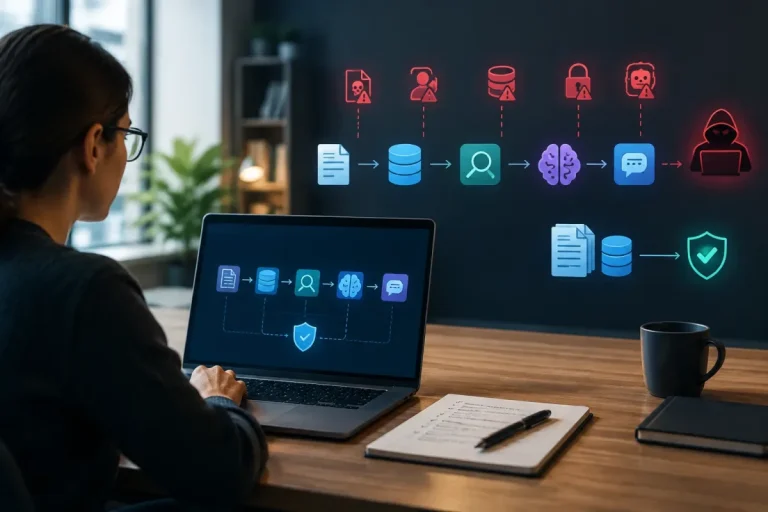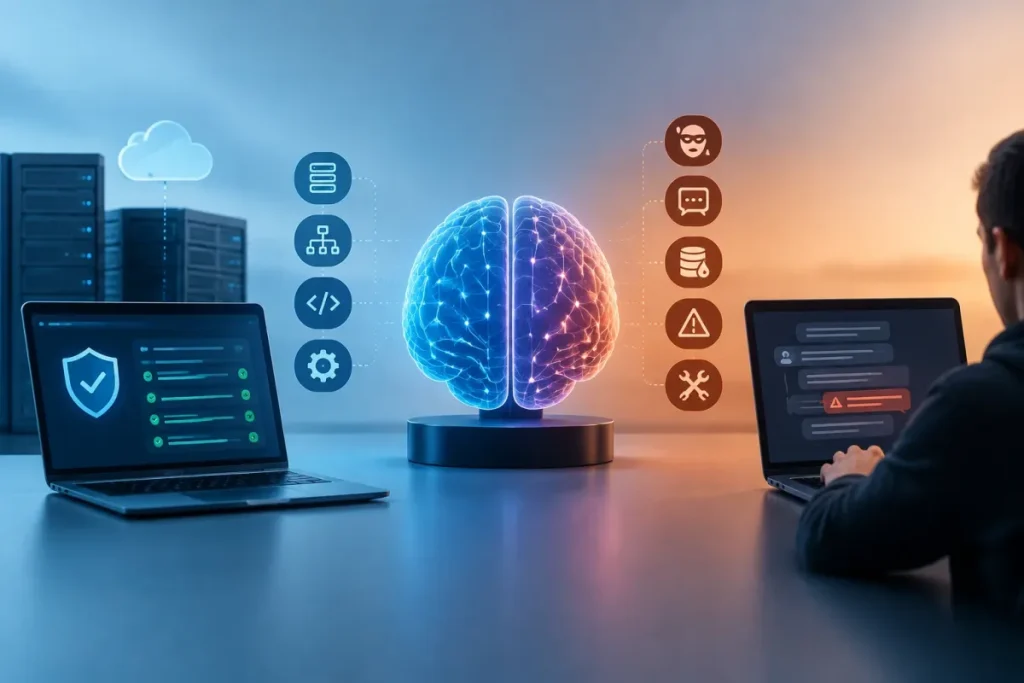

At a glance
- AI red teaming and vulnerability scanning serve different, complementary purposes: vulnerability scanning automates broad checks for known technical weaknesses in infrastructure and software, while AI red teaming uses adversarial, often human-guided testing to expose AI-specific behavioral, security, and safety failures. Scanning should not be treated as a substitute for testing the AI system itself, and AI red teaming does not replace baseline infrastructure scanning.
- Use vulnerability scanning for continuous baseline hygiene of servers, networks, dependencies, code, and configurations.
- Use AI red teaming before and after deployment to test prompt injection, jailbreaks, data leakage, unsafe outputs, tool misuse, and other model or application behaviors.
- Combine both in an AI security program because infrastructure security and AI behavior require different testing approaches.
- The difference is direct: scanning checks technical assets, while red teaming tests AI behavior.
AI red teaming and vulnerability scanning serve different, complementary purposes: vulnerability scanning automates broad checks for known technical weaknesses in infrastructure and software, while AI red teaming uses adversarial, often human-guided testing to expose AI-specific behavioral, security, and safety failures. Scanning should not be treated as a substitute for testing the AI system itself, and AI red teaming does not replace baseline infrastructure scanning.
A complete AI security program uses both practices at different layers: scanning for technical hygiene and AI red teaming for the behavior and resilience of models, applications, agents, RAG pipelines, and connected tools.
AI Red Teaming vs. Vulnerability Scanning at a Glance
| Dimension | Vulnerability scanning | AI red teaming |
|---|---|---|
| Primary target | Infrastructure, networks, software, dependencies, and configurations | AI models, LLM applications, agents, RAG and data pipelines, prompts, APIs, outputs, and connected tools |
| Primary method | Automated checks for known weaknesses, missing patches, exposed services, and configuration issues | Adversarial prompts, threat scenarios, chaining, adaptive probing, and manual or automated evaluation |
| Typical findings | Potential technical weaknesses that require review, validation, and remediation | AI-specific behavioral, security, and safety failures, including misuse paths and control weaknesses |
| Coverage | Depends on asset inventory, technical visibility, signatures, and identifiable weaknesses | Depends on threat modeling, scenario selection, scope, adaptability, and test depth |
| Best use | Continuous or recurring baseline hygiene | Pre- and post-deployment evaluation of AI behavior and resilience |
AI red teaming is broader and more goal-driven than a routine vulnerability scan, but it is not simply an automated scan. The two practices are complementary, not interchangeable.
What Is Vulnerability Scanning?
Vulnerability scanning is generally an automated, broad-coverage process for identifying potential technical weaknesses across systems, networks, software, configurations, and related infrastructure. Common findings include missing patches, insecure settings, exposed services, and other detectable weaknesses.
Targets and scope
A scan may cover:
- Servers, endpoints, networks, and other infrastructure
- Software, dependencies, and applications
- System and cloud configurations
- Unpatched software and insecure settings
- Technical assets that support an AI application
The output is usually a structured inventory of potential weaknesses. Security teams can then review, prioritize, validate, and remediate those findings. A scan result is not automatically proof that every finding is exploitable or relevant; professional review may be necessary, and false positives can occur.
What vulnerability scanning does not test
Scanning the infrastructure that supports an AI application does not comprehensively evaluate the application’s model behavior. It should not be treated as a complete assessment of:
- Prompt-injection resilience or jailbreak resistance
- Data leakage through model responses
- Unsafe or harmful outputs
- Hallucination-related behavior
- Agent decisions and connected-tool misuse
In short, vulnerability scanning answers whether technical assets have identifiable weaknesses. It does not establish whether the AI system behaves safely under adversarial or unexpected conditions.
What Is AI Red Teaming?
AI red teaming is structured, authorized adversarial testing of AI and machine-learning systems. It uses realistic attack or misuse objectives to evaluate how an AI system behaves, whether its controls work, and how resilient it is under pressure.
AI systems and components in scope
Depending on the assessment scope, AI red teaming can examine:
- Foundation models and other AI models
- LLM applications and user-facing interfaces
- Agents and their connected tools
- Prompts, APIs, and application logic
- Retrieval-augmented generation (RAG) and data pipelines
- Application outputs and related AI attack surfaces
This broader view matters because an AI failure can originate in the model, its instructions, retrieved data, surrounding application, or connected tools.
Methods and failure modes
AI red-team assessments may use adversarial prompts, threat scenarios, chaining, adaptive probing, and manual or automated evaluation. High-level, authorized scenarios can test for:
- Prompt injection and jailbreak attempts
- Data leakage
- Harmful or unsafe outputs
- Hallucinations and unreliable responses
- Model-related weaknesses
- Agent misuse and unsafe tool actions
The goal is not merely to find a technical defect. It is to determine whether a user or attacker can produce unacceptable behavior, bypass a safeguard, reveal information, misuse a tool, or create a harmful path through the AI application.
Because AI systems can produce probabilistic outputs, reproducing a result and defining a pass-or-fail condition may be more difficult than in conventional technical testing. Coverage therefore depends on the selected scenarios, threat scope, adaptability, and depth of assessment.
How Their Objectives and Methods Differ
The practices differ in what they are designed to determine:
- Vulnerability scanning asks: Which assets have identifiable technical weaknesses that require attention?
- AI red teaming asks: Can a realistic user or attacker cause the AI system to behave unsafely, reveal information, misuse a tool, bypass a safeguard, or fail under a defined threat scenario?
Vulnerability scanning uses repeatable checks across many assets. Its coverage is shaped by the asset inventory, available technical visibility, signatures, and the weaknesses the scanner can identify.
AI red teaming is more adaptive and objective-driven. Testers design scenarios around realistic misuse or attack goals, probe the system’s behavior, and may chain multiple conditions to understand how a failure occurs. Automation can improve breadth and repeatability, while human judgment helps interpret behavior and pursue meaningful outcomes.
A clean scan does not show that an AI application resists prompt injection or jailbreaks. Likewise, a successful AI red-team assessment does not show that the application’s servers, dependencies, networks, or configurations are free of technical weaknesses.
What Each Approach Finds—and Misses
Vulnerability scanning: technical exposure
Scanning is strongest at broad discovery of concrete, detectable technical issues. It can provide visibility into the systems and configurations supporting an AI application and identify weaknesses that belong in routine remediation workflows.
Its main limitation is scope. A scanner may identify a weakness in the environment without showing how the model responds to adversarial instructions or whether an agent will use a connected tool inappropriately.
AI red teaming: behavioral and AI-specific risk
AI red teaming is designed to expose probabilistic, emergent, or AI-specific failures that may not appear as conventional infrastructure weaknesses. It can reveal unsafe outputs, data leakage, misuse paths, control bypasses, and unsafe agent behavior. For a focused treatment of this risk, see our guide to AI agent tool misuse.
Its limitation is different: no finite assessment covers every possible scenario. Results depend on the threat model, test cases, system access, assessment depth, and the behavior examined.
Why the coverage boundaries matter
Neither approach provides universal coverage. Scan coverage depends on asset inventory, technical visibility, signatures, and identifiable weaknesses. AI red-team coverage depends on threat modeling, scenario selection, scope, adaptability, and test depth. Findings from one approach should not be assumed to replace or fully represent findings from the other.
When to Use Each Practice
Use vulnerability scanning for continuous baseline hygiene
Use vulnerability scanning for recurring visibility across servers, networks, dependencies, code, configurations, and other technical assets. It is appropriate for identifying concrete weaknesses that should be reviewed and addressed as part of routine security operations.
Use AI red teaming before and after deployment
Use AI red teaming before deployment, after deployment, and when significant AI components, controls, or use cases change. It is appropriate for testing prompt injection, jailbreaks, data leakage, unsafe outputs, hallucination-related behavior, agent misuse, detection, response, and resilience.
Where AI pentesting fits
AI pentesting is a related activity with a narrower emphasis on validating whether selected weaknesses can be exploited in an authorized assessment. Vulnerability scanning focuses on broad weakness identification. AI red teaming is more goal-driven: it evaluates whether realistic misuse or attack scenarios can produce unacceptable AI behavior or outcomes.
The activities can overlap, but they are not interchangeable. The appropriate sequence depends on whether the immediate need is technical visibility, exploit validation, or deeper evaluation of AI behavior and resilience.
Recommended Combined Workflow
1. Establish technical visibility
Begin with broad vulnerability scanning across the infrastructure and software supporting the AI system. Address concrete technical weaknesses and confirm that relevant assets are within the assessment scope.
2. Conduct the AI assessment
Use authorized AI red teaming against the relevant models, applications, agents, RAG and data pipelines, prompts, APIs, outputs, and connected tools. Define scenarios around realistic security, safety, misuse, detection, response, and resilience objectives. For a structured assessment workflow, see our AI security risk assessment guide.
3. Remediate and retest
Remediate confirmed technical weaknesses and AI-specific behavioral findings. Retest under relevant conditions to determine whether the controls work and whether changes introduced new problems.
| Stage | Primary activity | Purpose |
|---|---|---|
| Visibility | Vulnerability scanning | Identify broad, detectable weaknesses across technical assets. |
| AI assessment | AI red teaming | Evaluate adversarial behavior, misuse paths, safety, detection, response, and resilience. |
| Closure | Remediation and retesting | Verify that fixes address the findings under relevant conditions. |
All testing should be authorized and conducted within defined boundaries for systems, data, scenarios, and reporting.
Choosing Tools and Defining Scope
There is no universal best tool for AI red teaming. Selection should follow the system’s scope and risk rather than a generic product ranking. For additional tool-selection context, see our comparison of AI agent security tools.
Useful selection criteria include:
- Support for the relevant models, LLM applications, agents, and APIs
- Coverage of the AI risks and scenarios in scope
- A practical balance of automation and adaptive assessment
- Ability to assess connected applications, data pipelines, and tools
- Quality of evidence, reporting, and remediation guidance
- Integration with existing security and governance processes
- Authorization, access control, auditability, and retesting support
For vulnerability scanning, selection should reflect asset visibility, coverage of the technical environment, reporting quality, and how findings will be reviewed and remediated.
Conclusion: Use Both at Different Layers
AI red teaming and vulnerability scanning address different layers of AI security. Vulnerability scanning supplies broad technical visibility across infrastructure and software. AI red teaming evaluates AI-specific behavior, misuse, safety, detection, response, and resilience.
Use scanning for ongoing baseline hygiene and AI red teaming before and after deployment or when AI-specific risks change. Then remediate and retest. Neither practice fully replaces the other, so an effective AI security program may need both.