
AI Agent vs. AI Model: At a Glance
- An AI model is the underlying component that processes data and generates outputs, whereas an AI agent is a goal-oriented system that uses one or more models together with tools, state or memory, planning, and execution logic to complete tasks. The model primarily answers or predicts; the agent can decide what steps to take and act on the result.
- AI models and AI agents differ in role, initiative, planning, memory or state, tool use, and output.
- The model is the engine or brain, while the agent is the driver or complete task-executing system.
- A chatbot can use an AI model without being a fully autonomous agent.
- An AI model provides the prediction, generation, or reasoning component.
An AI model is the underlying component that processes data and generates outputs. An AI agent is a goal-oriented system that uses one or more models with tools, state or memory, planning, and execution logic to complete tasks. A model answers or predicts; an agent can decide steps and act.
AI Agent vs. AI Model: At a Glance
- AI model: Processes inputs to generate predictions, classifications, recommendations, or content.
- AI agent: Adds goals, planning, tools, state, and execution capabilities around one or more models.
- Main difference: Models are generally reactive, while agents can coordinate multi-step work toward a goal.
- Relationship: An agent commonly uses a model; it does not replace the model.
What Is an AI Model?
An AI model is the computational component that processes an input and produces an output. Depending on its design, that output may be a prediction, classification, recommendation, response, piece of text, image, or another generated result.
AI models are generally reactive: they respond to prompts, data, or other inputs. They can analyze information, generate content, or provide a recommendation, but the model itself is not necessarily responsible for deciding the broader objective or carrying out later actions.
In a model-based workflow, information is sent to the model and its output is passed to a person or another system. The model supplies the generation, prediction, or reasoning component; it is not necessarily the complete task-executing application.
Training and inference
During training, a model learns patterns from data and stores what it has learned in its parameters. Inference is the process of using that trained model to produce a prediction or response from new input. These functions explain what the model does, but they do not by themselves give it goals, tools, or authority to take external actions.
What Is an AI Agent?
An AI agent is a broader, goal-directed software system. It commonly combines one or more AI models with instructions, planning, orchestration, tools, memory or state, and execution logic.
Planning, tools, and execution
Rather than only responding to an individual input, an agent can pursue a high-level goal and break it into smaller steps. Depending on its design, it may select a tool or API, retrieve information from a connected system, evaluate an intermediate result, and continue through a multi-step workflow.
Tools may include external software, databases, browsers, APIs, or other connected systems. These capabilities allow an agent to do more than generate an answer: it can use the answer to select a next step and carry out permitted actions.
Memory, state, and oversight
Agents may use memory or state to preserve information across steps, but this is not implemented identically in every system. Autonomy also varies. An agent may request approval before an external action, operate within defined limits, or escalate a task to a person.
“Autonomous” does not mean unlimited independent operation. It means the system can take a greater role in choosing and coordinating steps toward a goal than a model responding to an isolated input.
How AI Models and AI Agents Work Together
The model is the engine; the agent is the driver
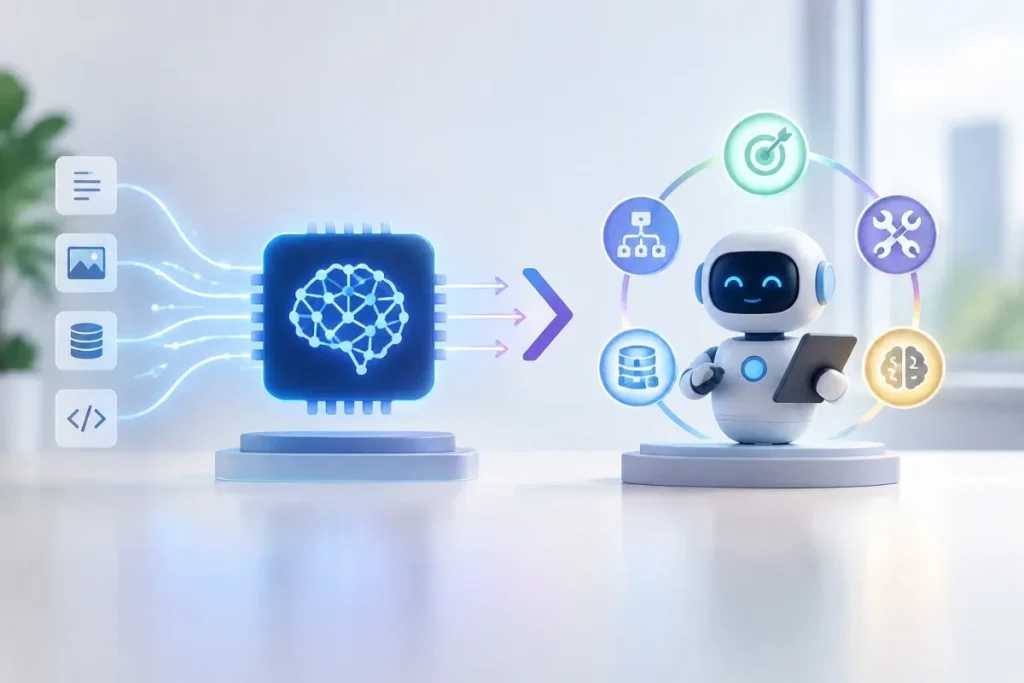
A useful analogy is that the AI model is the engine or brain, while the AI agent is the driver or complete task-executing system. The analogy is not a technical definition, but it captures the relationship: the model supplies generation, prediction, or reasoning, while the agent adds goals, orchestration, planning, tools, and action.
An agent commonly incorporates a model rather than replacing it. A single agent may use one model or coordinate multiple models, depending on its design. The surrounding software determines how the system handles goals, chooses steps, accesses tools, maintains state, and executes actions.
A chatbot can use an AI model without being a fully autonomous agent. If it receives a prompt and returns a response, the model is performing the central task. Additional planning, tool use, state management, and execution capabilities may make the application part of an agentic workflow.
A simple system structure
- Model: Generates, predicts, classifies, or reasons from an input.
- Agent capability: Adds a goal, instructions, planning, state, tool selection, and execution logic.
- Agentic application or system: Coordinates those capabilities within a broader workflow, with permissions and human oversight where required.
Some systems use a coordinating agent alongside specialized agents that perform bounded tasks. Defined interfaces, permissions, shared state where appropriate, and escalation rules help control that coordination. Terminology and implementation vary across vendors and products.
AI Agent vs. AI Model: Side-by-Side Comparison
| Dimension | AI model | AI agent |
|---|---|---|
| Role | Processes inputs and generates predictions, classifications, responses, or other outputs. | Uses one or more models within a broader system designed to achieve a goal. |
| Initiative | Generally reactive to a prompt, input, or request. | Can take greater initiative in deciding which steps to pursue toward a goal. |
| Goal orientation | Produces an answer or prediction for a given input. | Works toward a high-level objective and can decompose it into tasks. |
| Planning | Planning is not necessarily part of the model’s role. | Can plan, coordinate, and revise a multi-step workflow, depending on implementation. |
| Output versus action | Primarily generates an output for a person or another system to use. | Can use outputs to select next steps and carry out permitted actions. |
| Tools and APIs | Does not inherently provide external tool or API orchestration. | May select and use tools, APIs, or connected systems as part of a task. |
| Memory or state | May process the context provided to it. | May maintain or use state across steps, although the form and persistence vary. |
| Execution | Usually stops at producing a prediction or response for the surrounding workflow. | Can coordinate and execute multiple steps within defined permissions. |
| Human oversight | Often reviewed as an output, depending on the application. | May require approvals, monitoring, escalation, and boundaries before or during actions. |
| Best fit | Focused prediction, classification, recommendation, or content-generation tasks. | Complex workflows involving coordination, tool use, planning, and action. |
A Practical Example
Drafting an email versus completing a follow-up task
Consider a business communication task:
- Model-based task: An AI model drafts an email from instructions and information supplied in the prompt. A person or another application decides whether to edit, approve, and send it.
- Agent-based workflow: An AI agent could be configured to identify relevant messages, determine which follow-ups are needed, draft replies, and send permitted follow-ups through connected tools, subject to the workflow’s permissions and approval rules.
The second system is not an agent instead of a model. It is an agent using one or more models as part of a larger workflow. Human approval or escalation can remain part of the process, especially when an action affects a person or an external system.
AI Agent vs. Agentic AI
Agentic AI generally refers to a broader architecture or operating concept in which systems pursue goals, coordinate steps, use tools, and take action. An AI agent is an individual software component or application operating within that broader system.
The terms are related but not interchangeable. A system may contain one agent, several specialized agents, or an agentic coordinator that assigns bounded tasks to other components.
When to Use an AI Model or an AI Agent
Model-based workflows are a practical fit when the task is well defined and the desired result is a prediction, classification, recommendation, or generated response. Examples include producing a response draft or categorizing incoming support requests. To explore higher-autonomy systems in more detail, read the autonomous AI agent guide.
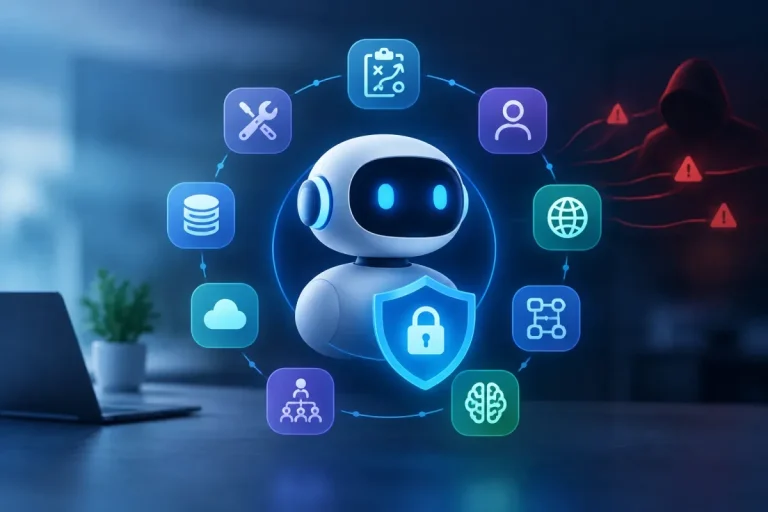
AI-agent workflows are more appropriate when the work requires several coordinated steps, tool use, planning, or action. Examples include customer-support workflows that combine retrieval and routing, research workflows that organize information-gathering steps, and IT workflows that coordinate investigation with permitted response actions. For a focused look at the risks of unsafe tool use, read about AI agent tool misuse risks.
These are use-case categories, not guarantees that every product labeled an agent can perform all of these actions. Capabilities, permissions, tools, and oversight depend on the implementation.
Limitations and Governance
The ability to plan and act creates additional governance needs. Organizations using agents should consider:
- Privacy: What information the system can access and how it is handled.
- Security: How tools, APIs, credentials, and connected systems are protected.
- Unintended actions: What could happen if the system misunderstands a goal or selects an unsuitable step.
- Oversight and escalation: When a person must approve, review, or take over.
- Monitoring and auditing: How actions, decisions, and system behavior are recorded and evaluated.
A model may be the right choice when a person or a defined workflow should control the next step. An agent can be useful for complex, multi-step work, but it should operate within clear permissions, monitoring, and human escalation rules. For practical controls around permissions, monitoring, and escalation, see the AI agent governance guide.
Frequently Asked Questions
Does an AI agent use an AI model?
Usually, yes. An agent commonly uses one or more AI models for generation, prediction, or reasoning, then adds planning, tools, state, orchestration, and execution logic around them. For a closer comparison, see AI agent vs. LLM differences.
Can an AI model act on its own?
An AI model can produce an output in response to an input, but it is not inherently a goal-directed system that chooses and executes a broader sequence of actions. That behavior belongs to the surrounding application or agent architecture.
Are AI agents and AI models interchangeable terms?
No. A model is an underlying computational component, while an agent is a broader system that may use models to pursue goals and complete multi-step work.
What is the main difference in one sentence?
An AI model generates or predicts; an AI agent uses models and surrounding capabilities to plan and act toward a goal.
Bottom Line
An AI model is the prediction, generation, or reasoning component. An AI agent is a broader goal-oriented system that commonly combines one or more models with planning, tools, state, orchestration, and execution. Models are generally reactive, while agents can coordinate multi-step work and act within defined permissions.
Use a model-based workflow for focused, well-defined tasks. Consider an agentic system when the work requires coordinated steps, external tools, and permitted action—but keep privacy, security, monitoring, auditing, and human oversight in the design.