
AI-agent inventory in brief
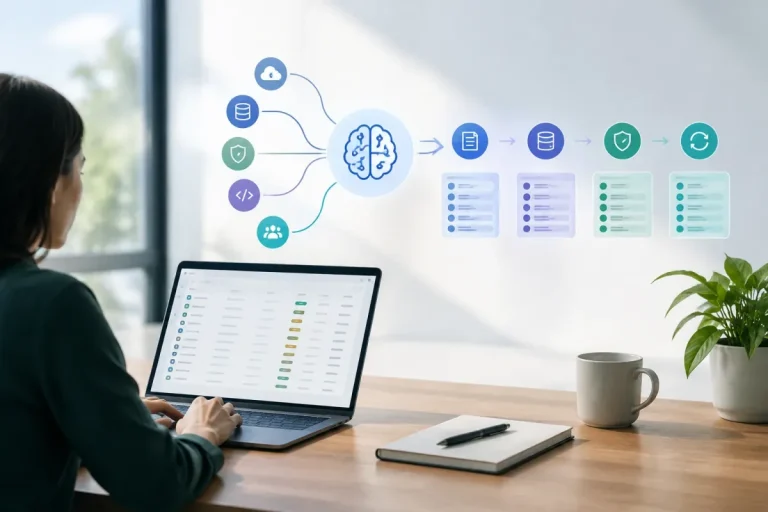
- Inventory AI agents by establishing a centralized agent registry, discovering both sanctioned and shadow agents, recording ownership, purpose, autonomy, models, integrations, data access, credentials, and permissions, then continuously monitoring and updating the registry with registration and access controls.
- Build a structured centralized registry or catalog.
- Use security, API-gateway, identity, and observability telemetry to discover and monitor agents.
- Adopt a mandatory registration and approval gate for production deployment.
- Assign accountable business and technical owners and define shutdown or rollback responsibility.
Inventory AI agents by establishing a centralized registry, discovering sanctioned and shadow agents, recording ownership, autonomy, models, integrations, data access, credentials, and permissions, then continuously updating the registry with registration and access controls.
What an Organization-Wide AI-Agent Inventory Must Do
An organization-wide AI-agent inventory is a current operational record of the agents used across the business, what they can do, what they can access, and who is accountable for them. It is not merely a list of approved tools or a one-time spreadsheet.
The centralized registry should be the single source of truth. Include approved agents, pending deployments, active and paused agents, retired records, and potentially unmanaged or shadow agents discovered across business units, applications, cloud environments, APIs, and identity systems.
1. Define the Inventory Scope
Include every agent and environment
Define what qualifies as an AI agent in your organization. Include software that interprets a goal, makes decisions, calls tools, accesses systems, or takes actions with limited human intervention.
Scope the inventory across:
- Business units, departments, workflows, and applications
- Cloud environments and hosted workloads
- Internal and external applications
- APIs, tool connectors, and MCP servers
- Service accounts and other non-human identities
- Automation, workflow, and developer platforms
- Connected data stores and enterprise systems
Include every lifecycle stage: pending, active, paused, and retired. Also include agents that are unapproved or discovered outside the normal deployment process.
Separate sanctioned and shadow agents
Mark each record as a sanctioned agent or a shadow or unmanaged agent. A shadow agent may run through a team application, cloud account, API key, or service identity without appearing in the official catalog.
Do not delete an unapproved finding. Create a provisional record, investigate it, and assign one of these outcomes: register, restrict, remediate, or retire.
2. Build the Centralized Agent Registry
Create a structured registry or catalog rather than relying on disconnected spreadsheets, tickets, or team documentation. Every AI agent should have one authoritative record that can be updated as its design, integrations, and access change.
Minimum AI-agent registry schema
| Category | Fields to record |
|---|---|
| Identity | Unique agent identifier, name, environment, deployment location, and lifecycle status |
| Ownership | Named business owner, technical owner, operating team, and escalation contact |
| Purpose | Business purpose, supported process, intended users, and deployment date |
| Classification | Agent type, operating model, readiness level, and scope |
| Authority | Autonomy level, permitted actions, boundaries, approval requirements, and human-oversight points |
| Model and hosting | Model and version, hosting environment, runtime, and relevant configuration |
| Integrations | Tools, APIs, MCP servers, applications, workflows, and connected systems |
| Data access | Data stores, data types, read or write capability, sensitivity, and geographic or environment scope |
| Identity and permissions | Credentials, service accounts, IAM roles, API keys, scopes, and other permissions |
| Lifecycle and review | Status, last review date, next review date, change history, shutdown plan, and rollback owner |
Keep sensitive credentials and secrets in an approved secrets-management system rather than copying secret values into the registry. Document the credential or identity relationship without exposing the credential itself.
Give each record a stable identity so changes can be tracked when an agent changes models, tools, or hosting. Keep retired records for historical and accountability purposes, including when the agent was disabled and whether its credentials, connectors, and permissions were removed or transferred.
3. Discover Agents Across the Organization
Discovery should combine business-process reviews with technical evidence. No single source will reliably identify every sanctioned and shadow AI agent. For practical methods to identify unmanaged AI use, see the shadow AI discovery checklist.
Start with business-process discovery
Ask each department and application owner to identify workflows where software interprets requests, makes decisions, invokes tools, or takes actions. Map the systems involved, manual handoffs, connected data, process owners, and responsible teams.
This pass reveals agents that may not be labeled consistently across departments. Follow it with technical discovery so declared deployments can be compared with actual identities, workloads, connectors, and activity.
Use multiple discovery sources
- Business-unit and application-owner reviews
- Cloud workload and deployment records
- Application inventories and software catalogs
- API gateways and integration platforms
- Identity and access-management systems
- Security telemetry and non-human identity records
- Observability data, runtime logs, and workflow activity
- Source repositories, infrastructure-as-code, and deployment pipelines
- Model, tool, connector, and API usage records
Look for agent-like behavior as well as explicit agent labels. Signals include automated model calls, repeated tool invocation, service accounts initiating workflows, new connectors, and permissions that allow an application to read or change enterprise data.
Reconcile findings with the registry
For every finding, determine whether it matches an existing record. If it does, update the record with the new integration, identity, permission, or runtime detail. If it does not, create a provisional record and assign an owner for investigation.
Classify each finding as registered, duplicate, inactive, unauthorized, or requiring review. This step prevents technical alerts from becoming a second disconnected inventory.
4. Assign Ownership and Accountability
Assign both a business owner and a technical owner where practical. The business owner is accountable for the agent’s purpose, outcomes, and continued need. The technical owner is responsible for implementation, maintenance, integrations, permissions, and operational changes.
Do not accept a department or generic team name as the only owner. Identify a person or accountable role that can answer questions, approve changes, and coordinate remediation.
Define shutdown and rollback responsibility
Document who can pause or shut down the agent, revoke its identities and credentials, and execute rollback if an integration or automated action causes a problem. Define these responsibilities before production use.
5. Document Authority, Access, and Risk
Record autonomy and human approval
Record the agent’s autonomy level in operational terms. State whether it only recommends actions, prepares changes for approval, or can execute permitted actions without approval at each step.
Document:
- Actions the agent is allowed to take
- Actions that are prohibited
- Events that require human approval
- Spending, volume, geographic, or system boundaries
- Conditions that require the agent to stop or escalate
Map integrations, data, and permissions
For every meaningful connection, record the tools, APIs, MCP servers, applications, workflows, and data stores the agent can use. Note whether it can read, create, modify, delete, send, approve, or otherwise act on data. For security guidance on the MCP servers mentioned here, see the local MCP security checklist.
Record the identities behind those actions: credentials, service accounts, IAM roles, API scopes, and other permission assignments. Store this access metadata securely and apply least-privilege controls.
Apply a simple inventory risk rating
Prioritize review using the agent’s sensitive-data access, impact of allowed actions, autonomy level, permission breadth, and exposed access paths. Use the result to identify which records require the earliest review or the strongest restrictions.
The rating does not replace detailed governance. It gives the registry a consistent way to distinguish routine records from agents that can affect sensitive data or perform high-impact actions.
6. Assess Readiness and Prioritize Initial Work
Separate inventory remediation from pilot selection. An agent may be valuable but not ready for deployment if its process, data, documentation, integrations, ownership, or controls are incomplete.
For each candidate, record:
- Process value and expected impact
- Data quality and availability
- Process documentation and owner readiness
- Integration readiness and permission requirements
- Autonomy, risk, and review complexity
Use these fields to rank initial pilots and identify the records that need remediation first. Do not treat a high-value candidate as production-ready until its ownership, authority, access, and governance requirements are documented.
7. Maintain the Inventory Continuously
A one-time audit is not enough. Agents change when teams add connectors, replace models, alter workflows, expand permissions, or move workloads between environments. Treat the AI-agent inventory as an ongoing governance process. For a broader inventory-building and maintenance workflow, see the AI asset inventory guide.
Monitoring and reconciliation workflow
| Stage | Action |
|---|---|
| Discover | Collect findings from business reviews, cloud, application, API, security, identity, and observability sources. |
| Match | Compare each finding with the centralized registry and identify new, changed, duplicate, or inactive records. |
| Review | Route new agents, connectors, identities, and permission changes to the accountable owner. |
| Update | Record changes to models, hosting, tools, systems, data, credentials, roles, autonomy, or status. |
| Decide | Approve, restrict, pause, retire, or remediate the agent based on its purpose and access. |
| Verify | Confirm that shutdown, rollback, credential removal, or permission changes were completed when required. |
Set reviews and change triggers
Set a review cadence based on the agent’s risk and change rate. Confirm the owner, purpose, autonomy, integrations, data access, permissions, lifecycle status, and shutdown or rollback plan at each review.
Trigger an additional review when an agent gains a connector, accesses more sensitive data, receives broader permissions, changes its model or hosting, or moves from recommendation to automated execution. Update the last review date after each completed review.
8. Gate Production Access and Governance Review
Require registration and governance review before an agent is deployed to production. The review should confirm its purpose, owners, authority, integrations, data access, permissions, lifecycle status, and operational controls. For the broader control framework behind this review, see the AI agent governance guide.
Use the registry as a control point before granting production credentials or access to sensitive enterprise data. A material change to the agent’s model, tools, connected systems, data scope, credentials, IAM roles, or autonomy should trigger another review. For guidance on governing the identities, credentials, and access described here, see IAM for AI agents.
Implementation Checklist
Discovery and classification
- Define what qualifies as an AI agent.
- Include sanctioned, shadow, pending, active, paused, and retired agents.
- Review departments, workflows, applications, cloud environments, APIs, tools, service accounts, and non-human identities.
- Use security, API-gateway, identity, and observability telemetry as discovery inputs.
- Classify agent type, operating model, readiness, scope, and inventory risk.
Registry and accountability
- Create one centralized registry or equivalent source of truth.
- Give every agent a stable identity and lifecycle status.
- Record business and technical owners, purpose, autonomy, human approvals, and allowed actions.
- Map models, versions, hosting, tools, APIs, MCP servers, systems, data stores, credentials, service accounts, and IAM roles.
- Define shutdown and rollback responsibility.
Governance and maintenance
- Require registration and governance review before production credentials or sensitive-data access.
- Reconcile new agents, connectors, non-human identities, and permission changes with the registry.
- Review records periodically and update the last review date.
- Keep sensitive access metadata secure and apply least-privilege controls.
The goal is not a one-time list of known tools. A useful AI-agent inventory stays current through discovery, reconciliation, ownership, risk-based review, and controlled access. When the registry reflects what each agent can do and reach, it becomes an operational foundation for accountable deployment and timely shutdown or rollback.