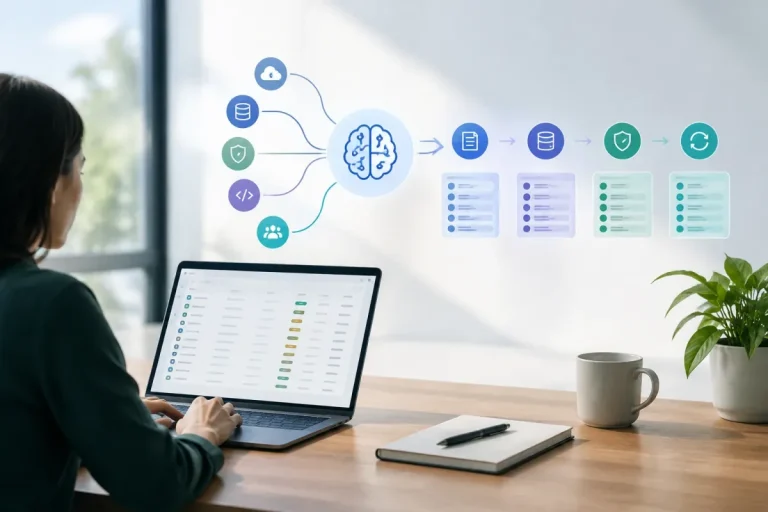
AI security program roadmap
- Build the program in stages: assign accountable cross-functional ownership; inventory AI tools, models, data, dependencies, and shadow use; classify risk and define acceptable-use and data-handling rules; map controls to established AI-security frameworks; secure development, access, data, inputs, outputs, and agent workflows; establish monitoring and AI-specific incident response; then continuously test, audit, and update the program.
- Start with a cross-functional governance and ownership model.
- Create an AI asset and data inventory, including shadow AI.
- Formalize risk-based acceptable-use, privacy, security, and vendor policies.
- Harden AI applications and agentic workflows with identity, least privilege, isolation, guardrails, secure pipelines, and monitoring.
Build an AI security program in stages: assign accountable cross-functional ownership; inventory AI tools, models, data, dependencies, and shadow use; classify risk; define enforceable rules; apply recognized frameworks and technical controls; prepare incident response; then continuously test, audit, and update the program.
An AI security program extends cybersecurity, privacy, secure development, monitoring, and incident response to the organization’s AI tools, models, applications, agents, users, data, dependencies, and business use cases. It must cover both third-party AI adoption and internally built models or agentic applications.
1. Assign Ownership and Cross-Functional Governance
Start with a named AI security owner or accountable security function. This owner maintains the roadmap, coordinates risk decisions, connects AI controls to existing operations, and escalates material issues to leadership. For a broader implementation guide, see AI security governance frameworks and controls.
Include representatives from:
- Security and security operations
- Engineering, architecture, and development
- Legal and privacy
- Compliance, risk, and audit
- Procurement and third-party risk
- Business owners and AI users
Assign each group a clear responsibility. Engineering implements safeguards, privacy reviews data handling, procurement evaluates providers, business owners approve use cases, and security manages access, monitoring, threat detection, and response.
Integrate this ownership model with existing cybersecurity, privacy, secure-development, monitoring, and incident-response processes. A committee or policy document cannot replace operational accountability.
2. Inventory AI Use and Classify Risk
Build an AI asset and data inventory
You cannot protect AI use that the organization cannot see. Maintain an inventory of approved, tolerated, unsanctioned, and shadow AI activity.
Record at least:
| Inventory field | What to record |
|---|---|
| Asset type | Tool, model, application, API, plugin, dataset, or agent |
| Provider and model | Third-party provider, internal owner, model, or application name |
| Users and owners | Business owner, technical owner, user groups, and accountable function |
| Data access | Information the system can receive, retrieve, generate, modify, or expose |
| Use case | Business purpose and operational workflow |
| Dependencies | APIs, plugins, connectors, libraries, systems, and external services |
| Governance status | Approved, tolerated, unsanctioned, or under review |
| Risk classification | Risk tier, rationale, required approvals, and control requirements |
Cover employee adoption as well as formal development projects. Include browser-based services, embedded AI features, internal applications, APIs, local tools, hosted agents, and agents connected to business systems.
Discover shadow AI continuously
Shadow AI is AI use that has not gone through normal approval or visibility processes. Review procurement records, application inventories, development repositories, access records, and business workflows where appropriate. Respect applicable privacy and employment requirements during discovery.
Do not classify risk based only on approval status. Consider the information involved, system access, business purpose, provider relationship, and available safeguards.
Define risk tiers
Assess each use case according to:
- The information the AI system can access, retain, change, or expose
- Whether it handles sensitive, confidential, regulated, or restricted data
- The impact of incorrect, manipulated, or unavailable outputs
- Provider data-handling terms and contractual obligations
- Whether it can call tools, modify records, or affect other systems
- The identity, access, isolation, validation, monitoring, and recovery safeguards available
Use risk tiers to determine approval requirements, data restrictions, technical controls, monitoring, review frequency, and owner responsibilities. Risk classification should reflect the organization’s architecture, data, use cases, and obligations rather than a universal numerical threshold.
3. Turn Acceptable-Use Rules into Enforceable Controls
An AI security policy should state which platforms and use cases are approved, which require review, and which are prohibited or restricted. It should also identify exception approvers and explain how decisions are recorded.
Define rules for:
- Permitted business uses and approved platforms
- Sensitive, confidential, regulated, or restricted data
- Prompts, uploads, retrieval sources, outputs, and retention
- Human review for consequential uses
- Third-party providers, contracts, and data-handling expectations
- Agent permissions, tool use, filesystem access, and network access
- Training, monitoring, reporting, enforcement, and exceptions
Connect policy to data protection
Policy language must connect to technical enforcement. Data classification can determine whether information may be sent to a platform, whether it must be redacted, whether a private deployment is appropriate, and how long it may be retained.
Depending on the architecture and sensitivity, controls may include access governance, encryption, retention and secure deletion, provenance tracking, token filtering, blocking controls, and audit trails. Select controls according to the use case and provider terms.
Address vendors, developers, and agents
Vendor requirements should address the provider’s role, data access, contractual obligations, dependencies, security safeguards, and approved use. Agent rules should specify permitted tools, actions, data access, and monitoring expectations.
Train users and developers on secure AI use, data handling, redaction, local-agent configuration, relevant risks, and review of AI-generated code. Enforcement should connect to access management, procurement, development, and incident response—not rely only on awareness.
4. Use Frameworks to Structure Risk and Controls
Use recognized frameworks to organize governance, threat identification, threat modeling, and control development. They are useful references, not guarantees of security, legal compliance, or complete coverage.
NIST AI RMF
Use the NIST AI Risk Management Framework to structure risk identification, responsibility assignment, and control decisions. Build a control matrix that reflects actual systems and obligations instead of copying framework language without assessment.
OWASP guidance for LLMs and agentic AI
Use current OWASP guidance for large language model and agentic-AI risks during application threat modeling. Map relevant risks to each system’s architecture, data flows, inputs, outputs, tools, and downstream authorization paths.
MITRE ATLAS or comparable references
MITRE ATLAS or a comparable threat reference can support adversarial analysis of AI systems and inform security assessments. Use it alongside your own risk assessment, not as a complete checklist.
A practical framework matrix connects each risk to a policy requirement, technical or procedural control, owner, evidence source, and reassessment trigger. No single framework or control makes an organization secure.
5. Implement Technical and Secure-Development Safeguards
Controls should reflect whether the organization is consuming an AI service, developing an AI application, operating a model, or deploying an autonomous agent. A user accessing a hosted tool has different control needs from an agent connected to sensitive systems.
Identity, access, and data protection
- Use strong authentication and controlled identity verification.
- Apply least privilege to models, applications, data, tools, connectors, and service accounts.
- Use data classification to control what information can enter or leave an AI workflow.
- Apply encryption, retention, and secure-deletion controls where appropriate.
- Maintain audit trails for access, requests where suitable, tool actions, changes, outputs, and security events.
Isolation and agent safeguards
Agents require particular attention because they may access tools, files, networks, or business systems. Use sandboxing or other isolation, network restrictions, filesystem controls, token filtering, and blocking controls where appropriate.
Define permissions for each agent and workflow. Restrict tool access to what the use case requires, separate development and production access, and require human approval when the risk or impact warrants it.
Validation, scanning, and secure development
Secure development should include appropriate input and output validation, model and dependency review, code scanning, traceability of data and decisions, and review of AI-generated code before production use.
For AI applications and agents, address:
- Input and output validation
- Prompt-injection and data-poisoning defenses appropriate to the architecture
- Dependency and code scanning
- Output handling and downstream authorization
- Logging of requests, responses, tool use, errors, and security events
- Rollback or recovery capabilities for material changes
Traditional cybersecurity controls remain foundational, but they do not replace AI-specific validation, data-flow, model, output, and agent controls.
6. Prepare AI-Specific Monitoring and Incident Response
Monitor AI activity and behavior
Extend existing monitoring to include unusual access, unexpected tool use, abnormal data movement, changes in model or provider configuration, validation failures, and material changes in outputs or system behavior.
Logging should produce evidence that owners, security teams, and auditors can use to assess control performance. Apply data minimization, access control, and retention requirements to the logs themselves. For a monitoring checklist covering prompts, outputs, agent actions, and telemetry, see the AI security monitoring checklist.
Create incident-response playbooks
Prepare and test playbooks for:
- Data exfiltration or inappropriate disclosure
- Unauthorized tool or system use
- Model compromise or material model drift
- Anomalous agent behavior
- Compromised dependencies, providers, or connectors
- Unsafe or manipulated outputs affecting a business workflow
Each playbook should identify decision-makers, containment options, evidence to preserve, communication paths, recovery steps, and conditions for returning the system to service. Include rollback and recovery capabilities where appropriate.
Integrate with existing operations
AI events should flow into the existing SOC, vulnerability-management process, and incident-response program. Define how AI owners escalate events and how security teams involve privacy, legal, or compliance stakeholders.
Use security assessments and red teaming where appropriate for the system’s risk and operating model. These activities support assurance; they do not make future failures impossible.
7. Continuously Test, Audit, and Improve
Reassess after material changes
Reassess and, where appropriate, re-audit systems when models, providers, data, agents, tools, dependencies, workflows, or operating conditions change. A change to a base model or connected tool can alter risk even when the business use case appears unchanged.
Measure effectiveness
Assign an owner to each important metric, establish an organizational baseline, and define how results will be reviewed. Useful measures include:
- Approved and unapproved AI adoption
- Inventory coverage and owner assignment
- Security events detected, investigated, and resolved
- False-positive rates and investigation workload
- Training completion and policy exceptions
- Control-test results and reassessment completion
Use these measures to identify control gaps, prioritize resources, evaluate detection and response, and decide when a system requires reassessment. Avoid universal targets that do not reflect the organization’s risk profile.
Use maturity stages to guide progress
A practical AI security maturity model can describe four stages:
- Ad hoc: AI use is handled inconsistently, with limited ownership, inventory, or repeatable controls.
- Experimenting: The organization is testing governance, inventory, policy, and safeguards for its use cases.
- Defined: Ownership, risk classification, acceptable-use rules, technical controls, monitoring, and response processes are documented and applied consistently.
- Mature: The program is measured, audited, tested, integrated with security operations, and reassessed as systems and conditions change.
Progress is demonstrated by observable operating practices, not by adopting a label. The goal is for ownership, inventory, risk decisions, controls, monitoring, response, and improvement to work together in practice.
Include responsible-use review
Where relevant, governance should also address transparency, accountability, traceability, bias assessment, workforce effects, and broader societal impact. These reviews clarify ownership and system impact, but they do not replace security controls.
Make Build-or-Buy Decisions Part of Risk Planning
For each capability, compare building internally with buying or integrating a third-party service. Evaluate the security and operating controls required, data access, provider dependencies, maintenance responsibilities, expected business value, and the organization’s ability to monitor and respond to failures.
The decision should identify who owns the resulting system and which controls must be verified before use. Choosing a provider does not transfer accountability for the organization’s data, access, workflows, or incident response.
Illustrative 30/60/90-Day Implementation Sequence
This sequence is illustrative, not a universal deadline. Adapt it to the organization’s architecture, data sensitivity, resources, industry obligations, and applicable laws.
First phase: ownership, scope, inventory, and immediate risk
- Name the accountable AI-security owner and confirm cross-functional participation.
- Define the scope of third-party and internally built AI systems.
- Start the inventory of tools, models, applications, APIs, agents, data, users, providers, and dependencies.
- Identify shadow AI and urgent exposure involving sensitive data or excessive access.
- Record owners, use cases, governance status, and available safeguards.
Second phase: risk tiers, policy, frameworks, and priority controls
- Define risk tiers and approval requirements.
- Publish acceptable-use, data-handling, vendor, and agent-use rules.
- Use NIST AI RMF, OWASP guidance, MITRE ATLAS, or comparable references to organize threat and control discussions.
- Prioritize identity, least privilege, data protection, isolation, validation, logging, and secure-development controls.
- Assign each priority control an owner and an evidence source.
Third phase: monitoring, response, testing, and reassessment
- Connect AI security events to monitoring, the SOC, vulnerability management, and incident response.
- Exercise playbooks for data exposure, unauthorized tool use, model or provider compromise, and anomalous agent behavior.
- Test safeguards and conduct red teaming where appropriate.
- Establish adoption, detection, false-positive, and control-performance baselines.
- Reassess systems when models, providers, data, agents, workflows, or operating conditions change.
Conclusion
To build an AI security program, combine accountable ownership, complete visibility, risk-based rules, enforceable technical safeguards, operational monitoring, and AI-specific response. Then continuously test, audit, train, measure, and reassess the program as AI systems and business conditions change.
The result should be an operating process integrated with security and privacy functions—not a policy document, framework label, or one-time approval.