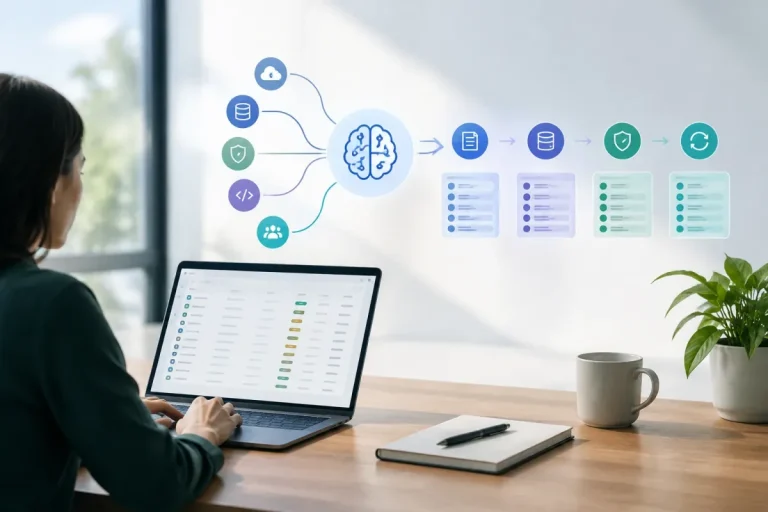

Shadow AI security essentials
- Shadow AI security means identifying and governing AI tools and AI-enabled capabilities used without organizational oversight. The practical response is to inventory usage, classify data and risk, provide sanctioned alternatives, enforce monitoring and access/data controls, and educate users—rather than relying on blanket bans.
- Build a comprehensive inventory of AI applications, models, agents, extensions, embedded SaaS features, OAuth connections, and active data flows.
- Create clear AI-use policies and classify prohibited, restricted, and permitted data and actions.
- Offer vetted enterprise AI tools and a fast approval path so users have practical sanctioned alternatives.
- Use browser, endpoint, identity, SaaS, DLP, access-control, and runtime monitoring to detect and limit risky use.
Shadow AI security means identifying and governing AI tools and AI-enabled capabilities used without organizational oversight. The practical response is to inventory usage, classify data and risk, provide sanctioned alternatives, enforce monitoring and access controls, and educate users—not rely on blanket bans.
Shadow AI security essentials
- Define and inventory unauthorized or ungoverned AI use, including applications, models, agents, extensions, embedded features, and connected tools.
- Prioritize sensitive-data leakage, privacy and compliance exposure, excessive permissions, credential misuse, and unvetted model or supply-chain risk.
- Use endpoint, SaaS, identity, OAuth, browser, network, application, and runtime visibility to discover AI activity and data flows.
- Set clear data and use policies, provide approved alternatives, and apply layered DLP, access, and monitoring controls.
- Apply least privilege to agents and integrations, then reinforce controls with training and just-in-time coaching.
What Is Shadow AI Security?
Definition and scope
Shadow AI is the unauthorized, unapproved, ungoverned, or insufficiently reviewed use of AI within an organization. It includes public chatbots, coding assistants, local or internal models, browser extensions, AI-enabled SaaS features, APIs, agents, and connected tools.
Unauthorized use is not necessarily malicious. An employee, developer, department, vendor, or consultant may use AI for a legitimate business task without the required IT, security, privacy, compliance, or governance review. That lack of oversight is the central security condition.
What a security program must accomplish
An effective program should establish:
- Where AI applications, models, agents, extensions, and embedded features are being used.
- What organizational data they process and where active data flows exist.
- Which identities, tokens, OAuth connections, and permissions they receive.
- What actions a connected tool or agent can take.
- Which uses, data types, and actions are permitted, restricted, or prohibited.
The organization can then classify exposure, provide approved alternatives, enforce monitoring and access controls, and educate users. This is a managed-use and guardrail problem, not simply a prohibition problem. A blanket ban is not a sufficient substitute for visibility, practical approved tools, policy, and layered controls.
Shadow AI vs. Shadow IT
Shadow IT generally means technology used without organizational approval or oversight. Shadow AI includes that governance problem but adds risks related to AI processing, model behavior, retention, embedded functionality, and autonomous actions.
| Dimension | Shadow IT | Shadow AI |
|---|---|---|
| Data processing | Unapproved systems may store or move business information. | AI tools and models may process prompts, source code, customer information, contracts, or other business data. |
| Model behavior | Traditional applications generally follow defined application logic. | Models interpret prompts and produce variable outputs, creating additional review and auditability concerns. |
| Embedded functionality | An unapproved application is usually identifiable as a separate service. | AI may be activated inside an otherwise approved SaaS product or integration without a new review. |
| Retention and visibility | Data flows may be difficult to track across an unapproved service. | Organizations also need visibility into AI endpoints, prompts, integrations, and related data flows. |
| Autonomous action | Applications may have user or service permissions. | Agents can use granted or inherited permissions to access data, invoke tools, or take actions. |
The distinction matters because an organization cannot find shadow AI by looking only for unfamiliar applications. An approved platform may introduce a new AI feature, while an agent or API may create a new data flow without appearing as a conventional end-user application.
Where Shadow AI Appears in an Enterprise
Employee-facing tools
Common entry points include public chatbots, coding assistants, AI writing tools, transcription and summarization features, and other employee-facing applications. Users may turn to them for speed, drafting help, analysis, or development support outside an approved workflow.
Embedded applications and internal integrations
Embedded AI may appear in an approved SaaS platform, business application, or infrastructure product. The organization may therefore have AI processing or capabilities that were not included in the original application review. Internal teams may also connect models to applications through APIs without a complete security assessment.
Agents, connected tools, and non-human identities
AI agents can use tools or connected services to perform tasks. MCP, or the Model Context Protocol, can provide a way for an AI system to interact with tools and data. These capabilities may operate through non-human identities and delegated permissions, so they belong in the same inventory as applications, models, extensions, and OAuth connections. For a security-focused treatment of this protocol, see our MCP security guide.
Practical Shadow AI Examples
- An employee enters confidential customer information into a public chatbot.
- A developer submits proprietary source code to an unapproved coding assistant.
- A team uses a public AI service to process contracts, financial information, or other confidential business material without review.
- A browser extension processes business information while a user works in a web application.
- A developer connects a model through an unreviewed API, creating an unknown data flow or integration path.
- An approved SaaS product activates an AI feature without a new security, privacy, or compliance review.
- A vendor or consultant uses AI while handling organizational data or accessing organizational systems.
Why employees adopt it
Productivity pressure, easy access, and the desire for faster answers or development support can lead people to choose an AI tool before an approval process is complete. Slow or unclear intake paths can increase that incentive. The answer is not to treat every user as malicious; it is to combine clear boundaries with practical, approved alternatives and a fast route for review.
Shadow AI Security Risks
Sensitive data and intellectual property
Unapproved AI use can expose proprietary data, source code, credentials, customer information, financial information, contracts, intellectual property, and other confidential business information to third-party AI providers. The risk is not limited to the initial prompt: organizations also need visibility into the associated application, integration, access path, and data flow. For controls focused on this risk, see our guide to preventing LLM data leakage.
Privacy, compliance, auditability, and trust
Unapproved processing can create privacy, data-lineage, auditability, and compliance concerns. Depending on the information and context, it may create potential exposure under frameworks or regulations such as GDPR and HIPAA. Each use case still requires an assessment of the organization’s applicable obligations; the presence of an AI tool does not by itself establish a legal conclusion.
Credentials and excessive permissions
AI-connected applications and agents may receive credentials, OAuth grants, tokens, or access through another identity. If the permission scope exceeds the task, the AI capability may reach systems or data beyond the user’s intent. Identity review and least privilege are therefore central to shadow AI governance.
Integration and model-related risks
Shadow AI can introduce insecure integrations, prompt injection, model poisoning, hijacked agents, and excessive permissions. Prompt injection uses instructions in content or inputs to influence an AI system’s behavior. Model poisoning involves compromised or manipulated model-related material. The concern increases when the system can access business applications, invoke tools, or operate through a non-human identity.
Why AI Agents Require Separate Controls
A chatbot that answers a question and an AI agent that can act in connected systems are not the same security problem. An agent or connected tool may use permissions granted directly to it or inherited through a connected identity. If those permissions are broader than the task requires, the agent may access data or services beyond the user’s intent.
Connected agents may retrieve information, invoke tools, modify records, or perform other actions available through their integrations. Governance should establish which identity is acting, which permissions it has, which tools it can call, and whether a person must approve a consequential action.
- Use scoped identities and role-based permissions.
- Review tokens, connectors, inherited permissions, and OAuth connections.
- Restrict tool access to the systems and data required for the task.
- Apply rate limits where appropriate.
- Require human approval for consequential agent actions.
Agents should not be treated as merely another type of chatbot. Their delegated permissions can enable data access, tool invocation, or actions that a user did not intend.
How to Discover and Prioritize Shadow AI
1. Build a comprehensive inventory
Inventory more than named applications. Include:
- AI applications, models, and public or internal services.
- Browser extensions and coding assistants.
- Embedded AI features in SaaS and business applications.
- APIs, integrations, OAuth connections, and active data flows.
- AI agents, connected tools, connectors, and non-human identities.
- Vendors and consultants that process organizational data or access organizational systems with AI.
2. Combine visibility signals
Achieve broader visibility by combining endpoint and SaaS telemetry, API discovery, OAuth audits, browser activity and extension scans, identity data, network or application visibility, code-pipeline signals, vendor changes, and runtime behavior. Review both user activity and machine-to-machine activity.
3. Use continuous discovery
Shadow AI discovery should be continuous rather than limited to periodic audits. Embedded features, vendors, AI endpoints, integrations, agents, prompts, and permissions can change over time. Update the inventory as those capabilities and data flows change.
4. Prioritize by exposure
Do not treat every AI use case as equally urgent. Prioritize findings using:
- Data sensitivity: What information is processed?
- Permission scope: What systems, records, or tools can the user, integration, or agent access?
- Business impact: What could happen if the data or capability were misused?
- Exposure context: Is the activity connected to a public service, third party, internal system, or embedded application?
- Autonomy: Is a person directly using the tool, or can an agent make decisions and take actions?
A practical order of work is to address sensitive data combined with broad permissions or autonomous action before lower-sensitivity experimentation. Formal scoring thresholds should be validated against the organization’s risk appetite and operating context.
Shadow AI Governance and Acceptable-Use Policy
Define permitted, restricted, and prohibited use
An AI acceptable-use policy should identify approved tools, permitted use cases, prohibited or restricted data, disclosure expectations, and escalation or intake paths. It should address source code, customer information, credentials, financial information, contracts, intellectual property, and other confidential business data according to the organization’s classifications.
Cover embedded AI, vendors, APIs, and agents
The policy should apply to standalone tools as well as embedded SaaS features, APIs, OAuth connections, AI agents, connected tools, vendors, and consultants. State what review is required before a new AI capability processes organizational data or connects to business systems.
Set review and disclosure expectations
Employees should know when AI use must be disclosed, what information may be entered, how to request approval, and where to report a concern. Vendors and consultants should be included when they use AI with organizational data or systems.
Review and maintain the policy
Because tools and vendor capabilities evolve, policy review should recur alongside inventory review. Governance should provide guardrails for managed use rather than relying solely on a blanket ban.
Approved Alternatives and Fast-Lane Intake
Provide pre-vetted alternatives
Offer sanctioned, pre-vetted enterprise AI tools for common business and development needs. Evaluate alternatives in relation to data access, vendor practices, compliance considerations, and available substitutes. For a structured vendor review, see our AI vendor security assessment checklist.
Create a structured approval path
A fast intake process should give employees and teams a practical way to request a tool, integration, model, extension, or agent. Capture the proposed use case, data involved, required permissions, connected systems, and responsible owner.
A fast, structured process improves visibility while reducing the incentive to work around governance. It also lets security and compliance focus review effort where data, permissions, or autonomy create the greatest exposure.
Technical Controls for Shadow AI Security
Browser, endpoint, network, and gateway controls
Layered controls can provide visibility and enforcement across browsers, endpoints, networks, and centralized AI gateways. These controls may help identify AI services, extensions, prompts, uploads, integrations, and other activity that requires review.
DLP and runtime enforcement
Data-loss prevention, browser-native controls, runtime monitoring, sandboxing, and access restrictions can apply policy during AI use. Controls may warn, restrict, or block activity according to organizational rules and data sensitivity. No single control should be treated as a guarantee against every form of leakage.
Identity and access controls
Use scoped identities, role-based access, least privilege, and rate limits for AI applications and connected agents. Review tokens, OAuth grants, connectors, and service permissions. For agents, add controls around tool invocation and require human approval for consequential actions. For the identity layer behind these controls, see our IAM for AI agents guide.
Match controls to risk
Technical controls should reflect the approved use case and its exposure. A low-sensitivity interaction may require visibility and user guidance, while sensitive data, broad permissions, or autonomous actions may require stronger restrictions, additional approval, or prevention at the point of interaction.
Employee Training and Just-in-Time Coaching
Role-specific training
Training should explain which tools are approved, what data may be used, when AI use must be disclosed, and how to request approval or report a concern. Developers, data users, administrators, and employees who work with customers may need different examples and guidance.
Just-in-time coaching
Contextual coaching can warn or guide a user when a risky prompt, upload, extension, or connection is attempted. The goal is to help the employee choose an approved alternative and follow the intake path rather than depend on concealment or workarounds.
A Practical Implementation Roadmap
- Discover: Establish an initial inventory using endpoint, SaaS, identity, browser, network, application, and runtime signals. Include embedded features, agents, extensions, OAuth connections, vendors, and active data flows.
- Prioritize: Rank findings by data sensitivity, permission scope, business impact, exposure context, and autonomy. Address the combinations that create the greatest exposure first.
- Govern: Publish permitted, restricted, and prohibited uses; define data classifications; assign review and escalation paths; and identify responsible owners.
- Enable: Provide sanctioned tools and a fast approval process that captures the use case, data, permissions, connected systems, and owner.
- Control: Deploy layered monitoring, DLP, access, browser, endpoint, identity, and runtime controls. Apply least privilege and human approval to consequential agent actions.
- Educate and improve: Train users, provide contextual coaching, review findings, and update policy and controls as AI capabilities change.
Program reviews can examine inventory coverage, approval activity, risky-use trends, policy exceptions, permission reviews, coaching events, and whether controls remain aligned with current data flows. The measures should support better visibility and safer managed use, not simply reward a higher number of blocked actions.
Continuous Monitoring and Program Maintenance
Maintain the shadow AI inventory as a living view of organizational use. Monitor embedded features, vendor changes, AI endpoints, prompts, integrations, agents, permissions, browser extensions, and runtime behavior. For a practical monitoring checklist, see our AI security monitoring guide.
Review findings against current data classifications and acceptable-use rules. Retire stale entries, reassess changed integrations, and update policy and training as organizational use and vendor capabilities evolve. Continuous monitoring should cover both newly discovered tools and changes to already approved capabilities.
Shadow AI Security Checklist
| Program area | Action |
|---|---|
| Inventory | Identify AI applications, models, agents, extensions, embedded features, APIs, OAuth connections, identities, vendors, and data flows. |
| Classification | Classify the data, permissions, exposure context, business impact, and level of user or agent autonomy. |
| Policy | Publish approved tools, permitted use cases, restricted and prohibited data, disclosure expectations, and review requirements. |
| Alternatives | Provide sanctioned tools and a fast, structured intake path. |
| Monitoring and DLP | Use layered browser, endpoint, network, gateway, DLP, and runtime controls. |
| Access | Apply scoped identities, role-based access, least privilege, token review, connector review, and rate limits. |
| Agent controls | Constrain tool invocation and require human approval for consequential actions. |
| Training | Train users by role and provide contextual coaching for risky prompts, uploads, or connections. |
| Continuous review | Update the inventory, policy, controls, vendor oversight, and training as AI capabilities change. |
The essentials are clear: inventory AI use, classify and govern it, provide sanctioned alternatives, monitor and constrain risky activity, and educate and review continuously. That managed-use approach provides stronger enterprise security than relying on a blanket ban alone.