
OAuth for autonomous agents: key points
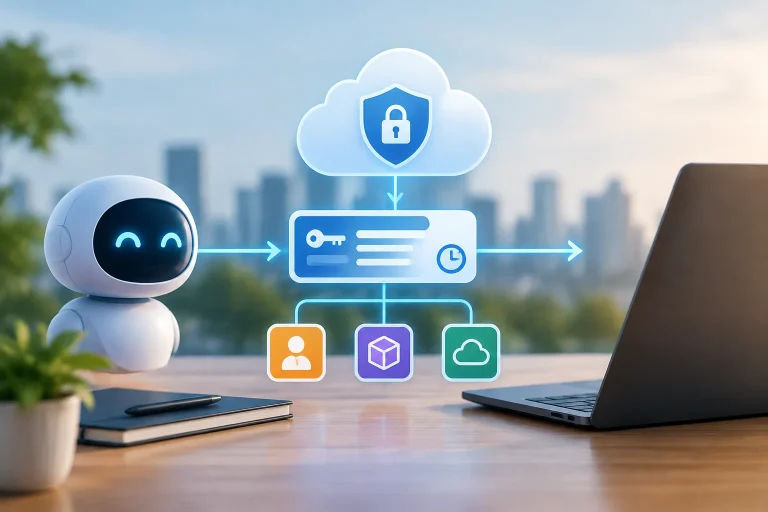
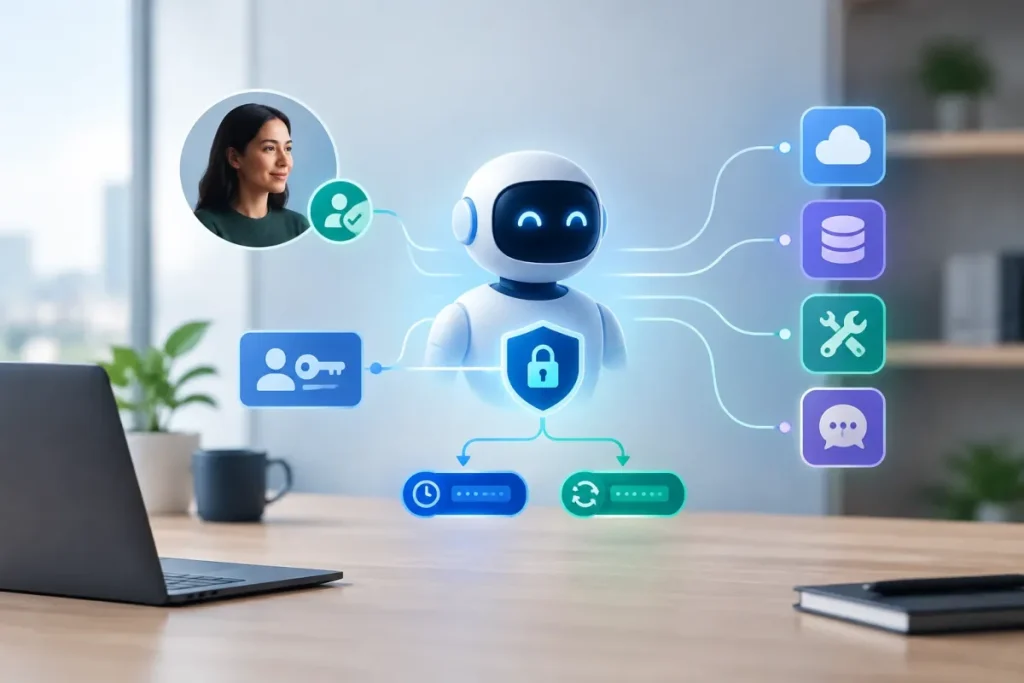
- OAuth works with autonomous AI agents by issuing scoped access tokens to an agent—either as its own client identity or on behalf of a consenting user—so the agent can call protected APIs and tools without receiving the user’s password or a broad shared API key. In autonomous and multi-agent workflows, the basic OAuth model is adapted with fine-grained scopes, short-lived and revocable tokens, explicit actor/delegation context, and protections against token misuse.
- For user-delegated access, use an authorization-code-style flow with user consent, then give the agent a narrowly scoped, short-lived access token and refresh/revocation controls.
- For autonomous service-to-service access, use a distinct non-human client or workload identity with client credentials or equivalent strong authentication, avoiding shared service accounts where possible.
- For tool and multi-agent chains, including MCP or similar tool protocols, enforce resource- or tool-specific scopes, attenuate privileges at each hop, bind or otherwise protect tokens from unintended forwarding, validate audience and actor context, and require the client or agent to present a valid OAuth token before executing protected tools.
OAuth gives autonomous AI agents scoped access tokens—issued by an authorization server—to call protected APIs and tools as their own client or for a consenting user, without the user’s password or a broad shared API key.
In autonomous and multi-agent workflows, this model is adapted with fine-grained scopes, short-lived and revocable tokens, explicit actor and delegation context, and protections against token misuse. OAuth authorizes access; it does not by itself make an agent trustworthy or prove that its decisions are safe.
How OAuth Works With Autonomous AI Agents
The core OAuth roles remain the same:
- The authorization server authenticates the client or receives user consent, then issues an access token.
- The AI agent uses that token as a non-human client or as a user’s authorized delegate.
- The protected resource—such as an API, tool, or service—validates the token before allowing the operation.
There are two primary cases:
- Agent acting as a service or client: The agent uses its own non-human client or workload identity for service-to-service access.
- Agent acting on behalf of a user: The agent uses authorization delegated by a person who approved specific access.
In both cases, the agent presents an access token rather than a password or broad shared credential. The protected resource decides whether the token’s scope, audience, resource, and state permit the request.
The Basic OAuth Flow for an AI Agent
1. Register or authenticate the client
The agent must be represented to the authorization server as a recognized client, workload, or other authorized caller. For autonomous service access, use a distinct non-human client or workload identity rather than an undifferentiated shared account when the provider supports that model.
Client credentials or another provider-supported mechanism can authenticate a service-to-service agent. Workload identity or mutual TLS may also be relevant when stronger client authentication is needed, depending on support from the authorization server and protected resource.
2. Obtain consent or request authorization
When the agent acts for a person, an authorization-code-style flow is the usual delegated pattern: the user reviews the requested permissions and gives consent, after which the authorization server issues tokens to the authorized client.
When the agent acts autonomously as a service, authorization is arranged in advance through the client or workload relationship. A person does not need to approve every request at runtime, but headless execution does not justify unlimited access. The client still receives only its assigned permissions.
3. Receive and present a scoped access token
The authorization server issues an access token representing a defined authorization decision. The agent presents it when calling an API or invoking a protected tool.
The protected resource validates the token before executing the request. It should check that the token is intended for that resource, carries the required permissions, remains valid, and has not been revoked where those checks are supported.
4. Handle expiration, refresh, and revocation
Access tokens should have lifetimes appropriate to the task. When a token expires, the client may use a supported refresh process or obtain authorization again. Refresh-token handling, rotation, and failure behavior vary by provider, so the implementation defines how these functions work.
Authorization should also be revocable when a user withdraws consent, a client is compromised, or the agent should no longer access a resource. Short lifetimes reduce the window for misuse, but they do not replace secure storage or request validation.
Two Authorization Patterns
| Pattern | Actor | Authorization step | Key controls |
|---|---|---|---|
| User-delegated access | An AI agent acting for a human | Authorization-code-style flow with user consent | Narrow scopes, short lifetime, refresh and revocation controls, explicit user and agent context |
| Autonomous service-to-service access | A non-human agent, client, or workload | Client or workload authentication without interactive consent at runtime | Distinct client identity, strong authentication, audience validation, limited scopes, secure storage |
User-delegated access
Here, the human user and the agent have different roles: the user authorizes access, while the agent performs subsequent API or tool calls. The resulting token should represent only the permissions granted through that delegation.
For example, a user might authorize an agent to read a particular class of data but not change account settings. The exact permissions depend on the authorization server and protected API. The design principle is to request and enforce the smallest useful scope rather than expose the user’s entire account.
The agent can continue working after the interactive authorization step, including in a headless environment. That convenience does not remove the need for short-lived access, revocation, secure token handling, and resource-side validation.
Autonomous service-to-service access
In this pattern, the agent acts with its own service authority rather than representing a human. A distinct non-human client or workload authenticates to the authorization server, requests a token for defined scopes, receives that token, and calls the protected resource. When the token expires, the client reauthenticates or follows the provider’s supported renewal process.
This Client Credentials-style sequence suits scheduled or event-driven work that does not require a person to approve each action. It does not make the agent trustworthy by itself. The protected service must still enforce scopes, audiences, resource permissions, expiration, and other policy controls.
OAuth Authorization Versus Identity
Agent identity and user identity
Several principals can matter in one agent transaction:
- The human user: The person who may have approved delegated access.
- The agent or workload: The non-human caller that makes the request.
- The application: The client software or service through which the request is delivered.
OAuth is primarily an authorization framework. It answers which access has been granted to a client for a protected resource. It does not, by itself, establish every identity claim or prove that the agent behaved correctly. For a direct comparison of these roles, see human identity versus AI agent identity.
When user identity claims are needed, OpenID Connect or another identity mechanism may be used alongside OAuth. Workload identity or mutual TLS may be relevant for stronger client authentication, depending on the architecture. For the relationship between authorization and identity claims, see OAuth vs OpenID Connect for AI agents.
A bearer token does not automatically prove which internal agent made a decision, whether the agent acted safely, or whether its instructions were trustworthy. Those questions require appropriate identity, runtime policy, logging, and operational controls in addition to OAuth authorization.
Security Controls for Headless and Multi-Agent Workflows
Least privilege and token containment
Autonomous agents often choose tools at runtime, so permissions should be constrained before those decisions occur. Use resource- or tool-specific scopes where supported, request only necessary access, and keep tokens short-lived and revocable. For the benefits and implementation practices, see short-lived tokens for AI agents.
Protect tokens as sensitive credentials. Store them in an appropriate protected location, keep them out of prompts, tool inputs, and logs, and treat them as bearer credentials. Someone who obtains a usable token may be able to present it until it expires or is revoked.
Every protected resource should validate the token’s audience or resource, permissions, validity period, and revocation state where available. A token issued for one service should not automatically be accepted by another merely because both services use OAuth.
Delegation chains and runtime decisions
A multi-agent workflow may involve a planner, a specialist agent, and one or more tools. Passing the original token through every hop can blur who was authorized to do what and increase the consequences of exposure.
Preserve explicit actor and delegation context across each hop. Where the architecture supports it, attenuate privileges as work moves to another agent or tool, use a token intended for the next resource, and bind or otherwise contain the token so it cannot be forwarded unexpectedly. These protections depend on provider and protocol support; they are not automatic properties of OAuth.
At each tool call, check the requested operation against the token’s permissions and the current delegation context. This helps limit confused-deputy behavior, in which an agent uses authority granted for one purpose to perform a different or overly broad action. It also reduces the impact of misleading instructions or prompt-injection attempts that try to turn an authorized tool into an unintended action.
Inbound and outbound access
OAuth can protect an agent-facing resource or authorize an agent’s outbound request:
- Outbound access: The agent is the OAuth client and calls a third-party API, tool, or service. That resource validates the agent’s token.
- Inbound access: An API, tool endpoint, or agent service is the protected resource. The calling client or agent must present a valid token before using it.
The direction changes which component obtains and presents the token, but the principle remains the same: the protected resource enforces authorization instead of trusting the agent’s stated intent.
MCP as a Tool-Access Example
Model Context Protocol (MCP) is a representative tool-integration pattern, not a requirement for every agent architecture. In an OAuth-enabled MCP-style integration, the MCP server or similar tool endpoint can be treated as a protected resource. The client or agent presents a valid OAuth token before the endpoint executes protected tools. For a remote MCP implementation, see MCP OAuth security.
This separates tool authorization from the agent’s internal reasoning. The agent may decide to request a tool, but the protected endpoint still checks whether the presented authorization permits the operation.
An API proxy can play a similar role by receiving the agent’s request, validating the token for the intended resource, and forwarding an authorized call. Depending on the architecture, the client, agent, proxy, or MCP server may obtain and present the token. The exact flow and provider support depend on the implementation; do not infer them from the protocol name alone.
Choosing a Flow and Understanding the Limitations
| Situation | Common pattern | What to verify |
|---|---|---|
| The agent acts for itself | Client Credentials or equivalent workload authentication | Distinct identity, narrow scopes, audience, token lifetime, and revocation |
| The agent acts for a user | Authorization-code-style delegation | User consent, user and agent context, refresh handling, and revocation |
| The agent calls another agent or tool | Resource-specific authorization with attenuated delegation | Actor context, token containment, audience, and permissions at each hop |
| The interaction is headless or non-browser | Provider-supported OAuth adaptation or emerging extension | Current status, interoperability, and whether the flow is actually supported |
Emerging agent-specific OAuth extensions
Traditional OAuth flows are being adapted for headless agents that make runtime decisions and interact with tools or other agents. The IETF Agent Authorization Grant is an emerging OAuth 2.1 extension intended for AI agents invoking web APIs.
These agent-specific extensions are not finalized or universally supported. A redirect-based consent flow may not fit voice, messaging, or another interaction in which a browser is unavailable. Proposed alternatives address these constraints, so check their status, terminology, and interoperability before adoption.
What OAuth does not guarantee
OAuth alone does not provide complete agent authentication, trustworthy behavior, complete identity, or full auditability. A valid token shows that the authorization server issued access under defined conditions; it does not prove that the agent will use that access safely.
Calls should be attributable to the relevant user, agent, application, and workload where the architecture requires it. Delegation decisions, tool access, token lifecycle events, and revocation paths should be subject to appropriate operational review, especially when an agent’s permissions can change rapidly.
Deployment checklist
- Decide whether the agent acts for itself, on behalf of a user, or through another agent.
- Give each agent or agent class a distinct client or workload identity where appropriate.
- Use authorization-code-style delegation and user consent for user-authorized access.
- Use Client Credentials or another provider-supported strong client-authentication pattern for autonomous service access.
- Request the narrowest useful scopes and enforce permissions at the tool, resource, and action level where supported.
- Validate the token’s audience or resource, actor context, permissions, expiration, and revocation state.
- Use short-lived, revocable tokens and protect stored credentials from prompts, logs, theft, and unintended forwarding.
- Attenuate privileges and preserve delegation context across multi-agent hops.
- Confirm provider support for headless access, refresh, revocation, MCP integration, and any emerging agent-specific extension.
The practical answer is conditional: OAuth gives an autonomous agent controlled access to protected APIs and tools through scoped tokens. Safe deployment requires separate identity where appropriate, explicit delegation, least privilege, token containment, resource validation, and controls beyond OAuth itself.