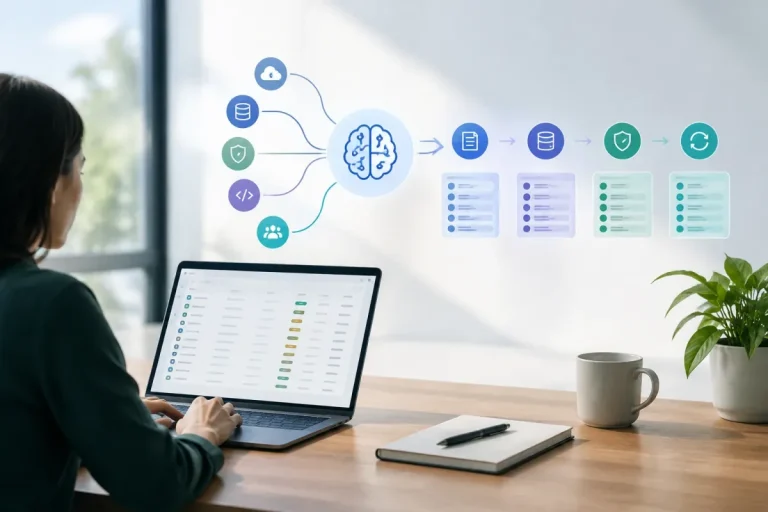

AI security governance at a glance
- AI security governance is a structured, cross-functional framework that converts an organization’s AI risk tolerance, security requirements, ethical principles, and regulatory obligations into enforceable policies, assigned accountability, technical safeguards, documented lifecycle controls, and continuous monitoring. A practical program should use risk assessment and governance checkpoints from AI intake through retirement, and may align with frameworks such as NIST AI RMF and ISO/IEC 42001 while addressing applicable regulations such as the EU AI Act.
- Create an inventory of AI use cases, models, vendors, data sources, and owners.
- Classify use cases by risk and define approval or escalation gates.
- Establish a cross-functional governance body with explicit decision rights.
- Publish acceptable-use, security, privacy, third-party, and incident-response policies for AI.
AI security governance is a structured, cross-functional framework that turns an organization’s AI risk tolerance, security requirements, ethical principles, and regulatory obligations into enforceable policies, accountability, technical safeguards, documented lifecycle controls, and continuous monitoring. It uses risk checkpoints from AI intake through retirement and may align with NIST AI RMF, ISO/IEC 42001, and applicable EU AI Act obligations.
AI security governance at a glance
- Build an inventory of AI use cases, models, vendors, data sources, dependencies, and owners.
- Classify use cases by risk and establish approval, escalation, and reassessment gates.
- Use a cross-functional governance body with explicit decision rights and human accountability.
- Apply policies, secure engineering controls, testing, monitoring, incident response, documentation, and retirement procedures throughout the AI lifecycle.
What is AI security governance?
AI security governance is the organizational framework for managing security risks created by AI systems and their related data, infrastructure, vendors, models, applications, application programming interfaces (APIs), agents, and dependencies. It translates organizational principles and risk tolerance into decisions and safeguards, including:
- Acceptable-use, security, privacy, procurement, third-party, and incident-response policies;
- Named owners, human oversight, and explicit decision rights;
- Risk assessments, use-case classifications, approval gates, and escalation paths;
- Technical controls such as authentication, authorization, encryption, secrets protection, secure APIs, logging, and testing;
- Lifecycle documentation and evidence; and
- Continuous monitoring, response, recovery, reassessment, suspension, and retirement procedures.
The security focus is essential. A complete program connects confidentiality, integrity, availability, privacy, robustness, resilience, accountability, transparency, fairness, and compliance. It also identifies who may approve deployment, accept residual risk, require remediation, or suspend a system.
AI security governance versus broader AI governance
Broader AI governance establishes principles, policies, accountability, and risk processes for using AI. AI security governance applies that structure specifically to protecting AI systems, associated data, infrastructure, users, and dependencies from misuse, compromise, leakage, manipulation, and operational failure.
The areas overlap. Privacy, fairness, transparency, explainability, human oversight, and regulatory obligations all affect security decisions. However, a general responsible-AI policy is not sufficient if it omits identity and access management, data integrity, prompt-injection defenses, supply-chain review, secure deployment, monitoring, and incident response.
Why AI security governance matters
AI systems may process sensitive information, influence business decisions, invoke tools, connect to APIs, and depend on third-party services. Weak governance can therefore create risk across the model, application, data, infrastructure, supply chain, and organizational decision process.
A structured AI security governance program helps an organization:
- Protect systems and data with appropriate identity, access, privacy, encryption, and environment controls.
- Manage risk consistently by classifying use cases and applying approval or escalation gates before deployment and material changes.
- Establish accountability for outputs, deployment decisions, security events, and risk acceptance.
- Support privacy and compliance by connecting data handling, retention, access, documentation, and applicable obligations.
- Improve resilience through monitoring, incident response, recovery, suspension, reassessment, and retirement procedures.
- Maintain evidence through risk assessments, testing records, approvals, data lineage, model documentation, monitoring records, and change history.
Governance should not be reduced to ethics or compliance. Fairness, transparency, explainability, and accountability must operate alongside preventive, detective, response, and recovery controls that protect systems and information.
Core principles of AI security governance
A practical program should make the following principles operational rather than leaving them as statements of intent:
- Accountability: Assign owners and decision rights for each use case, system, risk acceptance, and incident.
- Transparency: Document how AI is used, what data and dependencies it involves, what limitations apply, and what decisions it influences.
- Privacy: Control sensitive information across collection, training, retrieval, prompts, outputs, access, retention, and disclosure.
- Fairness: Evaluate whether system behavior may produce unequal or inappropriate outcomes and define review responsibilities.
- Security: Protect models, applications, data, infrastructure, APIs, tools, and users against compromise and misuse.
- Robustness and resilience: Test relevant failure and attack scenarios and maintain processes for containment, recovery, reassessment, and retirement.
- Human oversight: Provide a way to review outputs, challenge results, require remediation, or suspend use when the risk warrants it.
Explainability, fairness, and human oversight
Explainability supports governance by helping appropriate audiences understand how a system is used, what decisions it influences, what limitations apply, and when human review is required. The form and depth of explanation should reflect the use case, audience, decision impact, and risk.
Fairness reviews and bias testing help identify potentially unequal or inappropriate outcomes. Human oversight provides a decision path for reviewing outputs, challenging results, requiring remediation, or suspending use. Together, these practices strengthen accountability and audit evidence, but they do not replace security controls or risk assessment.
AI security governance across the lifecycle
Governance should follow an AI system from initial intake through retirement. Treat the artifacts as practical governance patterns, not universally prescribed requirements.
| Lifecycle stage | Key decisions | Controls and evidence |
|---|---|---|
| Intake, design, and acquisition | What is the use case? Who owns it? What data, model, vendor, and dependencies are involved? What risk tier and approval path apply? | Inventory entry, owner assignment, initial risk assessment, vendor review, and approval or escalation record. |
| Data and development | Can the organization use the data? Is it protected, reliable, traceable, and appropriate? | Data provenance and lineage, sensitivity and access review, quality and integrity checks, secure development, and testing records. |
| Evaluation and deployment | Are security, robustness, privacy, fairness, explainability, and operational risks understood? | Evaluation results, model or system documentation, security testing, change record, deployment approval, and environment separation. |
| Monitoring and retraining | Have behavior, data, performance, risk, or regulatory circumstances changed? | Monitoring for drift, bias, anomalous behavior, data integrity, policy compliance, security events, and operational use. |
| Incident response and recovery | Should the system be contained, suspended, reassessed, restored, or changed? | Audit trails, escalation procedures, response records, recovery planning, suspension decisions, and corrective actions. |
| Retirement | Is continued operation justified, and what access, dependencies, data, and records must be addressed? | Retirement decision, access review, documentation retention, dependency review, and post-retirement assessment. |
Reassess a system when it is retrained, connected to a new data source, given new tools, moved into production, or materially changed. Such changes can alter the original risk assessment.
Governance roles and decision rights
AI security governance is cross-functional. Security, technology, engineering, risk, compliance, privacy, legal, procurement, business, and audit stakeholders should participate according to the organization’s size, structure, and risk profile.
A practical operating model may use an AI governance council, an existing risk committee, or a federated network of accountable teams. It should define:
- Who owns each AI use case and system;
- Who approves, rejects, escalates, or accepts residual risk;
- Who can require testing, remediation, suspension, or reassessment;
- How security, privacy, legal, and business disagreements are resolved; and
- How decisions and supporting evidence are recorded.
A chief information security officer (CISO) may coordinate security requirements and incident oversight. A chief technology officer or engineering leader may oversee architecture and delivery. Data stewards may address provenance, quality, access, and retention. Legal, privacy, compliance, procurement, business owners, and internal audit may contribute according to the use case. These are practical patterns, not fixed assignments for every organization.
Centralized, decentralized, and federated models are all possible. The appropriate choice depends on organizational structure and risk context; the essential requirement is clear accountability and decision authority.
Inventory, classification, and risk assessment
Inventory is the foundation of governance. Record:
- AI use cases and business processes;
- Models, applications, agents, and hosting environments;
- Internal and third-party vendors;
- Training, fine-tuning, retrieval, and operational data sources;
- APIs, cloud services, open-source components, and other dependencies; and
- Business, technical, security, and data owners.
Classify each use case according to factors such as data sensitivity, business impact, autonomy, external exposure, access to tools or systems, and the consequences of misuse or failure. Classification should determine the level of review, testing, approval, monitoring, and escalation required.
A risk assessment should consider confidentiality, integrity, availability, privacy, fairness, transparency, explainability, robustness, security, operational resilience, third-party exposure, and applicable obligations. Revisit it when the system, data, model, vendor, use case, or operating environment changes. For a detailed process, see the AI security risk assessment guide.
Practical inventory fields
| Record | Useful fields |
|---|---|
| Use case | Business purpose, users, decisions influenced, operating environment, and risk classification. |
| System | Model, application, agent, APIs, tools, hosting environment, and dependencies. |
| Data | Sources, sensitivity, provenance, lineage, quality, access, retention, and integrity considerations. |
| Ownership | Business owner, engineering or technology owner, security contact, data steward, and approval authority. |
| Governance status | Assessment, testing, approval, exceptions, monitoring, incidents, material changes, and retirement status. |
AI security threats and corresponding controls
Threats should be connected to governance decisions and control categories rather than handled only as isolated engineering issues.
| Threat or concern | Preventive and detective controls | Response and recovery |
|---|---|---|
| Prompt injection and adversarial manipulation | Constrain instructions, access, tools, and data flows; test behavior; log relevant prompts, actions, policy violations, and anomalies. | Contain affected workflows, investigate, reassess, and apply corrective changes. |
| Data poisoning or compromised inputs | Govern provenance, integrity, access, quality, and source changes; monitor data integrity and unexpected behavior. | Quarantine affected data or systems, investigate sources, and determine whether suspension is necessary. |
| Information leakage | Apply data minimization, access control, privacy safeguards, secrets protection, and environment separation; monitor access and outputs. | Use incident response, containment, recovery, and reassessment as appropriate. |
| Unsafe tool execution or malicious use | Limit permissions, authenticate users and services, secure APIs, and apply suitable human oversight; record tool calls and policy violations. | Restrict access, contain actions, investigate, and review the use case. |
| Supply-chain and dependency risk | Assess vendors, models, cloud services, APIs, open-source components, and agents; monitor changes, behavior, access, and dependency events. | Escalate supplier incidents, isolate affected dependencies, and reassess continued use. |
| Model inversion and other specialized attacks | Require technical review and security testing appropriate to the system and data; monitor relevant access, outputs, and anomalies. | Validate the scenario, contain exposure, investigate, and reassess controls. |
Use four control categories when designing the program:
- Preventive: Policies, access restrictions, secure design, data protection, environment separation, and pre-release testing.
- Detective: Logging, monitoring, validation, anomaly detection, drift review, and policy-compliance checks.
- Response: Escalation, containment, access restriction, investigation, suspension, and corrective action.
- Recovery: Recovery planning, reassessment, restoration decisions, change management, and retirement where continued operation is not justified.
Governance reduces and manages risk; it does not guarantee complete risk elimination. Specialized attack scenarios require technical verification before adopting detailed mitigation guidance.
Technical safeguards for AI systems
Select controls according to the use case and risk classification. Relevant safeguards may include:
- Authentication and authorization: Verify users, services, applications, and agents before granting access.
- Role-based access control: Limit access to models, data, tools, environments, APIs, and administrative functions.
- Encryption and secrets protection: Protect sensitive data and credentials in appropriate storage and transmission contexts.
- Secure APIs: Authenticate, authorize, validate, control, and log interactions where applicable.
- Environment separation: Separate development, testing, and production and control movement between them.
- Security testing: Test for prompt injection, adversarial manipulation, poisoning, leakage, abuse, robustness, bias, and other relevant risks.
- Logging and monitoring: Maintain useful audit trails for access, system changes, requests where appropriate, tool use, policy violations, and security events.
- Privacy safeguards: Protect sensitive information and align collection, use, access, retention, and disclosure with applicable requirements.
Data governance, privacy, and integrity
AI security depends on trustworthy and appropriately protected data. Data governance should address:
- Where data came from and whether provenance is documented;
- How data flows through training, testing, retrieval, prompts, outputs, and operations;
- Lineage, quality, integrity, retention, and version changes;
- Sensitivity, access permissions, and protection of personal or confidential information;
- Whether data use is consistent with organizational policies and applicable obligations; and
- How data-related incidents, corrections, restrictions, and retirement decisions are handled.
Privacy is not separate from security governance. Poor access controls, excessive retention, weak lineage, or uncontrolled use of sensitive information can create both privacy and security exposure. Data owners and technical teams should coordinate these concerns.
Third-party AI, vendors, agents, and dependencies
Third-party AI can introduce risks outside the organization’s direct development process. Governance should cover vendors, hosted models, cloud services, APIs, open-source components, data providers, agents, and other dependencies through assessment and ongoing oversight.
Review each dependency’s role, data access, permissions, security practices, service changes, operational behavior, and impact if it becomes unavailable or compromised. Detailed vendor questionnaires, contractual requirements, control mappings, and assessment thresholds should be validated for the organization and use case rather than assumed to be universal. For a detailed review framework, see the AI vendor security assessment checklist.
AI agents require particular scrutiny because they may access systems, invoke APIs, interact with tools, and take actions with limited human intervention. Their inventory entry and risk assessment should reflect those permissions and actions, not merely the underlying model. For a focused treatment of agent identities and permissions, see IAM for AI agents.
Monitoring and AI incident response
Production monitoring
Production governance continues after approval. Monitor, as relevant:
- Security events and access behavior;
- Performance and reliability;
- Data and model drift;
- Bias and fairness-related signals;
- Data integrity and unexpected source changes;
- Policy compliance and prohibited use;
- Anomalous outputs, tool calls, or operational behavior; and
- Changes in the use case, vendor, model, data, or applicable obligations.
Monitoring results should feed back into risk assessments, testing, approvals, training, policies, and technical controls. Maintain records that show what was monitored, what was found, who decided what to do, and whether the system was changed, suspended, reassessed, or retained.
Incident response, recovery, and suspension
AI incident response should connect detection to an accountable decision process:
- Detect and record the event.
- Escalate it to appropriate security, technology, business, privacy, legal, or risk stakeholders.
- Contain the event, including restricting or suspending the system when justified.
- Investigate affected systems, data, dependencies, and decisions.
- Recover and apply corrective action.
- Reassess the system before normal operation resumes or the system is retired.
Retirement is a governance decision, not merely an infrastructure task. Record why the system is being retired, who approved the decision, what access and dependencies must be addressed, which records should be retained, and whether related systems or data require review.
Frameworks, standards, and regulations
Frameworks and regulations serve different purposes. Selection and alignment should reflect the organization, jurisdiction, system, use case, data, and risk profile.
| Instrument | Type | How it can inform a program | Applicability |
|---|---|---|---|
| NIST AI Risk Management Framework (AI RMF) | Risk-management guidance | Can help structure AI risk identification, governance, measurement, and management. | Not automatically mandatory for every U.S. organization. |
| ISO/IEC 42001 | AI management-system standard | Can inform policies, accountability, controls, and continual improvement. | Relevance depends on organizational objectives, adoption decisions, and applicable contractual or regulatory context. |
| EU AI Act | Regulation | May affect organizations or systems within its scope and should be assessed alongside the system’s use and risk profile. | Applicability is context-dependent and requires legal and jurisdictional verification. |
| OECD AI Principles | Principles and policy guidance | Can inform discussions of responsible, secure, transparent, accountable, and human-centered AI. | Use as guidance rather than assume a universal mandate. |
| GDPR, HIPAA, and CCPA | Privacy or sectoral regulation | May affect personal information, health information, consumer data, processing, disclosure, and security practices. | Applicability depends on the organization, data, activity, jurisdiction, and statutory scope. |
| ISO 27001 | Information security management-system standard | Can provide information-security governance context for AI systems, data, access, and operations. | It does not by itself settle every AI-specific governance question. |
NIST AI RMF, ISO/IEC 42001, and the EU AI Act are not automatically mandatory for every U.S. organization. Separate voluntary guidance, management-system standards, and binding regulation. Verify detailed obligations, scope, mappings, and legal applicability before making compliance, procurement, or certification decisions.
Implementation roadmap
Phase 1: Establish direction and ownership
Define principles and objectives. Set the organization’s risk tolerance and objectives for security, privacy, accountability, transparency, fairness, robustness, resilience, and compliance.
Form an oversight structure. Assign an accountable executive or committee, establish cross-functional participation, and document decision rights. An organization may begin with existing security, technology, legal, privacy, risk, and business staff rather than create a dedicated department.
Phase 2: Build visibility and assess risk
Inventory and classify AI. Record use cases, models, vendors, data sources, dependencies, APIs, agents, and owners. Classify use cases by risk and define approval, escalation, reassessment, and monitoring expectations.
Assess risks and data. Review provenance, sensitivity, lineage, quality, retention, integrity, access, and privacy. Assess prompt injection, adversarial manipulation, poisoning, leakage, malicious use, unsafe tool execution, supply-chain exposure, and other relevant threats.
Phase 3: Document and implement controls
Document policies and procedures. Publish or update acceptable-use, security, privacy, third-party, testing, incident-response, monitoring, and retirement policies. Maintain risk assessments, data lineage, evaluation results, model or system documentation, approvals, and change records.
Implement and test controls. Apply access management, secrets and data protection, environment separation, secure APIs, logging, monitoring, privacy safeguards, security testing, and dependency review according to risk. Validate controls against the actual system, not only policy language. Use this AI security controls checklist to organize and validate the safeguards.
Phase 4: Monitor and improve
Monitor, respond, and adapt. Monitor security, performance, drift, bias, data integrity, policy compliance, anomalous behavior, and operational use. Use incidents, changes, monitoring results, and regulatory developments to update assessments, controls, approvals, and retirement decisions. For a practical monitoring scope, see the AI security monitoring checklist.
| Phase | Primary owners | Core deliverables | Progress indicator |
|---|---|---|---|
| Direction | Executive sponsor, security, technology, risk, legal or compliance | Principles, objectives, governance structure, and decision rights | Accountability and escalation paths are documented. |
| Visibility | Business owners, engineering, data, procurement, security | Inventory, ownership records, classifications, and risk assessments | Relevant systems and dependencies are identified and prioritized. |
| Control implementation | Engineering, security, privacy, data, vendors | Policies, safeguards, testing records, approvals, and model documentation | Controls are applied and tested according to risk. |
| Operations | Security operations, system owners, risk, compliance | Monitoring, incident records, reassessments, change history, and retirement records | Findings lead to response, improvement, or lifecycle decisions. |
These phases are an implementation pattern, not a universal timetable. Sequence, staffing, evidence, and review depth should reflect the organization’s size, systems, data, risk, and obligations.
Metrics and audit evidence
Useful indicators may include inventory coverage, completed risk assessments, outstanding remediation, testing completion, monitoring coverage, security events, policy exceptions, vendor reviews, incident-response activity, and retirement decisions. For guidance on reporting these indicators, see AI security metrics and KPIs.
Maintain evidence that shows how governance operates:
- Inventory and ownership records;
- Risk assessments and classifications;
- Data provenance and lineage;
- Testing and evaluation results;
- Model or system documentation;
- Approvals, exceptions, and change records;
- Monitoring outputs and security events;
- Incident, recovery, suspension, and reassessment records; and
- Retirement decisions and related access or dependency reviews.
Quantitative thresholds, maturity scores, staffing assumptions, timelines, audit conclusions, and framework mappings should be validated before adoption. No universal measurement model fits every organization or AI system.
Practical AI security governance checklist
- Inventory: Are relevant use cases, models, vendors, data sources, APIs, agents, and dependencies identified?
- Ownership: Does every material system have accountable business, technical, security, and data contacts?
- Risk: Has each use case been classified, assessed, approved, escalated, or reassessed as appropriate?
- Policies: Do acceptable-use, security, privacy, third-party, testing, incident-response, monitoring, and retirement policies address AI?
- Data: Are provenance, lineage, quality, sensitivity, retention, integrity, access, and protection documented?
- Technical controls: Are authentication, authorization, role-based access, encryption, secrets protection, secure APIs, environment separation, logging, and testing applied according to risk?
- Threat testing: Has the organization considered prompt injection, adversarial attacks, poisoning, leakage, unsafe tool execution, malicious use, bias, robustness, and supply-chain risks?
- Third parties: Are vendors, models, cloud services, APIs, open-source components, agents, and dependencies assessed and monitored?
- Human oversight: Are explainability, fairness, review responsibilities, and escalation paths appropriate to the use case?
- Monitoring: Are security, performance, drift, bias, data integrity, policy compliance, anomalous behavior, and operational use monitored?
- Incident response: Are detection, escalation, containment, recovery, suspension, reassessment, and corrective actions defined?
- Documentation: Are risk assessments, data lineage, testing records, model or system documentation, approvals, monitoring results, and change records retained?
- Retirement: Are continued operation, access, dependencies, records, and retirement decisions reviewed?
The priority is a functioning governance loop: inventory and ownership, risk classification, cross-functional decisions, appropriate controls, testing, monitoring, response, documentation, and retirement. Framework and regulatory conclusions should always be checked against the organization’s jurisdiction, system, use case, data, contractual environment, and risk profile. That qualification is part of sound AI security governance.